

- Umrah pilgrim from Cumilla killed in Riyadh airport attack |
- Senior Secy to represent Dhaka at 1st BIMSTEC HMs’ meet in Delhi |
- Rooppur Nuclear Power Plant achieves nuclear criticality |
- PM Orders Proper Use of Public Money for National Interest |
- PM Seeks Marubeni Investment in AI Data Centre, KAFCO |
Roof Garden to Urban Agriculture For Green Cities
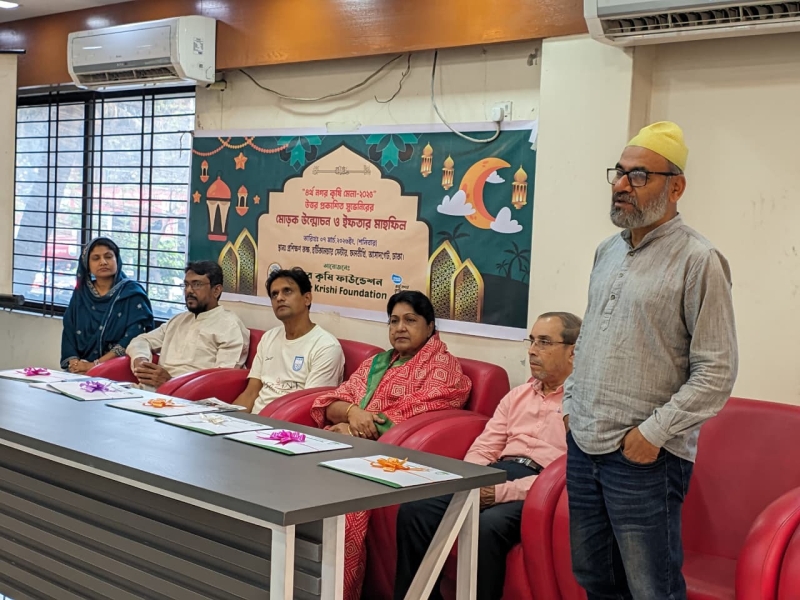
An iftar mahfil organised by Nagar Krishi Foundation
Rahima Khatun, 50, proudly held high a basketful of tomatoes and several eggplants she just plucked from her rooftop garden of a building in the Journalist Residential Area in Dhaka’s Mirpur 11. This was the day’s harvest. She got a yield of nearly 60 kilograms of the delicious winter crop this (2026) season. The quantity of tomatoes harvested daily was coming down as the season was nearing its end.
This rooftop garden being maintained for nearly two decades on just 1310 square feet of space has been transformed from one that was once occupied mostly by guava and mango plants to one where vegetable shrubs or creepers have taken most of the space along with a couple of mango plants of Amrapali variety, a few lemon, Pomegranate (Dalim) and Java applet (Jamrul) plants which give fruits at intervals. Rahima boasts of regularly producing leafy vegetables of three to four varieties in succession. Egg plants are produced almost throughout the year. Ladies finger or okra crops grow two to three times a year.
Like Rahima’s, rooftop gardens in the capital city of Dhaka have transformed in not only their crop varieties but also numbers. Gardening has expanded both vertically and horizontally to hanging balconies, rooftops of neighbouring buildings, lawns and unutilised space on the ground. A green movement has taken a firm shape over the raising of gardens with extremely beneficial impacts on life in the city of an estimated 20 million inhabitants. The rooftop gardens are estimated at several lakhs, as there has been no census.
On the one hand these gardens are not only adding to aesthetic beauty but also functioning as sources of invaluable oxygen that helps keep the polluted urban air inhalable and supplies fresh and vegetables and fruits that are largely free from contamination by harmful chemicals that are applied on commercial farms to control pest attacks.
When a modern Dhaka was planned in the early sixties a large suburban area – Dhaka-Narayanganj-Demra – (DND) was developed for the production of rice and vegetables to meet the demand of its population. To facilitate crop production a modern irrigation system was created with pump stations lifting water from rivers Buriganga and Sitalakhya to its canals that used to produce fish.
Over time however residents of the DND have not only constructed homes on the flood-protected land but also sold lands to people as well as real estate developers who came from outside to construct homes thus squeezing the area under crop production. The DND area is now virtually a large residential area with the inhabitants facing flood disasters whenever the polder embankment-cum-roads are breached in the rainy season. Sometimes floodings are caused in the area by unusually heavy downpour and water collects beyond the drainage capacity of its pumps.
Thus, the DND area has rather turned into a large unplanned housing area and is no longer in a position to supply the capital city with adequate rice and vegetables. The Green Roof and the Nagar Krishi (urban agriculture) movements have emerged as timely responses to meet at least a part of the capital’s demand for fresh food and nutrition.
Engineer Mohammad Golam Haider, chairman, Nagar Krishi Foundation, says the Roof Garden movement started in Dhaka City four decades ago in 1986 at the inspiration of Tipu Sultan Khan who used to live in the Rampura area with the objective of increasing green space as rapid but unplanned urbanisation led to disappearance of its green cover and grabbing of wetlands. The first organisation set up with the objective of promoting rooftop gardening in the rapidly growing metropolis was named, "Bangladesh Roof Gardening Association." The members of the organisation operated in a limited way for nearly 15 years when in 2005 the main inspiration behind its green thinking, Tipu Sultan Khan expired. The workers of the team formed the Bangladesh Green Roof Movement in the following year with Prof Niamul Huq as its President.
Their activities started transforming into Urban Agriculture movement in the early years of the present decade when they saw the prospect of planting samplings also in lawns, verandas and courtyards of some homes. The population of Dhaka City by then rose to an estimated 17 crore, and projections indicated that by the year 2050 all citizens of Bangladesh will live in some city or the other. And the urban centres will have to shoulder the responsibility of ensuring the proper environment, health, safe food, ecological balance and biological diversity for their citizens.
Golam Haider said the process of expansion of the urban green movement benefitted from the explosion in information and communication technology, the social media and other platforms. The developments that have taken place were unthinkable before and are praiseworthy.
Thus, in addition to the roof gardens, there emerged roof agriculture, balcony gardens, balcony agriculture, backyard gardens and balcony agriculture and even people started raising green plants inside homes at a commendable pace which was unthinkable before.
These green-lovers over time gave their valuable support and cooperation to turn the roads, ghats, grounds, throughfares and street medians green. They helped conserve the green spaces and protested against threats to felling or destruction of plants or trees. In other words, greening no longer remained restricted to rooftops of buildings, it expanded both horizontally and vertically even to drawing rooms, dining rooms, bed rooms and bathrooms apart from balconies and courtyards within four walls of homes.
Form the urge to encourage and recognise the men behind the expansion of the greening activities in urban areas came the need bring all those under one description - "Urban Agriculture," Golam Haider explained. After this naming, the idea of organising an Urban Agriculture Fair came to his mind, he said, but with no example anywhere in the world set before to learn from. Google search on urban agriculture gave zero result. They then thought of the likely partners of the proposed fair and sought to communicate with them. The result was the first Urban Agriculture Fair of 2022 at a cost of Taka two lakh. The fourth Urban Agriculture Fair has been concluded recently with the publication of "Sustha Nagar" (Healthy City) by the "Nagar Krishi Foundation" on 7 March 2026 at the Asad Gate Horticulture Centre auditorium.
In the old part of Dhaka City this green movement is carried forward by Dhakar Shekhor. Its trustee Mutalib Mashreki says, they not only distribute healthy saplings to their members but also help them procure green manure and share with them experiences of successful producers of vegetable and fruit items on rooftops of buildings.
They introduce improved varieties to members to have better yields and invite horticulture experts to brief them and answer their questions on problems they face and ways to overcome those. Experienced ones will tell you when to crop plants, change the soil or make improved soil preparation for better plant nutrition with minimal use of water and fertiliser bought from the market. Biodegradable kitchen wastes and the fallen leaves of plants are turned into compost to manure the gardens. The organisers of the movement have succeeded to influence policy and persuade the Dhaka City Corporation to give 5 percent rebate on holding tax for those households which have gardens in their compounds.
And why not? Roof gardens and urban agriculture do not only increase the aesthetic beauty of the city, but also give an estimated 20 million residents the invaluable of oxygen lowering the harmful impacts of carbon dioxide and other greenhouse gases that are emitted from many sources turning it into a gas chamber. The gardens supply the owners, organic vegetables and fruit that not only meets the demand of a section of the population but also reduces, to whatever extent, the pressure on the supply from outside. A healthy Bangladesh of tomorrow, that's to say, a healthy world of tomorrow will depend on healthy cities. Let all take part in and support this movement for green and healthy cities. (This story has been published in the April print edition of the GreenWatch)