

- Support to coastal security, early completion of MRT lines, Airport Terminal III, business promotion assured |
- Tarique Seeks Japanese Support for Energy, Tech and Infrastructure |
- Japan eyes 1 trillion yen investment in Bangladesh over 5 years |
- Dhaka Among World’s 11 Most Polluted Cities on Tuesday |
- Tide Rising, Time Running Out For Coastal People, Wildlife |
Impressive mustard yield worth Tk 151.38 crore in Faridpur
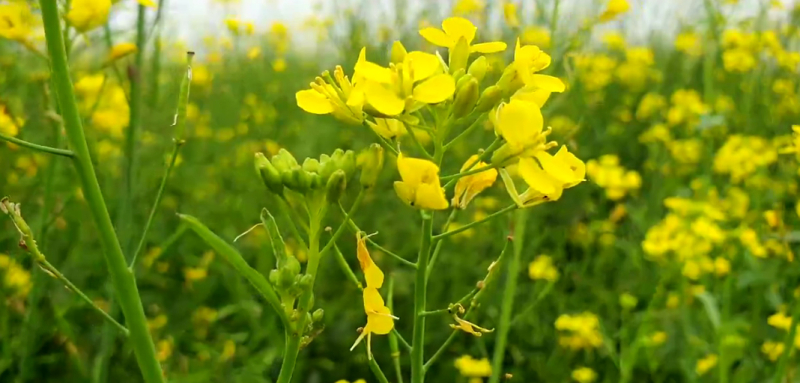
he Department of Agricultural Extension (DAE) in Faridpur has noted that mustard now spans 14,842 hectares.
In Faridpur, a significant increase in mustard cultivation has been reported, with the area under mustard crops expanding by over 2,000 hectares from the previous season. This expansion anticipates a high-yield output valued at an impressive Tk 151.38 crore.
The Department of Agricultural Extension (DAE) in Faridpur has noted that mustard now spans 14,842 hectares, targeting a yield of 1,360 kg per hectare. Given the current market rate, which surpasses Tk 3,000 per maund, the district's projected earnings are substantial.
Anwar Hossain, the Agriculture Officer of Faridpur Sadar upazila, attributes this growth to the rising prices of edible oils. He observed that mustard cultivation has become a preferred choice in nearly all fields across the district’s nine upazilas. “Farmers are increasingly turning to mustard due to its lower maintenance, availability of resources like fertilizers and medicines, and encouraging government policies,” said Hossain.
The district has seen the cultivation of various mustard varieties, including BARI-14, 15, 16, 17, Bina-4, 8, 9, and Tori-7. This diversification, coupled with the growing demand for pure mustard oil, has led farmers to focus on high-yielding strains.
Local farmers, Ibrahim Mollah and Rahim Matabbar from Ambikapur, highlighted the advice from the Department of Agriculture to plant an additional crop before the boro paddy season. This strategy maximizes the use of fields and aligns with the mustard’s shorter growth period of just 80-90 days.
The cost of cultivating mustard ranges from Tk 7,000 to Tk 8,000 per bigha, with the potential to yield 5-6 maunds of seeds per bigha, especially under favorable weather conditions. This efficient production cycle and promising market rates are driving Faridpur’s agricultural sector towards a robust mustard season.