

- World Food Day Observed Today Amid Global Hunger Crisis |
- World Lost More Than 7 Million Hectares of Forest in 2025 |
- Bangladesh Ranks 84th in Global Hunger Index 2026 |
- 10 Die of Dengue in Bangladesh, 1,943 Hospitalised |
- 28 Killed as School Roof Collapses in Northwest Pakistan |
Dhaka’s air ranks world's 4th most polluted city on Friday
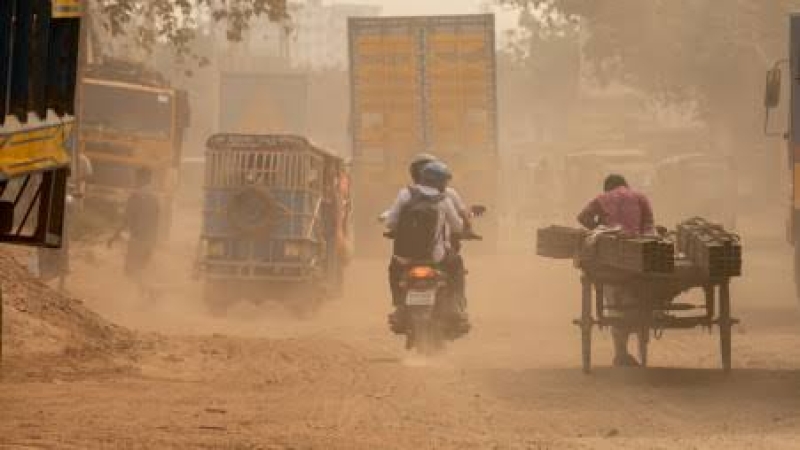
Dhaka’s air quality turned ‘unhealthy’ on Friday morning, with an Air Quality Index (AQI) score of 181 at 9:20am.
With the score, the capital ranked fourth among the world’s most polluted cities, according to the air quality monitoring platform IQAir.
Singapore topped the list with an AQI score of 236, followed by Indonesia’s Jakarta with 189 and Pakistan’s Lahore with 184.
On Thursday, Dhaka ranked 26th among the world’s most polluted cities, with an AQI score of 105 at 11am.
According to the AQI scale, the city's air quality was classified as “Unhealthy for Sensitive Groups”, poses health risks to children, older adults, and people with heart or lung diseases, while the general public is mostly unaffected.
An AQI score between 50 and 100 is considered "moderate" with an acceptable air quality, while one between 101 and 150 is considered "unhealthy for sensitive groups", while a score between 151 and 200 is classified as "unhealthy."
AQI readings between 201 and 300 are termed "very unhealthy", and anything above 301 is considered "hazardous", posing serious health risks.
The AQI is a daily indicator of air quality, showing how clean or polluted the air is and the possible health effects people may experience.
In Bangladesh, the AQI is calculated based on five major pollutants: particulate matter (PM10 and PM2.5), nitrogen dioxide, carbon monoxide, sulphur dioxide and ozone, reports UNB.