

- COP31 Update: Developing Nations Demand Action, Reject |
- Bangladesh Beat Sri Lanka 4-0 to Top Group |
- PM, Chinese vice-president discuss investment, climate cooperation |
- Shafiqur challenges Salahuddin over foreign intelligence agency link claim |
- 372 armed attacks kill 316 in CHT over five years: Salahuddin |
Dhaka Ranks 6th Among World's Most Polluted Cities on Thursday
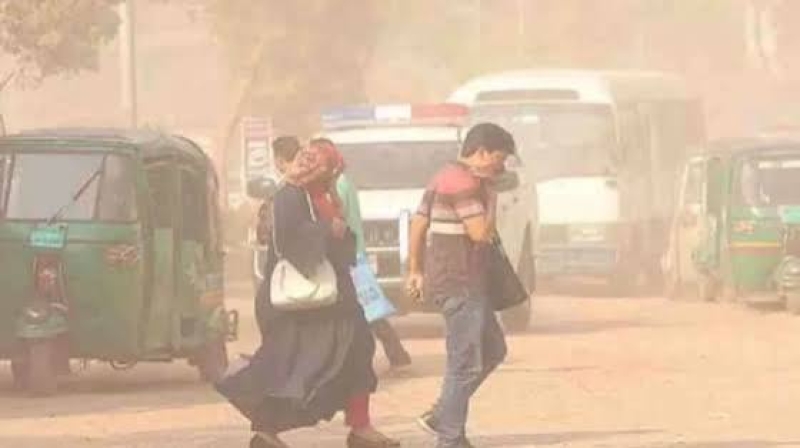
Dust, smoke and harmful particles are affecting people's daily lives, while air pollution levels continue to rise in cities around the world amid climate change and ongoing development activities.
Pakistan's Lahore topped the list of the world's most polluted cities, recording an Air Quality Index (AQI) score of 344. The level is classified as hazardous to human health.
Meanwhile, Dhaka ranked sixth among the 126 cities surveyed worldwide, with an AQI score of 158, indicating unhealthy air quality.
The figures were reported by IQAir, a Switzerland-based air quality monitoring organisation, on Thursday (November 12).
According to IQAir's air quality index, New Delhi, the capital of India, ranked second with a score of 284. Mongolia's capital, Ulaanbaatar, stood third with 169, followed by Algiers, the capital of Algeria, with 167. Beijing, China's capital, ranked fifth with a score of 166.
Under IQAir's classification, an AQI score between zero and 50 indicates good air quality.
A score of 51 to 100 is considered moderate, while 101 to 150 is classified as unhealthy for sensitive groups. Scores between 151 and 200 indicate unhealthy air quality, while 201 to 300 are considered very unhealthy. Any score above 300 is classified as hazardous.
In Bangladesh, the AQI is calculated based on five pollutants: particulate matter (PM10 and PM2.5), nitrogen dioxide (NO2), carbon monoxide (CO), sulphur dioxide (SO2) and ozone (O3).
A March 2019 report by the Department of Environment and the World Bank identified brick kilns, vehicle emissions and dust from construction sites as the three major sources of air pollution in Dhaka.
According to the World Health Organization (WHO), air pollution increases deaths from stroke, heart disease, chronic obstructive pulmonary disease, lung cancer and acute respiratory infections.
The organisation estimates that air pollution causes around seven million deaths worldwide every year.