

- Deadly Inani Beach Fire Exposes Gaps in Tourism Safety |
- PM Tarique Rahman Pledges Inclusive Dev in Dialogue with Persons with Disabilities |
- PM Inspects 13 Dhaka Sites, Sets Deadlines for Cleanliness |
- Efforts to build a clean Bangladesh must start now, PM tells students |
- Five killed as fire breaks out in Cox’s Bazar resort |
Biman’s Fleet Expansion Demands Efficiency, Quality Service
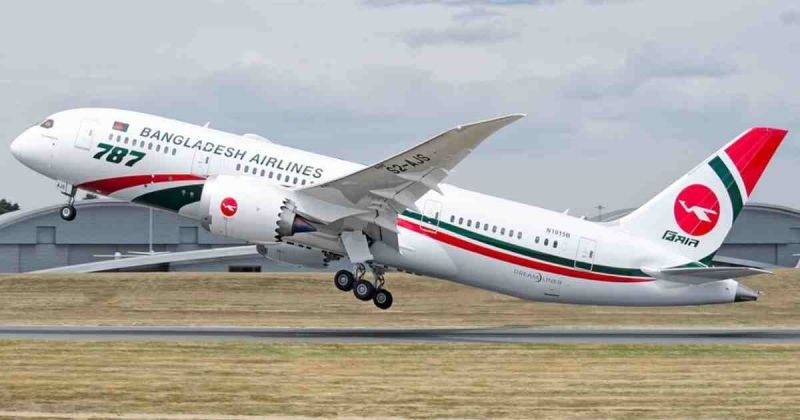
A Biman Bangladesh Airlines plane has just taken off.
Gulam Rabbani
Biman Bangladesh Airlines has taken an ambitious initiative to expand its fleet by adding aircraft from two major global manufacturers, Boeing and Airbus. However, its efforts to build and manage a larger fleet need to be streamlined by freeing the national airlines from administrative interference and enhancing institutional capacity.
In an effort to balance Bangladesh’s commercial interests with the United States, Biman had to sign a deal in April to purchase 14 Boeing aircraft, with another deal for 11 additional Boeing aircraft was signed on 23 September on the sidelines of the 81st UN General Assembly session.
The move drew pressure from Biman’s European partners, prompting the national flag carrier to consider purchasing 10 aircraft from European manufacturer Airbus. Officials said the Airbus deal could also be signed in October this year.
The national flag carrier has entered into these agreements largely out of compulsion, without adequately assessing whether it has the capacity to operate such a large fleet although the ordered aircraft will take around a decade to join the fleet. If all 35 new aircraft are added, Biman’s fleet will grow to 54 aircraft.
Insiders say, Biman is actually losing its share of income on air traffic from a number of lucrative routes for lack of aircraft. The routes include, Dhaka-Delhi, Dhaka-Jeddah, Dhaka-Dubai, Dhaka-Singapore on which different foreign airlines operate several return flights daily, but Biman struggles to operate just one return flight a day on each of those. The passengers on these routes are mostly of Bangladeshi origin. However, airline has to strengthen itself with skilled manpower, technical expertise and operational capacity required to manage such a sizeable fleet. Aviation experts say Biman currently lacks the capacity to operate a fleet of this scale.
Biman can draw a cautionary lesson from the experiences of two regional carriers, Pakistan International Airlines (PIA) and Air India. Both airlines have embarked on major transformation programmes, yet simply acquiring more aircraft has not been enough to guarantee growth or profitability.
PIA, following its recent privatisation, is seeking fresh investment, professional management and fleet renewal to rebuild the financially troubled national carrier. Its new owners are planning to inject capital and expand the fleet, but the success of the strategy will ultimately depend on operational efficiency and management capacity.
Air India presents an even stronger example. Following its takeover by the Tata Group, the airline placed one of the world’s largest aircraft orders as part of an ambitious expansion strategy. But mounting losses, operational challenges and safety concerns have forced the airline to reassess the pace of its expansion and capacity growth.
Against this backdrop, Biman’s plan to add 35 aircraft and potentially increase its fleet to 54 raises fundamental questions like whether the national flag carrier can take the challenge of professional management required to operate such a large fleet?
The examples of PIA and Air India suggest that fleet expansion can succeed only when it is matched by institutional reform, operational capacity and sound commercial management.
Beyond these challenges, Biman Bangladesh Airlines continues to grapple with management problems. Recent investigations suggest that Biman’s needs to overcome the problems of financial management, recruitment, promotions, procurement and even pilot licensing.
A probe body formed by the Ministry of Civil Aviation and Tourism found allegations of irregularities in Biman’s 2022 recruitment process for 14 Boeing 777 pilots to be substantiated.
According to a report prepared by the probe body, the entire recruitment process-from the publication of the recruitment circular to the appointment and training of the pilots- was riddled with irregularities.
However, despite the findings of irregularities, no disciplinary action was taken against the Biman officials involved in the recruitment process.
In a recent move, the Ministry of Civil Aviation and Tourism temporarily suspended all promotion-related activities at Biman Bangladesh Airlines following allegations of irregularities in the promotion process.
The ministry ordered the national flag carrier to halt all recent promotion activities until an investigation into the allegations is completed. According to ministry sources, the decision came after allegations of irregularities and administrative lacunae surfaced in the promotion process within Biman’s engineering department.
In addition, administrative interference in key decision-making is also hampering the airline’s growth. Over the past decade, at least six career bureaucrats have been appointed as Biman’s managing director and CEO, including several officials at the rank of additional secretary, despite having little or no professional experience in commercial aviation.
Kazi Wahidul Alam, an aviation expert and former board member of Biman, told this correspondent that, despite being a commercial entity, Biman lacks the autonomy to make key business decisions. According to him, running a commercial organisation “under bureaucratic control is ineffective and risks pushing the airline towards gradual stagnation.”
However, he welcomed the fleet expansion initiatives, noting that Biman’s existing aircraft need to be phased out within the next five years. He said the airline is unlikely to receive the aircraft ordered from Boeing and Airbus before 2032. Given the lengthy delivery timelines, Biman’s fleet is therefore unlikely to expand significantly in the near term, even after the new deals.
He further said that simply increasing the number of aircraft would not be enough to turn Biman Bangladesh Airlines into a stronger and more competitive carrier.
The airline must also improve its institutional capacity and operational efficiency while bringing corruption under effective control.
According to him, the new government has so not brought about any significant structural change in Biman’s management. In particular, it has not been able to reduce the dominance of bureaucrats in the airline’s decision-making process or ensure that aviation professionals with relevant commercial and technical expertise are given greater responsibility.
Despite these shortcomings, Biman currently operates flights to seven domestic and 24 international destinations, giving the national flag carrier significant scope to regain and expand its market share.
Officials said Biman once accounted for nearly 40 per cent of Bangladesh’s aviation market. However, the rapid expansion of foreign airlines, coupled with Biman’s relatively small and ageing fleet, has steadily eroded its market share and weakened its competitive position.
Competition is also intensifying in the domestic market. US-Bangla Airlines, the country’s only private carrier operating both domestic and international flights, is gradually expanding its fleet and network, further strengthening its position as Biman’s major private-sector competitor.
Bangladesh’s air passenger market is growing steadily. The opening of the third terminal at Hazrat Shahjalal International Airport is expected to increase passenger-handling capacity, stimulate international connectivity and create new opportunities for airlines to expand their operations.
Against this backdrop, expanding and modernising its fleet, while improving operational efficiency and service quality, will be crucial for Biman to regain lost market share and compete more effectively.
(From the print edition – GreenWatch. Please see greenwatchbd.com home page)