

- ADB Approves $100m Loan for Affordable Housing in Bangladesh |
- No Respite From Poisonous Air: Radical Cure Urgent |
- Minimising The Energy Shocks In Bangladesh |
- How Bad Loans, Capital Erosion Pressure Banks In BD |
How Bad Loans, Capital Erosion Pressure Banks In BD
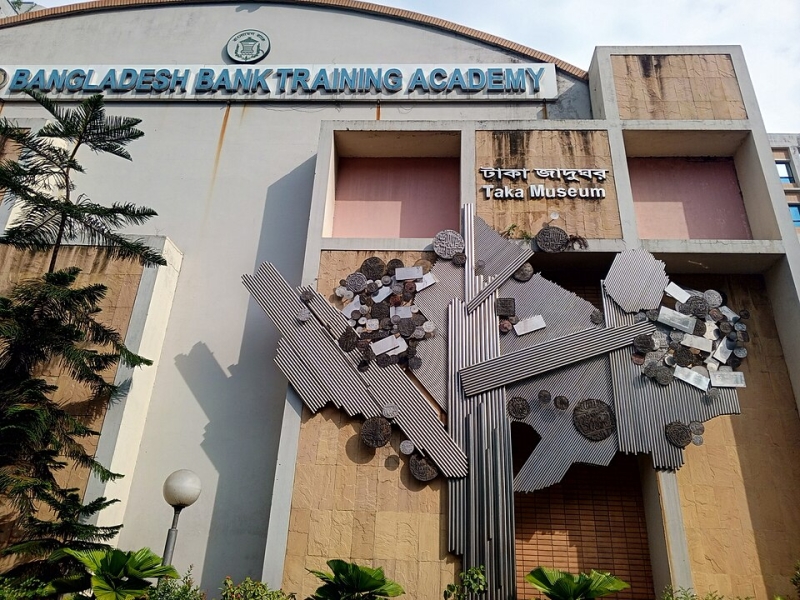
Bangladesh Bank Training Academy and Taka Museum. Wikimedia Commons
By Anisul Islam Noor
For decades, the banking sector served as the heartbeat of Bangladesh’s economic expansion, channelling public savings into industrialization, infrastructure, and commerce. Today, that vital core faces a structural crisis of unprecedented proportions. A 15-year legacy of politically influenced lending, balance-sheet manipulation, and weak oversight has finally caught up with the industry. And Bangladesh finds itself grappling with the highest defaulted loan ratio globally, alongside a severe capital shortfall that threatens to derail financial stability.
What began as localized distress in a handful of mismanaged lenders has mushroomed into a systemic crisis affecting depositors, corporate borrowers, and the country's international credit standing. A silver lining is the global credit rating agency Moody’s placing Bangladesh in stable category from negative most recently.
The Tk 6 lakh crore burden
When Bangladesh Bank updated its asset classification guidelines to align with international regulatory frameworks, hidden liabilities came to light. According to central bank statistics as of June 2026, total disbursed loans across the nation's banking sector reached Tk 18,50,594 crore. Out of this vast portfolio, Tk 6,06,555 crore was classified as non-performing loans (NPLs).
This places the national NPL ratio at an extraordinary 32.78% meaning nearly Tk33 out of every Tk100 extended as credit is either defaulted or impaired. In just a single quarter between March and June 2026, defaulted loans expanded by Tk17,851 crore.
Bangladesh's 32.78% default rate drastically exceeds India's 2.3%, Pakistan's 7.4%, and Sri Lanka's 12.6%. The global benchmark for a healthy Non-Performing Loan (NPL) ratio stands at 2% to 3% or less of a banking system's total outstanding loans.
The sharp escalation becomes clear when placed in a historical context:
2009: Defaulted loans stood at Tk22,481 crore when the previous ruling coalition assumed power.
June 2024: NPLs had officially expanded to Tk2,11,391 crore.
June 2026: Following independent asset quality reviews initiated under the interim administration, the true figure stood revealed at Tk 6,06,555 crore.
Bankers and forensic auditors report that years of political interference allowed unviable, fraudulent, and anonymous loans to remain disguised on paper. With these disguises removed, the full scale of asset impairment is now fully visible.
10 Banks Hold 72% of All Bad Debt:
The structural vulnerability of the system lies in its extreme concentration. Out of 61 operational banks in Bangladesh, just ten financial institutions account for Tk 4,39,526 crore —or 72%—of the total defaulted loans nationwide.
1. Islami Bank Bangladesh PLC: Holds Tk98,914 crore in NPLs (52.15% default ratio), largely tied to exposures acquired by the S. Alam Group following its change of control in 2017.
2. Janata Bank PLC: Leads state-owned lenders with Tk 75,728 crore in bad debt (75.05% default ratio), driven by concentrated exposures to large conglomerates such as Beximco, S. Alam, and Anon Tex.
3. First Security Islami Bank: Records an NPL ratio of 97.08% (BDT 60,645 crore in defaults).
4. EXIM Bank: Defaulted loans stand at Tk 38,052 crore (70.81% default ratio).
5. Agrani Bank PLC: State-owned bank holding Tk 32,133 crore in bad loans (43.98% default ratio), linked to groups such as Judge Bhuiyan, Zakia, and Moon Group.
6. Social Islami Bank: NPLs total BDT 29,799 crore (78.15% default ratio).
7. IFIC Bank: Holds Tk 28,520 crore in defaulted debt (63.38% default ratio).
8. National Bank: NPLs stand at Tk 28,276 crore (65.74% default ratio).
9. Union Bank: Bad loans hit Tk 27,134 crore (96.78% default ratio).
10. AB Bank: Defaulted loans total Tk 20,325 crore (56.04% default ratio).
Industry insiders note that a substantial portion of these loans went to politically connected figures, including leaders, associates, and affiliated business groups of the ousted Awami League administration—including Beximco, Nassa, Sikder, Uttara Group, Bengal Group, and Ashiyan. With many key directors currently detained or fleeing abroad, recovery through traditional channels has grinded to a near halt.
The Provisioning Vortex and Capital Erosion:
When a loan transitions from performing to default status, regulatory frameworks require banks to set aside capital buffers, known as provisions, to safeguard depositors. While standard loans require a modest 1% to 2% provision, fully impaired or bad assets mandate up to a 100% cash provision.
Because defaulted loans grew rapidly, banks were forced to absorb huge provisioning charges against their operating income. This wiped out profits, created massive provision shortfalls, and directly eroded core equity capital.
The numbers illustrate the depth of this shortfall:
December 2025: Banking sector provision shortfall stood at Tk 1,98,260 crore.
March 2026: Provision deficit grew to Tk 2,05,665 crore.
June 2026: Total provision shortfall rose further to Tk 2,22,357 crore.
As Mutual Trust Bank MD & CEO Syed Mahbubur Rahman explained, "When non-performing loans rise continuously, capital shortfalls inevitably follow. High provisioning requirements eat directly into net profits, generating sustained operating losses that hollow out the bank's capital base."
CRAR Falls to Negative Territory
A bank’s resilience is measured by its Capital-to-Risk-Weighted Assets Ratio (CRAR). Under global Basel III regulatory guidelines, commercial banks are expected to maintain a minimum CRAR of 12.50% to absorb financial shocks.
In Bangladesh, capital erosion has driven the aggregate national CRAR into negative territory. By March 2026, the sector-wide CRAR sank to negative 3.17%, down from negative 2.64% recorded in December 2025.
Regional Comparison: CRAR Benchmarks - Pakistan 21%, Sri Lanka 19%, India 17.20% and Bangladesh -3.17%.
This contrast highlights the isolation of Bangladesh’s banking sector relative to its South Asian peers. By March 2026, 21 individual banks faced a total capital deficit of Tk 2.94 lakh crore, up from Tk 2.74 lakh crore three months before. Even after accounting for capital surpluses in healthier banks, the net capital deficit across all 61 operating banks stood at Tk 2.39 lakh crore.
Top 10 Capital Deficit Banks (March 2026 Data)
First Security Islami Bank: Tk 66,264.80 crore shortfall, Bangladesh Krishi Bank: Tk 31,687.17 crore, Social Islami Bank: Tk 30,936.67 crore, Union Bank: Tk 30,594.56 crore, EXIM Bank :Tk 30,302.23 crore, Janata Bank: Tk 18,354.90 crore, Global Islami Bank: Tk 16,297.61 crore, National Bank: Tk 11,984.98, AB Bank: Tk 8,487.59 crore and Agrani Bank: Tk 8,234.92 crore shortfall.
Threats to Depositors and International Trade
Dr. Zahid Hussain, former Lead Economist at the World Bank’s Dhaka office, observes, widespread capital deficits trigger two distinct systemic consequences:
When capital turns negative, depositors face heightened uncertainty, hindering the bank's ability to maintain liquidity or extend fresh credit to productive sectors.
When over twenty domestic institutions suffer structural capital deficits, global banks reduce credit lines, inflate confirmation costs for Letters of Credit (LCs), and scrutinise cross-border trade transactions. This raises the cost of doing business even for well-capitalised, solvent banks.
Furthermore, as NRBC Bank MD & CEO Md. Touhidul Alam Khan notes, failing to meet CRAR requirements triggers automatic regulatory penalties—including restrictions on dividend payments, freezes on incentive bonuses, downgraded credit ratings, and elevated borrowing costs.
The Policy Response
Recognizing the threat to macroeconomic stability, Finance Minister Amir Khosru Mahmud Chowdhury recently announced to Parliament that the government is allocating nearly Tk 40,000 crore during the current fiscal year to restructure and recapitalise vulnerable institutions.
Simultaneously, financial experts and central bank leadership advocate a comprehensive, multi-step recovery framework:
Anis A. Khan, former Chairman of the Association of Bankers, Bangladesh (ABB), stresses that policy relaxations and loan rescheduling have failed to deliver results. The government plans to establish a specialized Asset Management Company to acquire distressed loans, liquidate mortgaged assets, and recover funds directly from uncooperative defaulters.
Industry experts, including Faruq Mainuddin, Vice Chairman of BRAC Bank and former MD of Trust Bank, emphasise that recovery requires treating wilful default as a criminal offense. Because significant capital has been siphoned off or transferred offshore, legal mechanisms must target personal assets and cross-border holdings.
A Critical Turning Point:
The crisis gripping Bangladesh’s banking sector represents decades of deferred accountability. While revealing true NPL figures and recognising capital shortfalls creates short-term pressure, transparency is an essential first step toward recovery.
Rebuilding confidence in the nation's banking system will require sustained policy discipline, rigorous asset recovery through specialised entities, and strict regulatory enforcement. Without structural reform, the financial sector cannot effectively fulfil its role as the primary engine of national economic growth.
(From the print edition - GreenWatch. Please also see greenwatchbd.com home page)