

- 3 Red Cards Mar Mexico vs South Africa World Cup Opener |
- Hwang In-beom inspires South Korea's 2-1 victory over Czech Republic |
- TIN mandatory for opening bank Ac; excise duty ceiling Tk 4 lakh |
- Tk 9.38 lakh crore budget with Tk 2.43 cr deficit placed |
- Govt Rolls Out Three-Tier Plan for Economic Transformation |
FY27 Budget Reflects Public Aspirations: Khosru
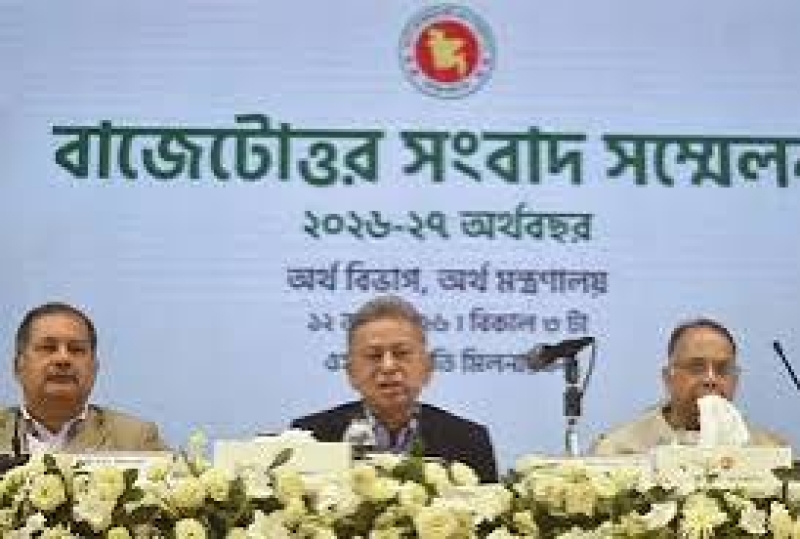
Finance Minister Amir Khosru Mahmud Chowdhury on Friday defended the proposed Tk9.38 lakh crore national budget for FY2026–27, describing it as an inclusive and people-oriented fiscal plan aimed at addressing public expectations and economic challenges.
Speaking at a post-budget press conference at the Osmani Memorial Auditorium, the minister said the budget was formulated through extensive consultations and designed to bring all sections of society into the country’s economic framework.
“When we speak about a budget, we are essentially reflecting the aspirations of the people,” he said, adding that the government sought to align policy priorities with public expectations following the parliamentary election held in February.
The finance minister said the budget had been prepared amid significant economic challenges, including inflationary pressure, energy uncertainty and a fragile global economic environment.
He also referred to institutional and fiscal constraints, saying the government had inherited a difficult economic situation while facing geopolitical tensions and disruptions in global trade.
The FY27 budget, unveiled in parliament on Thursday, proposes a record expenditure of Tk9.38 lakh crore alongside a Tk3 lakh crore Annual Development Programme (ADP), making it the largest fiscal package in the country’s history.
The government has framed the budget around the theme of economic democratisation and deregulation, with a focus on expanding economic participation, encouraging private investment and reducing regulatory barriers.
According to the finance minister, the proposed fiscal plan aims to move away from what he described as a patronage-based economic structure toward a more inclusive model that creates opportunities for wider participation in economic activities.
The budget places strong emphasis on education, healthcare, employment generation, entrepreneurship and social safety net programmes as part of efforts to strengthen human capital development.
To improve the efficiency of public spending, the minister said future government projects would be evaluated based on value for money, return on investment, employment generation and environmental sustainability.
“We want every taka spent by the government to create measurable economic and social benefits,” he said.
The government has projected GDP growth of 6.5 percent and inflation at 7.5 percent in FY27, while also pursuing structural reforms to improve the business climate and stimulate investment.
Khosru said the budget differs from previous fiscal plans by combining economic reform with a broader commitment to accountability, inclusiveness and sustainable growth, while welcoming scrutiny from parliament, media and citizens over its implementation.