

- PM calls FY27 budget 'life-friendly', promises relief |
- Govt Backs Off Package VAT After Business Outcry |
- Power Outages Continue to Disrupt Life in Sylhet |
- PM Tarique Makes Surprise Visit to SPARRSO |
- Argentina Beat Jordan 3-1 to Top Group J |
Budget aims to restore stability, accelerate growth: Khosru
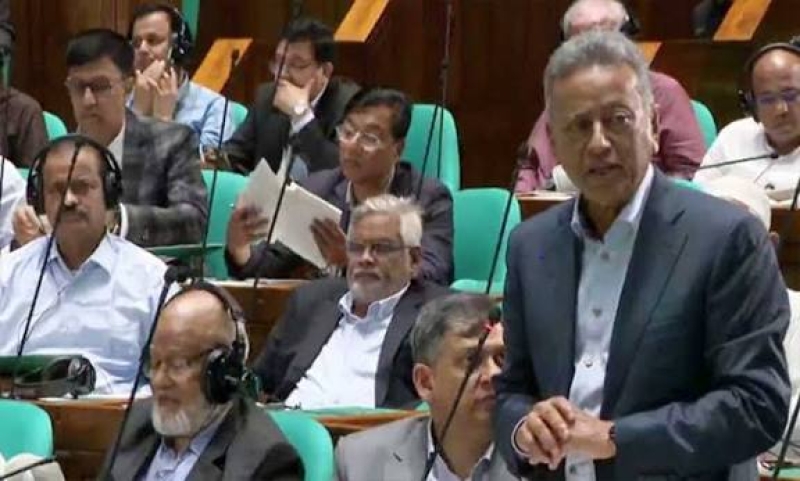
Finance Minister Amir Khosru Mahmud Chowdhury on Monday expressed confidence that Bangladesh would overcome its economic challenges through sound leadership and institutional reforms,saying the proposed budget is aimed at restoring stability, accelerating growth and ensuring the benefits of development reach all citizens. Bangladeshtravel guide
Delivering his winding-up speech on the proposed budget in Parliament, the finance minister said the government has inherited a fragile economy and weakened institutions but remained optimistic about steering the country towards sustainable growth.
"I firmly believe that no matter how great the challenges are, they can all be overcome through proper leadership, effective institutions, an efficient public administration and the spontaneous participation of people," he said.
"We want to build a Bangladesh where the benefits of development reach everyone, where merit and hard work are rewarded, where investment, production and employment drive the economy, and where every citizen can move confidently towards the future," he added.
The minister thanked members of Parliament for their "long, lively and constructive" debate on the proposed budget, saying their suggestions reflected people's expectations and would help strengthen the budget.
He also acknowledged observations made by economists, business leaders, professional bodies, civil society organisations, research institutions and the media, saying the government had carefully considered the constructive criticisms.
Finance minister described the proposed budget as more than an annual financial statement, calling it a roadmap for restoring economic stability, increasing investment, generating employment and ensuring social justice.
He said the government's economic strategy centred on what he termed the 3R framework—Recovery and Stabilisation, Restoration and Reconstruction for Acceleration—to revive the economy.
Addressing concerns over the government's projections of 7.5 percent inflation and 6.5 percent GDP growth, the minister said Bangladesh has inherited a "devastated economy" after years of policy failures, corruption, capital flight and manipulation of the exchange rate, compounded by recent geopolitical tensions in the Middle East.
Nevertheless, he said ongoing policy measures, public cooperation and stronger performance in agriculture, industry, services, exports and remittance earnings would support the recovery process.
The government, he added, was prioritising higher public and private investment, industrial expansion, creative industries, infrastructure development and human resource development to achieve the targeted growth.
Responding to concerns over ambitious revenue targets, Amir Khosru said the government would not rely on higher tax rates but would instead broaden the tax base.
He said tax policy and tax administration are being separated, while automation, deregulation and anti-evasion measures would improve transparency and encourage business activity.
The finance minister also announced that traditional markets and small grocery shops would remain outside the proposed flat-rate VAT scheme introduced for small businesses.
Despite sluggish economic conditions, he said National Board of Revenue collections has already crossed Tk 4 lakh crore for the first time within four months of the current government's initiatives.
The minister also pledged stricter fiscal discipline by reducing recurrent expenditure and increasing development spending.
Under the proposed budget, development expenditure would rise to 33.7 percent of total spending in FY2026-27 from 27.27 percent in the current fiscal year, while operational expenditure would fall to 66.3 percent from 72.73 percent.
Amir Khosru said excessive borrowing by the previous government has raised Bangladesh's debt risk from low to moderate.
At the end of FY2024-25, total public debt stood at Tk 21.44 lakh crore, equivalent to 38.61 percent of GDP. Of this, domestic debt amounted to Tk 11.95 lakh crore (21.51 percent of GDP), while external debt totalled Tk 9.49 lakh crore (17.10 percent of GDP).
Although the current administration inherited these liabilities, it had to service both the principal and interest, placing considerable pressure on public finances, he said.
To reduce debt dependence, the government plans to shift towards an investment-led economy, lower bank borrowing by Tk 6,000 crore next fiscal year, list state-owned enterprises on the stock market and expand alternative financing instruments, including bonds, asset securitisation and equity financing.
He also disclosed plans to establish private investment funds in Hong Kong, London and New York to mobilise foreign capital for Bangladesh without adding pressure to the domestic financial system.
The minister said the government has taken a tough stance against financial crimes.
By May 2026, assets worth around Tk 72,343 crore has been seized or frozen at home and abroad in connection with 11 priority cases involving alleged financial crimes.
He said Bangladesh sent 23 Mutual Legal Assistance Requests to 13 countries to recover laundered assets, while mutual legal assistance treaties with Malaysia and Hong Kong had been finalised.
Legal proceedings have also begun against six major borrower groups, and more than 15 affected banks signed over 60 non-disclosure agreements with international asset recovery firms.
Addressing depositors of the five merged Shariah-based banks, the minister assured that protecting public deposits remained the government's highest priority.
Individual depositors would be allowed to withdraw up to Tk 200,000 immediately from current and savings accounts, with the remaining funds to be repaid in phases.
Special arrangements have also been made for patients suffering from serious illnesses, Hajj savers and DPS account holders.
He further announced that the government has decided to repeal Section 18(a) of the Bank Resolution Act, 2026 following consultations with stakeholders.
"Our message is clear—those who looted public wealth will not be spared, while depositors' savings will remain protected," he said.
The finance minister proposed a package of tax incentives to strengthen the capital market.
These include tax exemptions on income from zero-coupon bonds, lower corporate taxes for listed companies, additional tax reductions for companies offloading at least 10 percent of shares through public offerings, reduced dividend tax rates for companies and individuals, and removal of the Tk 500,000 investment ceiling for mutual fund tax rebates.
He said these measures would encourage more quality companies to enter the stock market and expand long-term financing opportunities.
Rejecting criticism that Bangladesh has returned empty-handed from discussions with the International Monetary Fund (IMF), the minister said the government has voluntarily withdrawn from the previous IMF programme because certain conditions were not considered to be in the national interest.
He said Bangladesh remained open to negotiating a new programme with the IMF that better served the country's priorities.
The minister said the government is shifting from a debt-driven economy to an investment-driven one, with private enterprise, innovation and employment forming the pillars of future growth.
He said the Prime Minister's recent visits to Malaysia and China would strengthen investment, infrastructure, technology transfer and manufacturing cooperation.
The government's deregulation agenda aims to remove unnecessary bureaucratic barriers, reduce business costs and transform the state into a service-oriented facilitator rather than a regulatory obstacle, he said.
Special emphasis is also being placed on attracting foreign direct investment, supporting export-oriented industries, technology-based enterprises, SMEs and the creative economy.
On energy security, the minister acknowledged that unreliable power and fuel supplies remained a constraint on industrial growth.
He outlined plans to diversify energy sources, increase LNG import capacity, strengthen BAPEX, expand domestic gas exploration through international tenders, establish the Second Eastern Refinery and raise the share of renewable energy to 20 percent of electricity generation by 2030.
He urged people to remain patient while these long-term initiatives were implemented.
The finance minister reiterated that the budget focused on 10 priority areas, including inclusive development, quality education and healthcare, universal social protection, investment-led growth, deregulation, financial sector stability, energy security, ICT development, environmental management and accountable public institutions.
He said investment decisions would prioritise value for money, return on investment, employment generation and environmental sustainability.
Acknowledging implementation challenges, Amir Khosru said the success of the budget would depend not on its announcement but on effective execution.
He cited global economic uncertainty, geopolitical tensions, climate change, revenue mobilisation, financial sector reforms and investment climate improvements as key challenges ahead, reports UNB.
The government would therefore strengthen institutional capacity through results-based management, digital monitoring dashboards, timely project implementation, stronger project evaluation and greater administrative accountability, he said.