

- Tarique Seeks Japanese Support for Energy, Tech and Infrastructure |
- Japan eyes 1 trillion yen investment in Bangladesh over 5 years |
- Dhaka Among World’s 11 Most Polluted Cities on Tuesday |
- Tide Rising, Time Running Out For Coastal People, Wildlife |
- Dhaka Turns To Solar As Fuel Crisis Turns Power Plants Idle |
Dhaka Must BE Loud At COP31 Turkiye
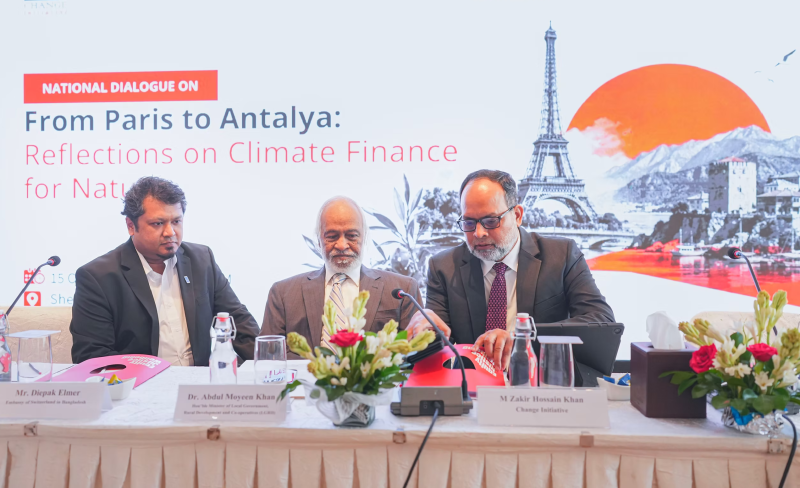
National Dialogue - From Paris to Altalya - A reflection on Finance for Climate and Nature
Dhaka Must Cry At COP31 Antalya: Botton-Up Climate Plan Urged
GreenWatch Dhaka
As the road to COP31 in Antalya takes shape, one message emerged with unusual clarity from a national dialogue in Dhaka in the middle of October: climate planning cannot continue to be designed in distant conference halls and ministerial offices while the people living on the frontline of climate disasters remain largely unheard. If global climate action is to succeed, planning must start from the bottom, drawing its legitimacy and urgency from communities that live every day with floods, droughts, salinity intrusion, water scarcity, biodiversity loss and displacement.
This was the central theme of the dialogue, "From Paris to Antalya: A Reflection on Finance for Climate and Nature," organised by Change Initiative in collaboration with WaterAid Bangladesh with support from the Swiss Agency for Development and Cooperation (SDC). The event brought together parliamentarians, former senior government officials, climate experts, researchers, community representatives, development partners and civil society leaders to examine the future of climate and nature finance ahead of COP31.
The timing of the conversation could not have been more important. Climate finance remains one of the most contested issues in international climate negotiations. Developing nations continue to argue that wealthy industrialised countries, whose economic growth was built on decades of fossil fuel consumption, must fulfil their financial obligations to countries bearing the brunt of climate impacts despite contributing very little to the problem.
Bangladesh stands at the centre of this climate injustice. The country contributes only a tiny fraction of global greenhouse gas emissions, yet it remains among the most vulnerable nations in the world to climate change. Rising sea levels threaten coastal communities, salinity affects drinking water and agriculture, cyclones cause recurring destruction, and increasingly erratic weather patterns endanger livelihoods and food security.
The climate crisis therefore presents Bangladesh with a paradox. It is a victim rather than a major contributor to global warming, yet it often bears the financial burden of adapting to consequences it did not create.
Participants at the dialogue emphasised that climate finance should not be viewed as charity. It is a matter of climate justice.
Climate and development expert Dr. Fazle Rabbi Sadeque Ahmed made this point forcefully, arguing that adaptation and loss-and-damage financing should be considered a right rather than a favour. For countries such as Bangladesh and Nepal, which are facing severe climate impacts despite negligible contributions to global emissions, access to adequate international finance is a legitimate expectation under the principles of climate equity.
Yet a growing share of so-called climate finance arrives as loans rather than grants. This creates a troubling reality in which vulnerable countries must borrow money to recover from disasters and adapt to climate impacts largely caused by others.
Bangladesh requires tens of billions of dollars annually for adaptation and resilience-building efforts, yet communities already spend significant amounts of their own limited resources to cope with disasters. The burden increases dramatically whenever major climate shocks occur.
In this context, some speakers argued that Bangladesh, Nepal and other highly vulnerable nations should develop stronger alliances and advocate collectively for adaptation support and loss-and-damage funding. Recent climate-related disasters in Nepal served as a reminder that vulnerability transcends national borders and calls for coordinated action among countries facing similar risks.
However, financing alone will not solve the problem. Diepak Elmer, Chargé d'Affaires of the Embassy of Switzerland in Bangladesh, argued that effective climate and nature finance depends on capable institutions, evidence-based decision making and clear accountability structures. The question is no longer simply how much money can be mobilised; it is also about how effectively that money is used.
This reflects a growing recognition within international climate policy that governance failures can undermine even substantial investments. Transparency, local level participation, legislative oversight and institutional coordination are therefore as important as financial commitments themselves.
Dr. Moin Khan, who attended as chief guest, warned that environmental vulnerability has continued to increase despite decades of warnings. Had environmental concerns been addressed more effectively in the past, many of today's problems might have been less severe. He also highlighted the unresolved issue of the "polluter pays" principle, which remains inadequately implemented despite widespread international acceptance.
The discussion pointed to one central proposition: planning must start from the grassroots.
Member of Parliament Mansura Akter stressed that climate initiatives disconnected from ordinary people are destined to fail. Her intervention echoed concerns shared by many participants that national plans often overlook local realities.
The newly launched Nature and Governance Policy Platform (NGPP) aims to help bridge this gap by connecting community evidence, research findings and policy expertise with decision makers. Public hearings envisioned under the platform could provide an important channel for grassroots voices to influence national climate and environmental policies.
The significance of local perspectives was reinforced by practitioners working directly with vulnerable communities. Farah Kabir of ActionAid Bangladesh pointed to the critical conditions in coastal districts such as Satkhira, where safe drinking water remains a growing challenge. Her observations underscored the interconnected nature of climate vulnerability. Solving water insecurity often helps address multiple social and economic challenges.
As there is the need for integrated solutions. Water security, food security, biodiversity conservation and rural development cannot be addressed through isolated policies and fragmented interventions.
Former Environment Secretary Dr. Farhina Ahmed described climate change, nature loss and pollution as a "triple planetary crisis" that cannot be tackled separately. An integrated response is therefore essential.
This perspective is especially relevant for Bangladesh, where environmental and social systems are deeply interconnected. The degradation of wetlands affects biodiversity and fisheries. Water scarcity influences agriculture and public health. Deforestation weakens natural disaster resilience. Climate adaptation strategies that ignore these linkages risk producing limited and short-lived benefits.
The speakers highlighted the importance of protecting natural ecosystems as part of climate resilience. A study cited during the discussion noted a stark imbalance: approximately 30 dollars are spent globally on activities that damage nature for every dollar invested in protecting it.
Against this backdrop, Bangladesh's natural assets such as the Sundarbans and Tanguar Haor assume even greater significance. These ecosystems function as carbon sinks, store biodiversity, buffer climate impacts and support millions of livelihoods. Protecting them is not merely an environmental objective but an economic and social necessity.
Zakir Hossain Khan, Executive Director of Change Initiative noted the emergence of tens of thousands of glacial lakes across the Himalayan region, many of which remain inadequately monitored despite the risks they pose. Hydropower development and ecosystem disturbances in fragile mountain environments are creating additional vulnerabilities. Recent glacier-collapse disasters in Nepal have highlighted the urgent need for regional cooperation on climate, water and ecosystem governance.
Yet the dialogue cautioned against surrendering to pessimism. Some positive environmental trends offer hope. The recovery of the ozone layer demonstrates that coordinated global action can work. There are also encouraging signs regarding parts of the Sundarbans ecosystem. Yet these gains coexist with alarming developments elsewhere, including declining numbers of migratory birds in ecologically important wetlands.
Ultimately, the path from Paris to Antalya is about far more than negotiating new funding targets or drafting declarations. It is about redefining what climate finance means and for whom it exists.
If COP31 is indeed to become a "COP of implementation," then vulnerable nations must move from the margins to the centre of decision making. Bangladesh has both the moral authority and practical experience to champion this shift.
The message from Dhaka is clear. Climate finance must support people before projects, resilience before rhetoric, and communities before bureaucracy. The voices of coastal residents struggling for safe water, indigenous peoples defending ecosystems, farmers confronting uncertain weather and families rebuilding after disasters must help shape global climate priorities.
Planning should not begin in palatial buildings far removed from climate realities. It should begin where climate change is lived every day.
And from Bangladesh to Nepal, from the Himalayas to the Bay of Bengal, the world's most vulnerable countries must ensure that those voices are heard loudly when the global community gathers in Antalya