

- Democrats Take Congress: Five Possible Shifts in Trump’s Foreign Policy |
- COP31: Can Nations Turn Climate Promises Into Action? |
- UN Warns Climate Adaptation Funding Falls Far Short |
- Bangladesh on The Verge of a Solar Energy Revolution |
- Bangladesh Bank Injects $100 Million Into Forex Market |
UN Warns Climate Adaptation Funding Falls Far Short
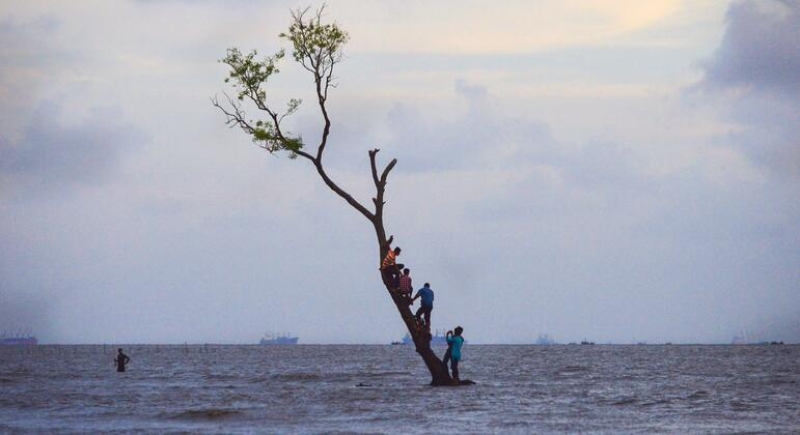
People climb the last standing tree as rising tidal waters engulf the shoreline in Chittagong, Bangladesh.
Global funding to help developing countries adapt to climate change remains far below what is needed, even as global warming is expected to exceed 1.5 degrees Celsius, according to a new UN report.
The UN Environment Programme (UNEP), in its 2026 Adaptation Gap Report published on Wednesday, estimates that developing countries will need around $305 billion annually by 2035 to strengthen resilience and reduce climate risks.
However, even if international public adaptation finance triples, it would cover only 20 to 29 per cent of the estimated requirements.
“The world is not ready to adapt to current climatic conditions, never mind what overshoot of 1.5°C will bring,” said Inger Andersen, UNEP executive director.
Adaptation finance growth stalls
The report, released ahead of the COP31 climate conference in Antalya, Türkiye, highlights persistent underfunding of adaptation efforts in developing countries, institutional barriers to implementation and mounting climate-related losses and damage.
International public adaptation finance reached between $28.2 billion and $31.7 billion in 2024, only around $1 billion higher than the previous year, indicating that growth is slowing.
The estimated annual requirement of $305 billion does not include the private sector's own adaptation needs, meaning the overall financing gap could be even larger.
Calls to increase climate funding
At last year's climate conference in Brazil, countries agreed to pursue a goal of tripling annual adaptation finance by 2035. The commitment forms part of an outcome known as the Global Mutirão, a Portuguese term based on an Indigenous expression meaning collective effort.
Even if the target is achieved, projected annual funding of $85 billion to $120 billion would meet only 20 to 29 per cent of developing countries' estimated needs after accounting for inflation.
At COP31 in Türkiye and beyond, countries must intensify efforts to meet the commitment while recognising that substantially more funding will be required to save lives, prevent losses and protect economies, Andersen said.
The report also noted that countries could still meet the Glasgow Climate Pact target of doubling adaptation finance from 2019 levels to $40 billion by 2025.
Multilateral development banks are likely to have increased their financing significantly in the previous year. Financial flows between developing countries have also grown, rising from $3.8 billion in 2019 to $9.6 billion in 2024.
However, the report stressed that money alone would not be enough. Stronger institutions and faster implementation are also necessary to protect vulnerable communities, build resilience and address growing climate-related losses and damage.
Climate action could save 1.6 million lives annually
Separately, the World Health Organization (WHO) has urged countries to scale up six proven climate-resilience measures that could save an estimated 1.6 million lives every year.
The appeal comes ahead of COP31 and highlights the need to recognise climate change as a health crisis while expanding affordable measures to prevent its impacts.
An estimated 3.3 billion to 3.6 billion people live in areas highly vulnerable to climate change.
The six measures include introducing early-warning systems for heatwaves, strengthening climate-resilient water and sanitation services, and promoting cleaner household fuels and technologies for cooking and heating.
WHO is also calling on governments to ensure that fossil fuel prices reflect the damage they cause to human health.
Such measures could prevent 1.2 million deaths annually by reducing air pollution, while also cutting greenhouse gas emissions. They could generate an estimated $5.4 trillion in annual tax revenue and deliver an additional $3 trillion in overall economic welfare gains each year.