

- COP31 Update: Developing Nations Demand Action, Reject |
- Bangladesh Beat Sri Lanka 4-0 to Top Group |
- PM, Chinese vice-president discuss investment, climate cooperation |
- Shafiqur challenges Salahuddin over foreign intelligence agency link claim |
- 372 armed attacks kill 316 in CHT over five years: Salahuddin |
COP31 Update: Developing Nations Demand Action, Reject
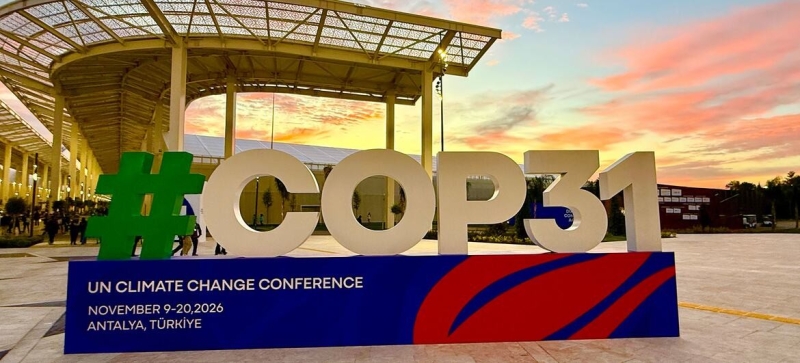
Sunrise over COP31 as participants arrived as early as 5am to avoid traffic closures. © UN News-Laura Quinones
ANTALYA, Nov. 11, 2026 — Developing countries Wednesday got united at the critical climate summit to declare that the Climate Finance Work Programme (CFWP) must deliver an immediate, binding roadmap to implement Article 9.1 of the Paris Agreement, firmly rejecting wealthy nations' attempts to turn the platform into an open-ended administrative talk-shop.
The collective declaration took center stage at the opening contact group session on "Article 9.1 of the Paris Agreement in the context of Article 9 as a whole" in Antalya. Presided over by Co-Chairs Georg Borsting of Norway and Yalchin Rafiyev of Azerbaijan, the high-stakes diplomatic session tasked global delegates with outlining their core expectations for the upcoming draft text.
The ensuing debate exposed deep-seated geopolitical divisions over who pays for global climate action, how funds are delivered, and who is held accountable.
Opening the floor on behalf of the G77 and China, negotiators delivered a stark reminder that the Paris Agreement and the United Nations Framework Convention on Climate Change (UNFCCC) are legally tethered to the principles of equity and Common But Differentiated Responsibilities and Respective Capabilities (CBDR-RC). Climate action, they argued, cannot be separated from the right to sustainable development and poverty eradication.
The developing bloc emphasized that global climate goals are entirely dependent on wealthy countries fulfilling their legal obligations to provide new, additional, and predictable financial resources. This position is anchored in Article 3 of the Paris Agreement, which explicitly links the climate compliance of developing nations to the provision of external support.
This demand comes at a time of severe macroeconomic strain for the Global South. The G77 expressed profound alarm over a visible decline in Official Development Assistance (ODA) from industrialized nations. With traditional development budgets shrinking, the group condemned the persistent insufficiency, extreme inaccessibility, and low availability of international climate finance.
They argued that current financial flows fail to reflect the actual, self-determined priorities of vulnerable states, representing a direct violation of commitments made under Article 4.3 of the UNFCCC.
To prevent developed nations from diluting their state-led responsibilities or shifting the financial burden to volatile private markets, developing countries are prioritizing the strict operationalization of Article 9.1. For these nations, the CFWP’s success hinges on immediate, structural reforms rather than bureaucratic delays.
The G77 and China outlined three non-negotiable financial milestones required to close the gap between current funding realities and regional survival needs: tripling the financial outflows from the operating entities of the UNFCCC’s Financial Mechanism, securing a global commitment to triple adaptation finance by 2035 without loading more debt onto developing economies, and constructing clear burden-sharing frameworks among wealthy nations listed under Annex II of the Convention to dictate exact budgetary contributions.
India, speaking for the Like-minded Developing Countries (LMDC), reinforced that the CFWP must transcend a mere exchange of diplomatic views. India demanded a strict procedural timeline, asserting that state parties must first formally agree on the precise scope, format, and expected outputs of the work programme before moving to its substantive implementation.
To ensure accountability, the LMDC suggested that the chief deliverable of this process must be a formalized, mandatory Action Plan for the Implementation of Article 9.1. India highlighted several substantive areas that require urgent course correction.
First, the quality of finance must be addressed: negotiations must move past aggregate, deceptive headline volumes to examine the nature of funds, prioritizing grant-based and highly concessional funding over commercial-rate loans that worsen sovereign debt crises.
Second, wealthy countries must provide accessible public finance to achieve the 2035 adaptation tripling goal, which is vital for developing states to deploy their National Adaptation Plans (NAPs).
Third, the work programme must evaluate the implications of Article 9.5 to guarantee that vulnerable states can accurately forecast and plan for incoming resources.
Fourth, tracking and reporting mechanisms under Articles 9.5 and 9.7 require rigorous upgrades to ensure developed nations are fulfilling their climate pledges rather than repackaging existing aid.
Finally, the program must establish objective formulas to distribute financial responsibilities equitably among Annex II developed countries, ensuring individual wealthy nations cannot shirk their obligations.
The Maldives, speaking for the Alliance of Small Island States (AOSIS), injected a powerful legal dimension into the room by citing the Advisory Opinion of the International Court of Justice (ICJ). AOSIS argued that the international community's highest court has reinforced the legal obligation of developed states to provide climate finance as a matter of international cooperation and harm prevention.
For Small Island Developing States (SIDS) and Least Developed Countries (LDCs), shrinking fiscal space and complex bureaucratic barriers make accessing international climate funds a matter of survival. AOSIS demanded a dedicated, protected space within the CFWP to guarantee predictable, grant-based financing tailored specifically to frontline communities.
Similarly, Kenya, representing the African Group, highlighted a distressing pattern of wealthy nations rescinding financial pledges. Kenya pointed out that the Global Environment Facility (GEF) recently suffered its lowest replenishment in 16 years, while the Green Climate Fund (GCF) continues to face severe deficits.
The African Group demanded an immediate procedural course correction, stating that Africa requires predictable, grant-based resources to shield its communities from climate shocks.
Honduras, speaking for the Independent Alliance of Latin America and the Caribbean (AILAC), echoed these concerns. AILAC stressed that the CFWP must unlock substantial public resources to back Nationally Determined Contributions (NDCs). They warned that the work plan must systematically dismantle cross-border financial barriers and enforce an equitable geographic distribution of wealth to prevent the overconcentration of climate funds in just a few select regions.
Brazil supported this view, stating that the CFWP offers a rare diplomatic window to move past entrenched positions. Brazil noted that the programme should guide the scaling up of global climate finance from the USD 300 billion floor toward a broader USD 1.3 trillion target, without reopening or renegotiating the hard-fought New Collective Quantified Goal (NCQG) decision.
The European Union (EU) offered a starkly different vision for the CFWP, warning parties against reopening or renegotiating the mandates settled during previous climate summits in Belem and Baku. The EU argued that three years of exhaustive technical dialogues under the NCQG framework had already established a substantial foundation of common ground.
While the EU expressed readiness to discuss Article 9.1, it asserted that discussions cannot take place in isolation and must address Article 9 as a whole. From the EU's perspective, successfully operationalizing the NCQG requires looking beyond public budgets to tap into a highly diversified base of global actors, private sector investments, and alternative financial markets.
The EU claimed that notable progress has already been made in reducing financial access barriers. They urged the contact group to focus on creating stable enabling environments within developing nations, overhauling the international financial architecture, and maximizing the lending capacity of Multilateral Development Banks (MDBs). On the contentious goal of tripling adaptation finance, the EU flatly maintained that this ambition must remain strictly within the pre-existing boundaries of the NCQG agreement.
The contact group session concluded in a state of unresolved tension, with numerous national delegates still demanding the floor to deliver counterarguments.
As the CFWP attempts to finalize its scope and modalities, the division remains clear: the Global South is demanding immediate, transparent public funding rooted in historical accountability, while the Global North pushes for market-driven solutions and shared global contributions. Negotiations are set to resume at the next scheduled contact group meeting. – Courtesy: Third World Network
Polluters must payMeanwhile, UN chief António Guterres called for a new global climate justice agreement at COP31 on Wednesday, urging governments to tax fossil fuel companies to help countries bearing the brunt of a crisis they did little to cause. His appeal came as world leaders gathered in Antalya amid unresolved questions over climate finance and the future of fossil fuels.
“Fossil fuel interests keep making a killing - while killing our planet.” At the #COP31 Climate Conference in Türkiye,
Antinio Guterres demands that those who profit most from fossil fuels must help foot the bill for the damage they have caused. “Polluters must pay.” – UN News