

- 95 platoons of BGB deployed in seven districts, including Gopalganj |
- Turkey's final draft at UN COP31 doesn't mention fossil fuels |
- Dhaka Ranks 14th Among World's Most Polluted Cities on Sunday |
- MoFA Says Indian Media Misreported PM's November 19 Speech |
- Gold Falls Below Tk 2 Lakh per Bhori for First Time in a Year |
COP31 Climate Deal Hangs on Fossil Fuel Dispute
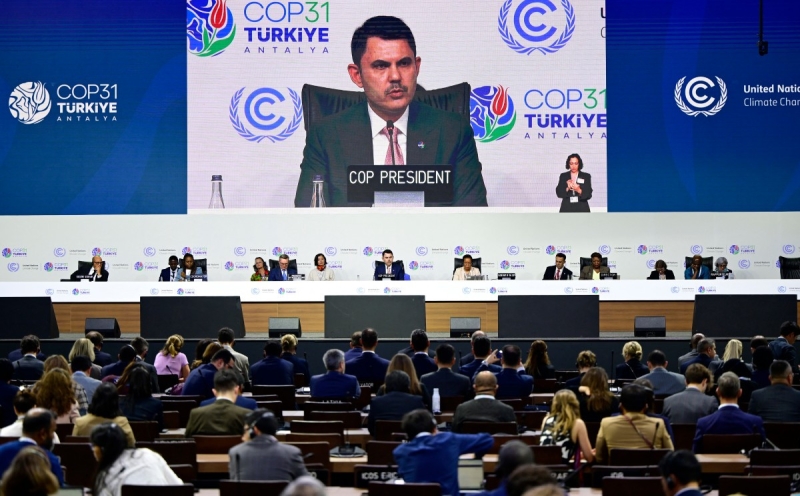
ANTALYA, Turkey: Global climate negotiations entered a second day of overtime on Sunday as a dispute over fossil fuels threatened to derail a final agreement at the UN COP31 climate summit in Turkey.
Countries braced for another lengthy night of negotiations after the latest draft climate deal removed all references to coal, oil and gas, prompting several nations to threaten to walk away from the talks.
The COP31 presidency held urgent meetings between opposing groups in an effort to bridge their differences and reach an acceptable agreement, more than 24 hours after the summit's scheduled conclusion.
The European Union and Saudi Arabia, which remain deeply divided over the future of fossil fuels, were brought together in an attempt to find a compromise.
At a plenary session in the early hours of Sunday, COP31 President and Turkish Environment Minister Murat Kurum said a third and "final" draft would be circulated for review.
He gave negotiators until 6am (0400 GMT) to reach an agreement, saying a closing plenary session would be held afterwards.
"We ask you to look at this decision carefully," Kurum told delegates, adding that negotiations were closer than ever to an agreement on the remaining issues.
European Union climate envoy Wopke Hoekstra had warned on Saturday: "It's better to have no deal than to have a bad deal."
Expectations of a major breakthrough in Antalya have remained low as countries grapple with an oil price shock and geopolitical tensions arising from the war in Iran.
The summit is taking place amid a series of climate-related disasters, from Europe to Nepal and Indonesia, while a developing super El Niño pattern is raising the risk of further extreme weather events.
An earlier draft climate agreement called for an accelerated phase-out of fossil fuels. However, a revised version released on Thursday removed all references to coal, oil and gas.
Fossil fuels are the main source of greenhouse gas emissions driving climate change, but their future remains one of the most contentious issues at UN climate negotiations.
The removal of references to fossil fuels from the draft agreement triggered protests, with some countries threatening to withdraw from the negotiations.
"That is a red line for us. We're talking about the root cause of all of this," Tuvalu's Climate Minister Maina Talia told reporters.
Talia said that if the international community could not address fossil fuels, "then we are wasting our time here".
Ireland's Climate Minister Darragh O'Brien said around 130 countries attending the summit wanted, at the very least, a reference to fossil fuels and their phase-out in the final agreement.
A proposal in the previous draft to expand carbon capture, a technology strongly promoted by the fossil fuel industry, also faced considerable opposition.
Critics argue that carbon capture is expensive and has a limited track record in reducing emissions. They warn that greater reliance on the technology could prolong the use of fossil fuels.
"There are several fights but the primary one is still the one between mostly the EU and Saudi Arabia" over fossil fuels and carbon capture, said Li Shuo, an analyst at the Asia Society Policy Institute.
Panama's Environment Minister Juan Carlos Navarro also threatened to reject any weak agreement, accusing a "petroleum mafia" of holding the world hostage.
Under pressure to address fossil fuel consumption, COP31 hosts Turkey and Australia have promoted "electrification" as a way to reduce greenhouse gas emissions while strengthening energy security.
The latest draft agreement proposed setting a target to electrify the global economy by replacing technologies that directly burn fossil fuels, such as diesel-powered vehicles and gas heating systems, with electric alternatives.
It called for global efforts to increase electricity's share of total final energy consumption to 35 per cent by 2035.
However, the proposal does not specify whether the additional electricity must come from renewable sources rather than coal or gas, prompting several countries to demand an explicit commitment to "clean electrification".
Around one-third of global electricity is currently generated from coal, while fossil gas accounts for another fifth.
Efforts by Saudi Arabia, India and Kenya to delay the next set of reports by the UN's Intergovernmental Panel on Climate Change (IPCC) have also emerged as a major source of disagreement.
Countries remain divided over how to respond to the growing risk of breaching the 1.5-degree Celsius warming limit established under the Paris climate agreement.
The latest draft expressed "deep concern" over the prospect of missing the target but dropped an earlier call to bring global warming back below 1.5 degrees Celsius as soon as possible within this century.
Negotiations have also been hampered by longstanding disagreements over climate finance, with developing countries accusing wealthy nations of failing to meet their obligations to help vulnerable countries tackle climate change.
The removal of a proposed $120 billion target for climate adaptation from the latest draft has further angered developing nations.