

- 8 Killed in Ashulia Garment Factory Fire |
- Apratim Murder Suspects Confessed, Says Home Minister |
- Dhaka's air decorded unhealthy for sensitive groups Sunday morning |
- Meet Earth’s newest wild cat species, the first named in over a century |
- Bus torched in Mymensingh early Sunday |
Thousands Gather in Nairobi as UNEA Advances Planet Protection
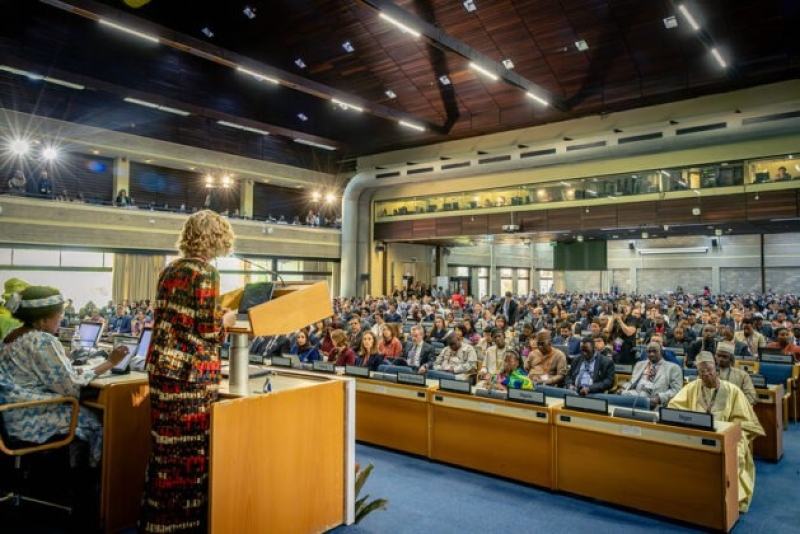
Highlights from the Opening Plenary at the seventh session of the UN Environment Assembly (UNEA-7) in Nairobi, Kenya.
“Now is the best time to invest in a stable climate, thriving ecosystems, and resilient lands, and in sustainable development that benefits all,” said Amina J. Mohammed, UN Deputy Secretary-General, during the opening plenary of the seventh UN Environment Assembly (UNEA-7), held from December 8–12, 2025.
“Following COP30, we must carry forward the momentum from Belém, showing that when countries, civil society, and youth unite, tangible progress is possible—from protecting forests and increasing climate finance to advancing Indigenous and women’s rights.”
UNEA serves as the primary global forum for shaping environmental policy. Delegates were warned that insufficient ambition has set the world on course to exceed the 1.5°C limit of the Paris Agreement within the next decade, risking 2.3–2.5°C warming by the end of the century.
Abdullah Bin Ali Al-Amri, UNEA President and head of Oman’s Environment Authority, said: “This week, we must make decisions that define our shared trajectory for the year ahead.”
Mohammed, who chairs the UN’s Sustainable Development Group, noted that while progress has been made, efforts to achieve the SDGs are significantly off track. “Twenty to forty percent of the world’s land is degraded, affecting over three billion people. One million species face extinction, and nine million people die prematurely each year due to pollution.”
Nearly 6,000 participants from 170 UN Member States, including 79 ministers and 35 deputy ministers, attended the Assembly in Nairobi. The theme of UNEA-7 is Advancing Sustainable Solutions for a Resilient Planet.
Inger Andersen, UNEP Executive Director, urged delegates to consider the global context: “The world’s turbulent geopolitics increase stress on multilateral environmental processes.”
Sessions addressed critical issues such as illegal wildlife trade, high seas protection, transboundary water cooperation, methane emission reduction, and artificial intelligence applications. Researchers from UC Berkeley presented Kigali Sim, an AI-driven tool that helps countries model and reduce hydrofluorocarbon (HFC) emissions, a potent contributor to climate change.
Global carbon markets were also discussed, including both compliance and voluntary systems aimed at reducing greenhouse gas emissions cost-effectively. A session on “High-Integrity Carbon Markets” brought together government, private sector, and civil society representatives to explore scaling carbon markets responsibly.
Delegates emphasized that success depends not only on outcomes but also on process, highlighting trust, transparency, compromise, and inclusivity. Indigenous voices, represented by Martha Korere from Kenya, called for accelerated action on land rights and carbon market integrity.
Youth participation was strong, with over 1,000 young delegates contributing to the Global Youth Declaration, outlining priorities for UNEA. Experts, farmers, and stakeholders discussed threats from invasive species, biodiversity loss, and biological pollution, highlighting the link between environmental health and human, animal, and plant well-being.
Since 2014, UNEA has held six sessions, adopting 105 resolutions addressing air pollution, biodiversity, health, financing for development, plastic pollution, and climate change, shaping the global environmental agenda.