

- First cruise ship crosses Strait of Hormuz since war began |
- MDBs stress co-op support global stability amid uncertainty |
- PM opens first Hajj flight, visits Ashkona camp |
- River ports asked to hoist cautionary signal No 1 |
- Oil prices drop 9% & Wall Street rallies to a record after Iran reopens Hormuz |
Islamabad Locked Down as Lebanon Strikes Threaten Truce
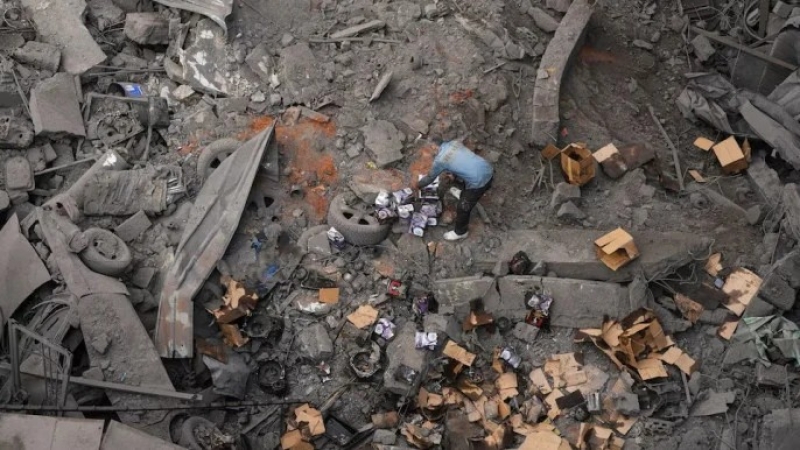
A man inspects the site of an Israeli strike in the southern suburbs of Beirut, Lebanon, April 9, 2026.
Pakistan’s capital Islamabad was placed under tight security on Thursday as preparations got underway for the first direct talks between the United States and Iran, while fresh Israeli strikes on Lebanon cast a shadow over the fragile ceasefire.
Israeli attacks continued across Lebanon a day after the deadliest wave of bombardment since the conflict widened, with more than 250 people reported killed. The renewed assault has intensified fears that the truce announced earlier this week could collapse before negotiations even begin.
Authorities in Islamabad sealed off a three-kilometre area around the Serena Hotel, where both the US and Iranian delegations are expected to stay. Access to the zone was blocked, and guests were asked to leave the hotel until Sunday as it was reserved for what officials described as an important event.
Despite the diplomatic push, there was no indication that Iran had eased its blockade of the Strait of Hormuz, a move that has severely disrupted global energy supplies. Tehran has insisted that no lasting agreement can be reached while Israel continues military operations in Lebanon.
The ongoing crisis has pushed physical oil prices sharply higher, with spot prices in Europe and Asia nearing $150 a barrel. Some refined products, including jet fuel, have climbed even further, adding to concerns over global inflation and supply disruption.
Israel, which launched operations in Lebanon last month targeting the Iran-backed armed group Hezbollah alongside its confrontation with Iran, maintains that its campaign there is separate from the ceasefire. Washington has also signalled that Lebanon is not formally covered by the truce.
However, Iran and Pakistan, which has played a mediating role, say Lebanon was meant to be included in the broader understanding. Several countries, including Britain and France, have also argued that any ceasefire must extend beyond Iran to include Lebanon.
A Pakistani source familiar with the talks said efforts were under way to secure a broader de-escalation package that could also cover Yemen, where Israel has targeted Iran-aligned groups. The issue is expected to be raised during the Islamabad discussions.
The Israeli military said it had killed a close relative of Hezbollah chief Naim Qassem and carried out overnight strikes on river crossings in southern Lebanon. Lebanese state media reported attacks on Beirut’s southern suburbs shortly before midnight and again at dawn, along with further strikes across the south.
Hezbollah, which had initially said it would pause attacks under the ceasefire framework, later announced it was resuming military action. The group said it had launched attacks across the border and targeted Israeli forces in southern Lebanon.
Lebanon declared a national day of mourning and closed state offices as rescue workers continued efforts to recover victims from buildings destroyed in the strikes. Hospitals in Beirut remained under pressure as ambulances carried casualties and bodies throughout the day.
One rescue worker described the aftermath as devastating, saying most recoveries involved body parts rather than intact victims. Survivors and relatives gathered outside hospitals, many searching for missing family members.
Iran strongly condemned the strikes, calling them a serious breach of the ceasefire. Iranian officials warned that continued Israeli operations risked plunging the region into a deeper crisis.
Inside Iran, large crowds gathered to mark 40 days since the death of Supreme Leader Ayatollah Ali Khamenei, who was killed at the start of the war. State media broadcast images of mourning ceremonies in several cities, with participants carrying Iranian flags and portraits of Khamenei and his designated successor.
US President Donald Trump has said American forces will remain positioned near Iran until what he called a “real agreement” is secured. He also warned that military action could resume if Tehran fails to comply with US demands.
Although Trump has portrayed the ceasefire as a success, major issues remain unresolved. Iran retains missile and drone capabilities, as well as a stockpile of highly enriched uranium, while its leadership has shown no sign of weakening under military pressure.
Tehran is now pressing for sweeping sanctions relief and formal recognition of its authority over the Strait of Hormuz as part of any final settlement. Iranian officials have also indicated they may impose new rules and fees on ships using the vital waterway, further complicating the path to peace.