

- Heatwaves Cost Bangladesh Nearly Tk 77,000 Crore a Year |
- Protecting Bangladesh’s coastal people From Tide-induced Loss, Damage |
- Four Warehouses Linked to Salman Muqtadir’s In-Laws Sealed |
- Dengue surge: N’ganj hospitals treat patients on floors, verandas |
- Dhaka ranks 5th among world’s most polluted cities on Friday |
Trump admin says its war in Iran ‘terminated’ before 60-day deadline
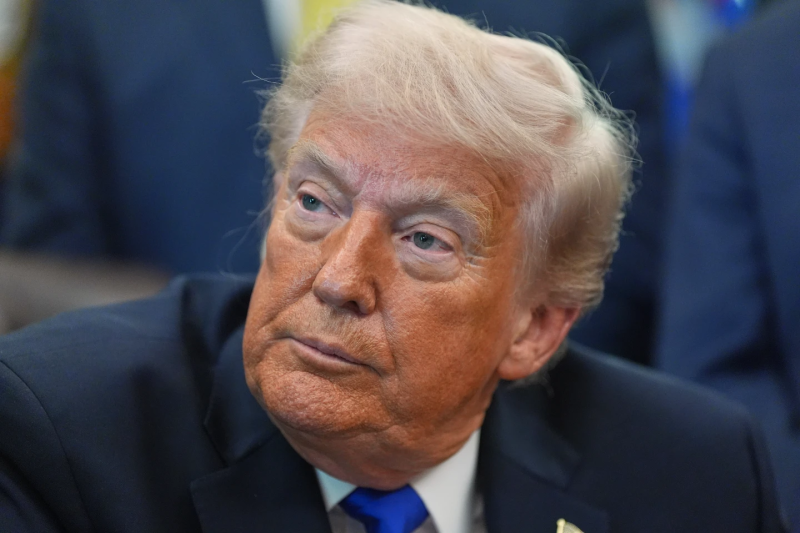
President Donald Trump speaks to reporters in the Oval Office of the White House, Thursday, April 30, 2026, in Washington. (AP Photo-Alex Brandon)
WASHINGTON, Mar 01 (AP/UNB) — The Trump administration is arguing that the war in Iran has already ended because of the ceasefire that began in early April, an interpretation that would allow the White House to avoid the need to seek congressional approval.
The statement furthers an argument laid out by Defense Secretary Pete Hegseth during testimony in the Senate earlier Thursday, when he said the ceasefire effectively paused the war. Under that rationale, the administration has not yet met the requirement mandated by a 1973 law to seek formal approval from Congress for military action that extends beyond 60 days.
A senior administration official, who spoke on condition of anonymity to discuss the administration’s position, said for purposes of that law, “the hostilities that began on Saturday, Feb. 28 have terminated.” The official said the U.S. military and Iran have not exchanged fire since the two-week ceasefire that began April 7.
While the ceasefire has since been extended, Iran maintains its chokehold on the Strait of Hormuz, and the U.S. Navy is maintaining a blockade to prevent Iran’s oil tankers from getting out to sea.
While the ceasefire has since been extended, Iran maintains its chokehold on the Strait of Hormuz, and the U.S. Navy is maintaining a blockade to prevent Iran’s oil tankers from getting out to sea.
Richard Goldberg, who served as director for countering Iranian weapons of mass destruction for the National Security Council during Trump’s first term, said he has recommended to administration officials that they simply transition to a new operation, which he suggested could be called “Epic Passage,” a sequel to Operation Epic Fury.
That new mission, he said, “would inherently be a mission of self-defense focused on reopening the strait while reserving the right to offensive action in support of restoring freedom of navigation.”
“That to me solves it all,” added Goldberg, who is now a senior adviser at the Foundation for Defense of Democracies, a hawkish Washington think tank.
During testimony before the Senate Armed Services Committee on Thursday, Hegseth said it was the administration’s “understanding” that the 60-day clock was on pause while the two countries were in a ceasefire. Sen. Tim Kaine, D-Va., who had asked Hegseth about the timeline, later told reporters that the defense secretary “advanced a very novel argument that I’ve never heard before” and “certainly has no legal support.”
Katherine Yon Ebright, counsel at the Brennan Center’s Liberty and National Security Program and an expert on war powers, said that interpretation would be a “sizeable extension of previous legal gamesmanship” related to the 1973 law.
“To be very, very clear and unambiguous, nothing in the text or design of the War Powers Resolution suggests that the 60-day clock can be paused or terminated,” she said.
Other presidents have argued that the military action they’ve taken was not intense enough or was too intermittent to qualify under the War Powers Resolution. But Trump’s war in Iran would certainly not be such a case, Ebright said, adding that lawmakers need to push back against the administration on that kind of argument.