

- State Minister Amit urges global firms to join BD offshore bidding |
- Heart Disease Linked to 777 Daily Deaths in Bangladesh |
- US Tech Firms Eye Over $1b Investment in Bangladesh |
- Dhaka ranks 6th globally in air pollution on Tuesday |
- Netanyahu Secretly Visits UAE Amid Rising Regional Tensions |
DRC peace deals fail to halt fighting as Ebola deepens crisis
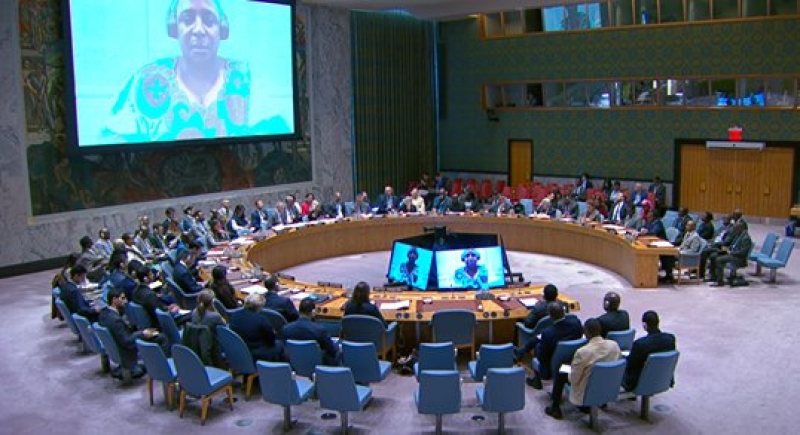
The UN Security Council is session. UN Web TV.
29 September 2026 - The Security Council is meeting in New York on the Democratic Republic of the Congo (DRC) Tuesday, where clashes between Government forces and M23 rebels continue in the east despite a series of peace agreements. Ambassadors are likely to focus on ceasefire monitoring, rising tensions between the DRC and Rwanda, and the country’s worst Ebola outbreak on record.
DRC calls on Council to suspend Rwanda’s participation in UN peacekeeping
Zenon Ngay Mukongo, Permanent Representative of the Democratic Republic of the Congo, stressed that the Council cannot remain indifferent to persistent insecurity in the eastern part of this country. Amidst the “manifest bad faith” of aggressors, he stressed that Kinshasa will continue to defend its territory.
Condemning a drone strike attributed to the Rwandan Defence Force on a Congolese position in Pinga on 20 September that killed five people, he underscored: “The Council cannot demand commitments without ensuring their implementation by all parties.”
He therefore urged the organ to suspend the participation, deployment and rotation of Rwandan contingents in UN peacekeeping operations until that country’s Armed Forces withdraw from his country’s territory.
“The Council cannot tolerate members in its peacekeeping operations who act as both firefighters and arsonists,” he stressed, adding: “The very authority of this Council and the credibility of its decisions are at stake.”
Burundi says countries hosting refugees must be supported
Zéphyrin Maniratanga, Permanent Representative of Burundi, noted that the Great Lakes region — particularly the eastern Democratic Republic of the Congo — has experienced “devastating cycles of violence” for decades.
The causes for this are well-known, and the Council has adopted several resolutions in response, he said, adding that the question now is “the effective implementation of decisions already adopted”.
“We cannot wait for another outbreak of violence to adopt a new resolution while previous commitments remain insufficiently implemented,” he stressed. “It is time to move from reaction to prevention, implementation and accountability,” he urged.
Also spotlighting the cost borne by neighbouring countries, he pointed out that Burundi hosts a “significant” number of Congolese refugees.
“This solidarity places a heavy burden on a country with limited resources and on the communities that host these families,” he pointed out, calling for this reality to be “fully taken into account” by international efforts towards regional peace and security.
Humanitarian response plan must be funded, urges United Republic of Tanzania
Togolani Edriss Mavura, Permanent Representative of the United Republic of Tanzania, expressed concern over civilian casualties, large-scale displacement, increased sexual and gender-based violence and the severe ongoing Ebola outbreak in the Democratic Republic of the Congo.
Against that backdrop, he urged better support for the half-funded humanitarian response plan for 2026, stressing that “the lack of funding should question our conscience”.
On the security situation, he stressed that “a key element for deescalation is the full respect for ceasefire arrangements”, welcoming the ceasefire monitoring carried out by MONUSCO in locales such as the provinces of North and South Kivu.
He also expressed support for community-based approaches to disarmament, demobilization and reintegration and highlighted the importance of continued dialogue between MONUSCO and the host Government regarding the Mission’s presence and future configuration.
Rwanda stresses FDLR must be neutralized
Recalling that the UN has committed more than $30 billion to address the security crisis in the eastern Democratic Republic of the Congo since 1999, Karoli Martin Ngoga, Permanent Representative of Rwanda, observed: “Yet, the core security challenges that repeatedly brought this regional crisis before the Council remain unresolved.”
“The FDLR [Democratic Liberation Forces of Rwanda] must be neutralized, and that neutralization must be effective, complete and verifiable,” he stressed.
The Forces’ continued presence in the east, along with “its genocidal ideology and the continued collaboration and support it receives from the DRC Government”, pose a “direct and existential security threat to Rwanda”, he said.
He underscored: “That is how Rwanda understands this threat, and that is how we must treat it. It is an immediate threat, it is not distant.”
War will never end if illegal mining continues
“The east is no longer in crisis, it is in collapse,” stressed Néné Bintu Iragi, President of the Coordination Bureau for civil society in South Kivu.
In areas of North and South Kivu controlled by M23, she said that “a parallel administration illegally taxes and extorts our compatriots at gunpoint”, part of a deliberate strategy to terrorize and suppress the local population.
“It is impossible to understand this war without addressing what fuels it — our minerals,” she stressed.
To illustrate, she noted that artisanal miners extract cassiterite, coltan and gold under armed coercion. This ore is then taxed at the mine site, transported elsewhere to be mixed with other ore to mask its origins and then exported through trading houses.
She underscored that “every ton of coltan that leaves the country illegally finances the purchase of weapons and the recruitment of our children”.
And, while standards issued by the Organisation for Economic Cooperation and Development (OECD) require every company purchasing Congolese minerals to verify their origin, she said: “On the ground, many buyers look the other way.”
“As long as people can kill to control a mine and sell its output internationally without facing consequences, this war will never end,” she underscored. – UN News