

- Bangladesh Gets Three More Years to Prepare for LDC Graduation |
- Dhaka ranks 5th among cities with worst air quality this morning |
- Netanyahu’s Bloc Loses Majority as Party Claims Vote Stolen |
- 3-Day Tourism Fair Begins; Theme 'AI Powered Tourism, Sustainable Destination' |
- Roopor NPP Unit One Gets Approval to Transmit Limited Power to Nat'l Grid |
Russian Drone and Missile Strikes Kill 20 in Ukraine
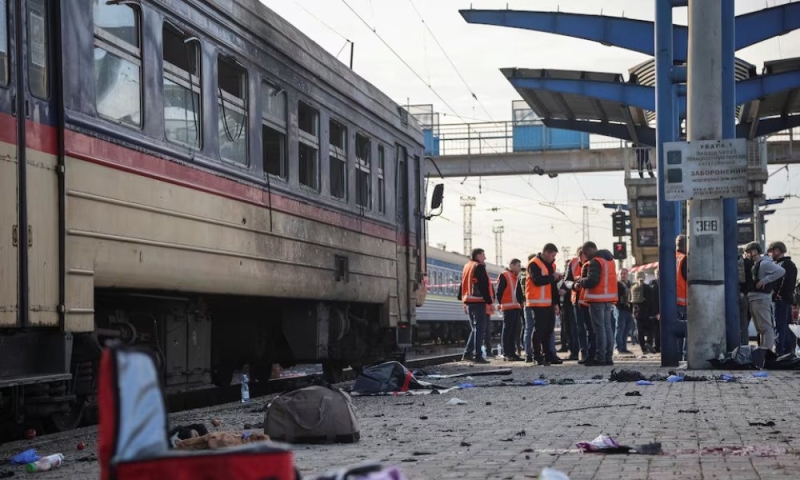
At least 20 people have been killed in Russian drone and missile attacks on several Ukrainian cities, according to Ukrainian officials. Fourteen people died in a drone strike on a busy railway station in Dnipro on Thursday.
Five more people were killed in attacks on Chernihiv and Kremenchuk the same day, while a missile strike on the capital, Kyiv, late Thursday night killed one person.
The successive attacks spread fear across Ukraine as diplomatic efforts to ease the conflict continued. Meanwhile, a six-day local ceasefire came into effect in the southern Kherson region with US assistance, raising hopes of renewed peace talks. However, the parties involved remain cautious about the truce.
Ukrainian Prime Minister Serhii Koretskyi said in a message on Telegram that Russia was deliberately killing civilians by attacking trains, railway stations and residential buildings. He said the attacks had no justification.
Kyiv's military administration reported that missiles struck several parts of the city shortly before 11pm on Thursday. One person was killed, several warehouses caught fire, and a building on the eastern bank of the Dnipro River was damaged.
Earlier, Ukrainian President Volodymyr Zelenskyy described the Russian attacks as extremely brutal. He said Russia was launching strikes while people were waiting for steps to reduce tensions, calling the attacks deliberate.
Zelenskyy also said Ukrainian intelligence had received information that Russia was preparing another wave of ballistic missile attacks. He called for necessary measures to stop the Russian strikes and destruction, adding that he was waiting for decisions from Ukraine's allies.
The six-day ceasefire in the Kherson region, arranged with US assistance, applies only to the designated area. The initiative aims to deliver humanitarian aid to Oleshky, a city under Russian control that has remained caught in the conflict since Russia launched its full-scale invasion in 2022.
Ukraine and Russia have both said mine-clearing operations in the area have been completed, allowing aid deliveries to proceed. Residents who wish to leave the city are also expected to be given an opportunity to evacuate safely.
Despite the local truce, Russian drone and missile attacks have continued elsewhere in Ukraine, particularly against railway lines and other critical infrastructure. The strikes have disrupted civilian life and damaged the country's economy.
Ukraine is facing a shortage of missiles for its air defence systems, a situation believed to be contributing to the intensification of Russian attacks.
In Dnipro, a passenger train was preparing to depart from the city's main railway station when a jet-powered drone struck the platform, according to Ukraine's state railway operator, Ukrzaliznytsia.
Bodies and metal fragments from the explosion were scattered across the platform, where blood covered parts of the floor. Air raid sirens were sounding as police moved bodies in black bags. Svitlana Shcherbak, 67, was sheltering in an underground refuge beneath the station.
Another attack in Dnipro set fire to a student residential building, regional governor Oleksandr Hanzha said. He added that Thursday's strikes left 350,000 households in the city without electricity.
In Chernihiv, northern Ukraine, a drone strike on a busy road killed two teenage girls and injured 23 people, including four children. The head of the city's military administration, Dmytro Bryzhynskyi, said the victims were civilians who had been going about their daily routines.
In Kremenchuk, central Ukraine, Russian strikes on residential buildings killed three people and injured 32, according to the regional governor. Several private buildings were also damaged.
Meanwhile, Russian drones carried out three separate attacks in Zaporizhzhia, in southeastern Ukraine, striking several buses and injuring six people, local officials said.
Efforts to restart peace negotiations with US assistance are continuing amid the devastating conflict, described as Europe's deadliest since World War II. Trilateral talks involving Ukraine, Russia and the United States are expected to take place again next month.
Against this backdrop, Ukrainian officials, including presidential adviser Kyrylo Budanov, have urged Kyiv's allies to increase pressure on Moscow, arguing that stronger international action is needed to halt the attacks.