

- Covered van hits Gazipur police patrol team, killing SI, BNP leader |
- Korean City scrambles to rescue dusky shark after it returns to canal |
- PM inspects Mongla Port, Sundarbans, proposed economic zone |
- Early winter cucumber brings hope of bumper harvest in Sirajganj |
- Saudi coalition intercepts Houthi missile after blasts in Riyadh |
Global Arms Sales Surge as Conflicts Drive Rising Deaths
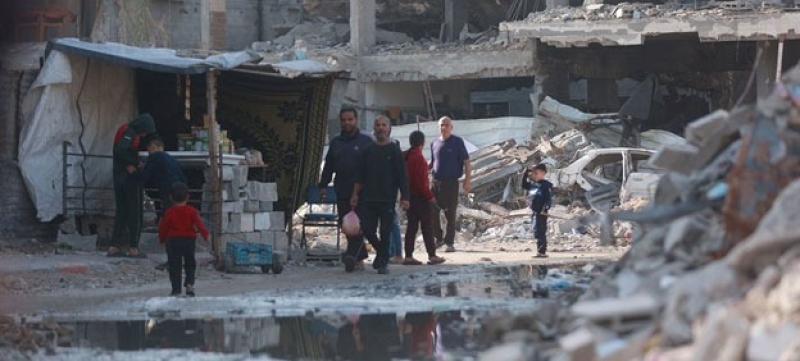
People walk through a destroyed neighbourhood in Gaza City.
Revenues from arms sales and military services by the 100 largest arms-producing companies rose 5.9 per cent in 2024, reaching a record $679 billion, according to new data from the Stockholm International Peace Research Institute (SIPRI).
Global arms revenues surged as demand was driven by wars in Ukraine and Gaza, regional geopolitical tensions, and rising military expenditure. For the first time since 2018, all five of the largest arms companies increased their revenues, SIPRI reported.
Currently, armed conflicts and civil wars are ongoing in Ukraine, Gaza, Myanmar, Sudan, Iraq, Libya, Morocco, Syria, Yemen, Haiti, the Democratic Republic of the Congo, Somalia, and Western Sahara, fueling global demand for weapons.
While the bulk of the revenue increase came from companies in Europe and the United States, all world regions in the Top 100 saw year-on-year growth, except Asia and Oceania, where issues in the Chinese arms industry lowered the regional total.
The surge in orders prompted many arms companies to expand production, enlarge facilities, establish subsidiaries, or conduct acquisitions.
“Last year global arms revenues reached the highest level ever recorded by SIPRI as producers capitalized on high demand,” said Lorenzo Scarazzato, researcher at SIPRI. He noted that companies still face challenges affecting costs and delivery schedules.
In Europe (excluding Russia), 23 of 26 Top 100 arms companies recorded revenue growth, with total revenues rising 13 per cent to $151 billion, largely due to demand linked to the Ukraine war and perceived threats from Russia.
However, the rise in arms revenues has coincided with devastating impacts on civilians. As of late November 2025, Gaza’s Health Ministry reported over 70,000 Palestinian deaths since October 2023. Estimates of casualties in the Russia-Ukraine war are less certain, but Russian military losses are thought to exceed 1 million, while Ukrainian military casualties are around 400,000.
Norman Solomon, executive director of the Institute for Public Accuracy, said the business of war has become “the business of lucrative death,” highlighting the moral costs of arms profiteering.
The United States remains the world’s largest arms exporter, with Russia and Israel also notable for aggressive military use of their weapons. Solomon emphasized that U.S. arms makers have profited significantly from conflicts in Ukraine and Gaza.
Dr Simon Adams, international human rights expert, warned that increased global arms sales are linked to rising displacement, with 123 million people currently uprooted—the highest number since World War II.
UN Spokesperson Stéphane Dujarric highlighted the disparity between funds flowing into weapons and those available for humanitarian operations, urging governments to prioritize human needs over military spending.
In 2024, combined arms revenues of U.S. companies in the Top 100 rose 3.8 per cent to $334 billion, with 30 of 39 companies reporting higher sales. Major producers include Lockheed Martin, Northrop Grumman, and General Dynamics.
Delays and cost overruns in key U.S.-led programs such as the F-35 combat aircraft, Columbia-class submarines, and Sentinel ICBMs continue to affect delivery schedules. “These delays and rising costs could impact U.S. military planning and budget efficiency,” said Xiao Liang, SIPRI researcher.