

Saturday, October 24, 2026
News update
- Dhaka's air 5th worst in the world this morning |
- Around 7,500 Bangladeshis imprisoned in Saudi Arabia: Shama Obaed |
- Bangladesh Outperforms India in Global Hunger Index 2026 |
- Covered van hits Gazipur police patrol team, killing SI, BNP leader |
- Korean City scrambles to rescue dusky shark after it returns to canal |
Why the US Is Attacking Iran
GreenWatch Desk:
Conflicts
2026-03-01, 12:14pm
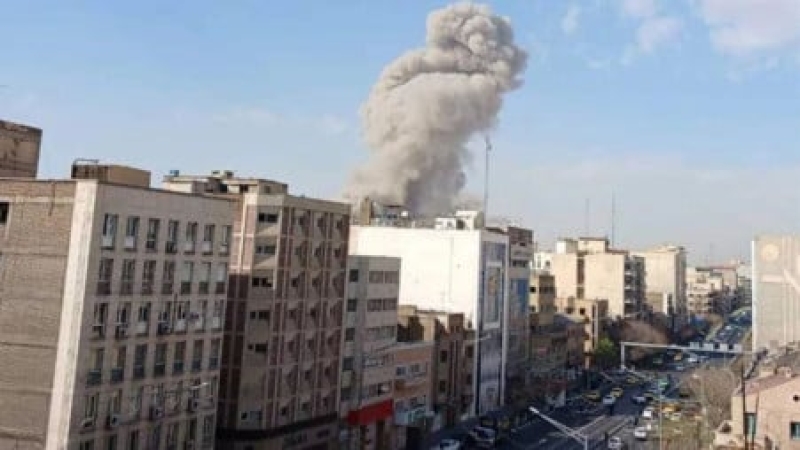
Israeli strikes on Iran were targeting "regime and military sites, including ballistic missiles," reports Kan public broadcaster.
The United States, in coordination with Israel, launched its most far-reaching strikes on Iran in decades on Saturday, in an operation that Iranian state media later confirmed killed Supreme Leader Ayatollah Ali Khamenei. The action marks one of the most consequential foreign policy decisions of President Donald Trump’s presidency.
Trump, who had campaigned as a “peace president” and previously said he preferred a diplomatic resolution to tensions with Tehran, outlined several objectives in a State of the Union address last week and in a video message released after the strikes.
Preventing a Nuclear-Armed Iran
A central justification has been preventing Iran from acquiring nuclear weapons. Trump has repeatedly insisted that Iran “can never have a nuclear weapon,” claiming earlier US strikes had severely damaged Tehran’s nuclear capabilities. He alleged this week that Iran had attempted to rebuild its program.
US and Israeli officials have argued that Iran was approaching the technical threshold needed to produce a nuclear weapon. However, the United Nations’ International Atomic Energy Agency and US intelligence assessments have previously concluded that Iran halted an organized nuclear weapons development program in 2003. Tehran denies ever pursuing nuclear arms, maintaining that its uranium enrichment activities are for civilian purposes under its rights as a signatory to the Nuclear Non-Proliferation Treaty.
Western governments argue that Iran’s enrichment levels exceed credible civilian needs and raise serious proliferation concerns.
Containing Iran’s Missile Program
Trump has also cited Iran’s expanding missile capabilities as a growing threat. He warned that Tehran was developing longer-range missiles capable of targeting US allies in Europe, American troops stationed overseas, and potentially the US homeland. While Iranian state outlets have reported progress in missile development, independent verification of specific long-range capabilities remains limited.
Countering Regional Threats and Proxies
Another stated objective is to eliminate what Washington describes as imminent threats posed by Iran and allied armed groups across the Middle East. Trump referenced past attacks linked to Tehran, including the 1979 hostage crisis at the US Embassy in Tehran, the 1983 bombing of US Marine barracks in Beirut, and more recent incidents involving US forces and regional shipping lanes.
He has also pointed to Iran’s support for Hamas, particularly following the group’s cross-border attack on Israel on 7 October 2023.
Human Rights Concerns
In his address, Trump accused Iranian authorities of killing tens of thousands of protesters during recent unrest. Independent monitoring groups have reported thousands of verified deaths, though figures vary and remain contested. Iranian officials have published lower official casualty counts, acknowledging fatalities among both civilians and security personnel.
Calls for Political Change
Beyond military objectives, Trump openly called on Iranians to rise up against their government, urging citizens to “take over” from their rulers. He warned that US strikes would continue “as long as necessary” to achieve what he described as lasting peace in the Middle East.
The developments represent a dramatic escalation in regional tensions, with far-reaching implications for global security, energy markets and diplomatic relations.