

- 3 Red Cards Mar Mexico vs South Africa World Cup Opener |
- Hwang In-beom inspires South Korea's 2-1 victory over Czech Republic |
- TIN mandatory for opening bank Ac; excise duty ceiling Tk 4 lakh |
- Tk 9.38 lakh crore budget with Tk 2.43 cr deficit placed |
- Govt Rolls Out Three-Tier Plan for Economic Transformation |
US Allies Reluctant to Join Hormuz Security Mission
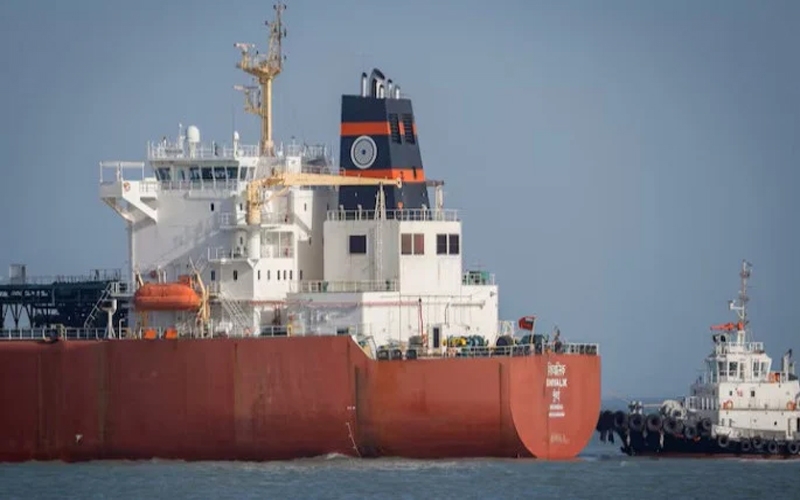
A coastguard boat approaches an Indian liquefied petroleum gas (LPG) carrier, Shivalik, as it arrives at Mundra Port via the Strait of Hormuz, amid the US-Israel conflict with Iran, in Gujarat, India, 16 March, 2026.
Several US allies have signalled reluctance to send naval forces to the Strait of Hormuz, declining a request by Donald Trump to support efforts to keep the strategic waterway open amid rising tensions in the Gulf.
The appeal came after Iran responded to joint military actions by the United States and Israel by launching drone and missile attacks and deploying naval mines, effectively disrupting tanker traffic through the vital shipping corridor. The strait normally carries about one-fifth of the world’s traded oil.
Despite their close ties with Washington, several members of North Atlantic Treaty Organization have indicated they are unwilling to become directly involved in the conflict.
Speaking in Berlin, Boris Pistorius questioned the value of deploying a small number of European naval vessels to a region already dominated by US military power.
“What does Donald Trump expect a handful of European frigates to achieve in the Strait of Hormuz that the powerful US navy cannot do?” he asked, adding that the conflict was not Germany’s war.
A government spokesperson in Germany also noted that neither Washington nor Tel Aviv had consulted European partners before launching the military operations.
“We were not asked to support the action, and the United States initially indicated that European assistance was neither necessary nor requested,” the spokesperson said.
However, some allies have left the door open for limited cooperation aimed at ensuring maritime safety rather than joining the conflict.
Kaja Kallas, the foreign policy chief of the European Union, said the bloc was discussing options with the United Nations, including the possibility of expanding maritime security arrangements similar to those used to facilitate grain exports during the Russia–Ukraine War.
She added that the EU was also reviewing whether the mandate of its naval mission, Operation Aspides, could be broadened to include patrols near the Strait of Hormuz. The mission currently focuses on protecting vessels in the Red Sea from attacks by Yemen’s Houthi forces.
Yet not all European governments are prepared to expand their role. Greece, which leads the Aspides mission, said its participation would remain limited to operations in the Red Sea.
Meanwhile, China said it was engaging with all parties involved in the crisis in an effort to reduce tensions and restore stability in the region.
In United Kingdom, Prime Minister Keir Starmer said Britain would work with allies on a collective approach to maintain freedom of navigation through the strait, although he stressed that the country did not want to be drawn into a broader conflict.
He noted that the UK possesses autonomous mine-hunting systems that could potentially assist in clearing shipping lanes if required.
Some European countries have expressed even stronger reservations. Spain said it would avoid any action that might escalate the conflict, while Italy’s Deputy Prime Minister Matteo Salvini warned that deploying warships to a combat zone would effectively amount to entering the war.
“Italy is not at war with anyone,” Salvini said, adding that sending naval vessels into a conflict area would be seen as direct involvement.
The situation in the Strait of Hormuz remains highly sensitive, as disruptions to the narrow channel could have serious consequences for global energy markets and international shipping.