

- $7.3 Trillion Fuels Nature Destruction, Guterres Warns |
- Infantino apologizes for World Cup furore but critics unhappy |
- Teesta irrigation project: Water in canals inadequate to enter fields |
- Biodiversity Targets Lag as UN Warns of a War on Nature |
- 18 railway coaches made in India set to arrive this afternoon |
Smart Cities Rise, But People Must Stay Central
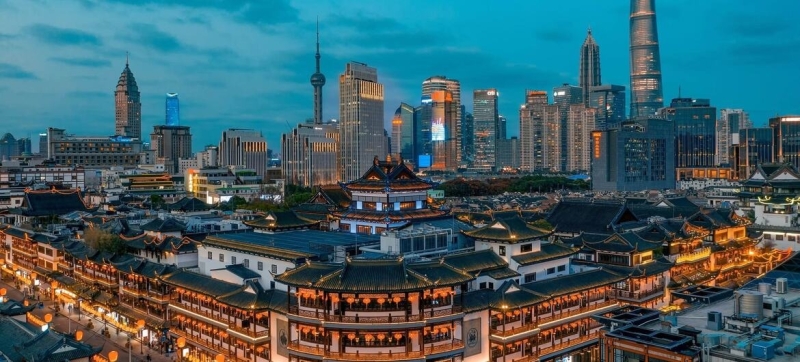
A night view of Shanghai.
From AI-powered transit systems to digital twins and flood-resistant parks, cities are adopting technology at an unprecedented pace. But as innovation accelerates, experts warn that inclusion, trust, and security will decide who truly benefits.
At a sprawling urban expo in Baku, visitors paused in front of giant digital screens showing flood simulations, subway control systems, and virtual replicas of entire neighbourhoods. Across the venue, cities presented a vision of urban life reshaped by artificial intelligence, digital infrastructure, and real-time data, offering a glimpse of what many governments now call the “city of the future.”
A Smart City in Practice
Few cities reflect the scale of smart-city ambition as clearly as Shanghai. At the China Pavilion during the 13th session of the World Urban Forum (WUF13) in Baku, officials showcased how the city is using big data and artificial intelligence to build its “Unified Management with One Network” platform, a system that integrates transportation, infrastructure, emergency response, and public services.
Shanghai has also worked to reduce the digital divide. Through its “one-stop government service” portal, residents can access more than 3,500 public services online.
Its transport system offers another glimpse into the future. The Shanghai Metro, one of the world’s largest networks with more than 800 kilometres of track and over 400 stations, uses AI-driven monitoring, 5G-enabled communication, and predictive systems to improve safety and reduce disruptions.
Several lines already run fully automated driverless trains. AI systems monitor tunnels for cracks, water leaks, and structural weaknesses, while passenger data is analysed in real time to prevent service disruptions.
One striking example is Lingang Starry Sky Sponge Park. Covering 54 hectares, it combines landscape design with advanced flood management. Permeable pavements, underground filtration systems, and smart drainage systems allow the park to absorb, clean, and reuse up to 15,000 cubic metres of rainwater daily.
Putting People at the Centre
Anacláudia Rossbach, Executive Director of UN-Habitat, which co-hosted the forum with Azerbaijan, said cities are facing multiple crises, including housing shortages, informal settlements, climate shocks, and rising inequality.
“We really need to maximise the technologies that we have available,” she said, noting that cities are on the front lines of climate change, conflict, and rapid urbanisation.
However, she stressed that technology alone is not enough.
“The most important thing in our work is that smart cities must be people-centred,” she said, adding that human rights, inclusion, and equity must remain central to digital transformation.
She also highlighted risks of digital exclusion. During the COVID-19 pandemic, many residents of informal settlements were cut off from education, services, and remote work due to lack of connectivity.
Who Really Benefits?
Despite the rapid expansion of artificial intelligence and digital infrastructure, some researchers warn against over-focusing on technology itself.
“Most people understand a smart city as being technology-driven,” said Gynna Millan, an architect and urban researcher from Colombia. She warned that technology can either empower citizens or become “a tool for control,” depending on how it is used.
For many cities in the Global South, especially informal settlements lacking basic infrastructure or internet access, the key question is not whether technology exists, but whether it improves daily life.
AI Arrives at City Hall
Artificial intelligence is quickly moving from pilot projects into everyday governance. “AI is no longer just a buzzword,” said Dmitri Atov, an adviser to the Moscow city government. “AI is a game changer for cities.”
Yining Zhao, a project officer at the International Telecommunication Union, outlined five major trends shaping urban life: AI-driven city simulation models, autonomous digital agents, robotics and drones, immersive virtual environments, and digital twins used to replicate entire cities.
Moscow already operates one of the world’s largest digital twin systems, updated twice a year with aerial imagery and containing more than 9,000 analytical layers used for traffic, infrastructure, and urban planning.
Risks Beneath the Surface
As cities become more connected, they also become more vulnerable. In Azerbaijan, officials said cybersecurity is now central to smart-city development.
“Cyberattacks are not just a technical issue,” said Aytaj Khalafli from the state cybersecurity agency. She stressed that cybersecurity must be integrated into urban planning from the earliest stages.
The agency monitors threats, protects critical infrastructure, and conducts penetration tests across government systems.
“If an attack happens, chaos can emerge in the country,” she warned, noting that transport systems have already experienced cyber incidents.
UN experts also emphasised that trust, transparency, and security must grow alongside innovation.
“Trust today is no longer just a luxury, it is infrastructure,” said Nicholas You, Executive Director of the Guangzhou Institute for Urban Innovation.
Smart, But for Whom?
Experts said the future of smart cities will not depend on the size of data centres or the number of sensors, but on how technology is used.
“Smart does not always mean introducing digital technologies. Sometimes it is about good planning, setting priorities, and understanding how infrastructure is interconnected,” said Dmitry Maryasin of the UN Economic Commission for Europe.
He pointed to examples such as urban greening, converting highways into public spaces, and promoting “active mobility” that prioritises walking and cycling.
In the end, the key question is not how smart cities can become, but who they are designed to serve.