

- Govt pursuing zero tolerance against human trafficking, organised crime: Salahuddin |
- PM Seeks Japan’s Help to Build Technology, Innovation Hubs |
- Bangladesh Plans Bonded Warehouse Reforms to Diversify Exports |
- Dhaka ranks 4th among world's most polluted cities this morning |
- Lula re-elected Brazilian president in runoff |
LMICs Urged to Prioritize Data Systems Over AI Hype
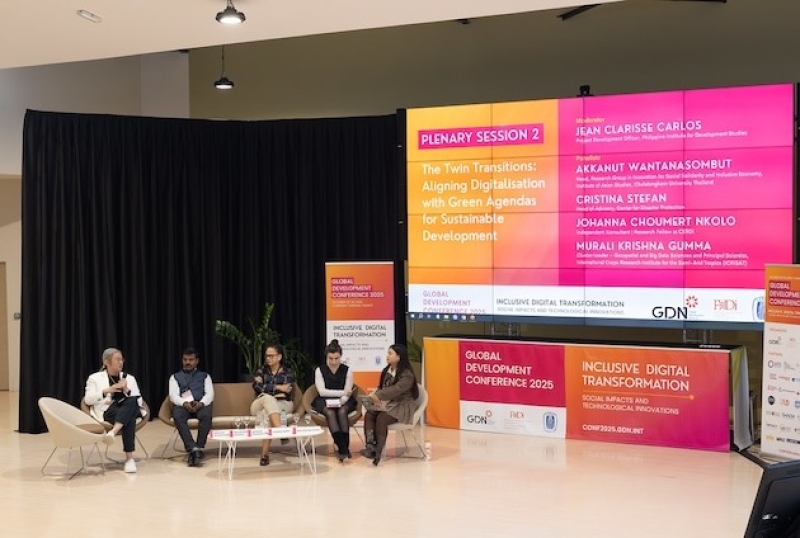
Johanna Choumert-Nkolo, third from right, speaking during a panel discussion at the Global Development Conference 2025 in Clermont-Ferrand, France.
During the Global Development Conference 2025, development experts and researchers warned that low- and middle-income countries (LMICs) are being pushed into a wave of digital transformation without the basic statistical systems, institutional capacity, or local context needed to ensure that AI and digital tools truly benefit the poor.
Prominent voices included Dr. Johannes Jütting, Executive Head of the PARIS21 Secretariat at the OECD, and development economist Johanna Choumert-Nkolo, who has over 15 years of research and evaluation experience. IPS interviewed both following the conference, which concluded about five weeks ago, regarding digitalization challenges in LMICs.
How is Data the Weakest Link?
Much of the conversation around AI’s potential in the Global South focuses on the promise of improved governance. Jütting, whose organization works on AI and data, highlighted a widening gap between the capacities of countries in the Global North and the Global South.
AI offers enormous potential. “For lower-income countries, the production side is promising because AI can reduce the high costs of traditional data collection. By combining geospatial data with machine learning, we can generate more granular and timely data for policymaking, including identifying where poor populations live,” Jütting told IPS.
“But real challenges remain. Many low-income countries lack the fundamental conditions required for AI use. First, connectivity; second, technical infrastructure such as data centers and reliable data transmission; third, human capacity and skills requiring sustained investment; and fourth, governance and legal frameworks that must be updated to reflect new technologies,” he said.
He also warned of risks, particularly regarding confidentiality, privacy, and the fact that most large AI models are trained on Global North data, limiting their usefulness for national statistical offices in the Global South.
Data collection processes, such as censuses and household surveys, are expensive, slow, and operationally difficult. Many national statistical offices lack the workforce, training, and budget needed for regular, reliable data production.
“Digital transformation is not just a technology issue. It is a change management, capacity development, skills, and political will issue,” Jütting emphasized.
Divide Within the Global South and Fiscal Constraints
While global debates often frame digital inequality as a gap between rich and poor nations, Jütting believes a more serious divide is emerging within the Global South. Some LMICs are advancing rapidly, while others lag behind—a divergence he calls “one of the most worrying trends in development today.”
“Countries like Rwanda, Kenya, the Philippines, and Colombia are advanced—sometimes more than OECD members. But others, like Mali, Niger, and several small island states, are left behind,” he said.
The divide appears in connectivity, infrastructure, institutional readiness, technological skills, and even access to basic demographic data. “How can we talk about fancy AI models when basic population data is missing?” he asked.
Jütting cautioned that development agencies may widen this divide by focusing on “low-hanging fruits” that yield quick results, instead of supporting long-term system-building.
“There is donor fatigue, and funding is shrinking,” he said.
He proposed three steps forward:
Every country needs a strong national strategy for the development of statistics (NSDS) aligned with national development plans.
Governments must invest domestic resources in their own data systems.
Donors must align spending strategically, ensuring investments in data complement broader development goals.
Complexity of Measuring Digital Impacts
Choumert-Nkolo focused on climate resilience, human behaviour, and evidence generation. She emphasized the long-term and complex nature of digital impacts.
“Digitalization is reshaping economies rapidly. From a climate perspective, we need to understand both opportunities and risks,” she said.
Digital tools may influence decisions years after deployment. “Understanding behavioural change is complex, and attribution to one digital tool is extremely difficult,” she explained.
Despite challenges, she highlighted the potential of digital tools to support climate adaptation. Farmers facing unpredictable weather can benefit from mobile-delivered climate information, and communities vulnerable to storms or floods can receive SMS alerts.
She urged caution, noting that not everyone can read or act on digital messages. “Literacy and accessibility gaps remain large in many countries,” she said.
Her research in East Africa reinforced the importance of context. Mobile money succeeded because it solved local problems and fit local realities. Not every challenge requires a digital solution.
A Future That Must Be Shaped Carefully
One theme emerged clearly: Digital transformation can support inclusive development, but only if countries strengthen statistical systems, build institutional capacity, and ground innovation in local realities.
“We need more and better data for better lives,” Jütting said. “But we must ensure the poorest countries are not left behind in this digital wave.”
Choumert-Nkolo echoed this sentiment: “Digital tools offer huge opportunities, but they must be rooted in context, evidence, and local needs.”
For LMICs navigating climate change, economic pressures, and technological disruption, these warnings are timely. Digital transformation can be a powerful equalizer—or a source of exclusion, depending on whether governments and development partners prioritize foundational systems.