

- People positive on Padma Barrage, experts urge caution over fallout |
- Parties convey their expectations at Bonn climate talks |
- ECNEC Approves 8 Projects Worth Tk 2,266 Crore |
- No Plan to Drop Bangla, History from Honours: Milon |
- Global turmoil shadows Bonn climate talks |
Bangladesh reaffirms commitment to BIMSTEC regional ties
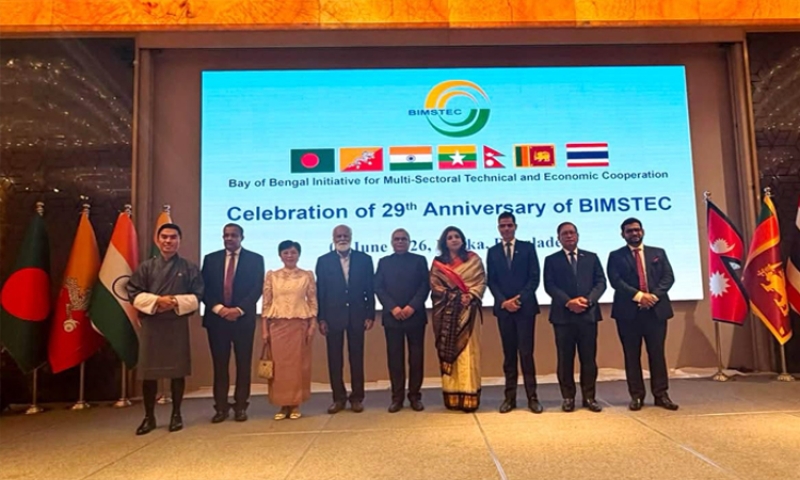
State Minister for Foreign Affairs Shama Obaed Islam has reaffirmed Bangladesh's commitment to advancing regional cooperation through BIMSTEC, highlighting connectivity, trade, technology transfer and people-to-people contacts as key drivers of shared prosperity.
Bangladesh, as the current Chair of BIMSTEC, remains committed to fostering trust, inclusivity and collaboration among member states, she said.
The state minister was speaking at a reception marking the 29th anniversary of the Bay of Bengal Initiative for Multi-Sectoral Technical and Economic Cooperation (BIMSTEC) in Dhaka on Monday evening, said a press release here today.
Shama stressed the importance of seamless multimodal connectivity, enhanced trade and investment, technology transfer, stronger supply chains and greater people-to-people contacts to build an open, prosperous and interconnected Bay of Bengal region.
Environment, Forest and Climate Change Minister Abdul Awal Mintoo and State Minister for Disaster Management and Relief M. Iqbal Hossain were present at the event.
BIMSTEC Secretary General Indra Mani Pandey said this year's BIMSTEC Day celebration held special significance as the regional grouping commemorates its 29th anniversary and begins year-long celebrations leading to its 30th anniversary.
He noted that BIMSTEC has made substantial progress over the years in promoting regional cooperation across multiple sectors and has established the institutional framework necessary to function as an effective regional organisation.
Referring to the BIMSTEC Charter and Vision 2030, Pandey said the organisation's agenda now encompasses a broad range of priority sectors supported by ministerial meetings, senior officials' meetings, joint working groups, expert groups and other institutional mechanisms.
The Secretary General said BIMSTEC is also strengthening partnerships with observer states, international and regional organisations, and UN agencies to support member states in implementing collective decisions and achieving their development aspirations.
He expressed gratitude to the government and people of Bangladesh for hosting the BIMSTEC Secretariat and providing continued support to the organisation.
Congratulating BIMSTEC and its member states on the occasion, Shama said Bangladesh attaches high importance to regional cooperation as a cornerstone of its foreign policy.
She described BIMSTEC as a unique bridge connecting South and Southeast Asia and underscored the role of cultural exchanges, education, tourism, sports diplomacy, youth engagement and professional interactions in strengthening mutual trust and friendship among the peoples of the region.
The State Minister also called for strengthening BIMSTEC's institutional foundations, operationalising the BIMSTEC Charter and ensuring that sectoral cooperation mechanisms are adequately resourced and effectively coordinated.
The reception brought together senior government officials, ambassadors and high commissioners of BIMSTEC member states, representatives of international organisations, members of the diplomatic corps, media representatives, think tanks and other distinguished guests.
A vibrant display of the cultural diversity and heritage of BIMSTEC member states marked the celebration. Representatives of the member countries participated in a symbolic parade carrying national flags and wearing traditional attire, reflecting the spirit of friendship and solidarity within the BIMSTEC community.
Cultural performances and exhibitions showcasing artefacts, handicrafts, textiles and other distinctive symbols from member states highlighted the rich heritage and unique identities of the region's peoples. Traditional cuisines from the seven member countries were also featured at the reception.
BIMSTEC Day was simultaneously commemorated across all member states, accompanied by congratulatory messages from heads of state, heads of government and foreign ministers.
BIMSTEC comprises seven Bay of Bengal countries-Bangladesh, Bhutan, India, Myanmar, Nepal, Sri Lanka and Thailand.
Established through the Bangkok Declaration on June 6, 1997, BIMSTEC has emerged as an important platform for regional cooperation and a vital bridge between South and Southeast Asia, reports BSS