

- Dhaka's air 5th worst in the world this morning |
- Around 7,500 Bangladeshis imprisoned in Saudi Arabia: Shama Obaed |
- Bangladesh Outperforms India in Global Hunger Index 2026 |
- Covered van hits Gazipur police patrol team, killing SI, BNP leader |
- Korean City scrambles to rescue dusky shark after it returns to canal |
Assertive Diplomacy Urged as Mecca Pact Ignites Strategic Security Issues
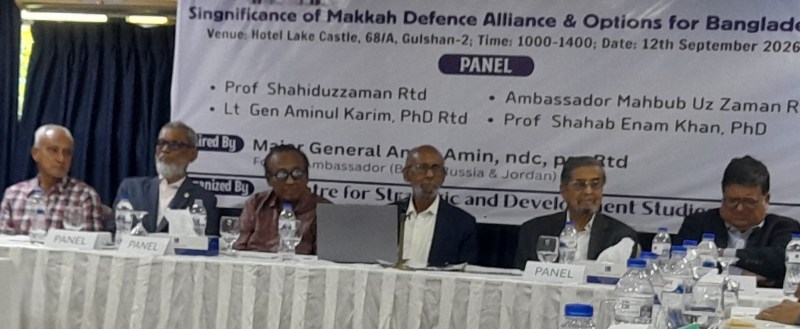
Penalists at the roundtable on the Mecca Pact organised by CSDS at a hotel in Gulshan Model Town on Saturday 12 September 2026.
GreenWatch Desk
DHAKA, 12 September – Security analysts, former diplomats, and international experts today called on Bangladesh to pursue assertive diplomacy to secure its national interests while navigating the emerging "Mecca Pact," a proposed security arrangement among key Muslim-majority nations. The observations were made at a high-level roundtable discussion on "Mecca Joint Defence Pact," organieed by the Centre for Security and Development Studies (CSDS) at a local hotel in Gulshan Model Town. The session was presided over by CSDS Chairman General AMSA Amin.
Delivering the keynote address, Lieutenant General Aminul Karim emphasized that the Mecca Pact should not be viewed as an ideological alignment, but rather as a mechanism for collective security. "Bangladesh needs to have credible deterrence. We had it in 1971 and 1952; we need to have it now," Lt. Gen. Karim stated. While stressing the necessity of maintaining friendship with India, he noted that a robust military is critical to providing Bangladesh with the "leverage to assert our own stand," particularly given the country's vulnerabilities in energy and maritime security. He urged Bangladesh to join beneficial multilateral arrangements, citing the African Union as a successful model. However, Mokammel Huq, former Secretary to the Government, urged caution, noting that details of the three-country Muslim alliance remain scarce. "Unity among Muslims is very important, and the pact has raised our hope... but first, we have to look at the reactions of our people," Huq remarked.
Several speakers highlighted that the pact is still in its infancy and faces significant geopolitical hurdles. Professor Shahiduzzaman of Dhaka University pointed out that neither a basic structure, a formalized institution, nor a finalized membership framework exists yet, despite Saudi Arabia proposing nations like Bangladesh, Türkiye, Egypt, Pakistan, and Somalia. Prof. Shahiduzzaman added that Saudi Arabia currently finds itself in a "precarious condition" following drone attacks on its East-West pipeline. He cautioned that the pact faces a testing ground, especially as Pakistan seeks to ensure the arrangement does not derail ongoing US-Iran dialogues.
Speaking virtually from Pakistan, Senator Mushahid Hossain, a journalist and former minister, confirmed that the pact is still evolving and is unlikely to become a conventional defense pact. "It may have to be renamed at some stage," Hossain stated, explaining that the initiative stems from the declining presence of the US in the Middle East and the structural inactivity of international agencies like the UN and WTO. He advised Bangladesh to "defer its expectations," suggesting that an observer status or acting as an eastern trade corridor would be more strategic than pursuing a defense role.
In contrast, another Pakistani panelist argued that the world order is actively reshaping amidst a US decline. He noted that recent political shifts in Bangladesh, Nepal, Sri Lanka, and the Maldives reflect a rejection of Indian hegemony. Characterizing the Mecca Pact as an alternative to the US-led security architecture and the Israel-supporting Ibrahim Accords, he asserted that Bangladesh and Pakistan share common geopolitical threats. He suggested a tripartite security alignment between Pakistan, Bangladesh, and China, while advising Saudi Arabia to make peace with the Houthi movement.
Elaborating on the pact's structural changes, General Lodhi of Pakistan revealed that the framework's name has softened from the "Mecca Joint Defence" to the "Mecca Defence Alliance" to allow for greater flexibility. Under the current understanding, an attack on one member will be deemed an attack on all, but it will not automatically trigger a military counter-attack. He suggested that regional neighbors like Egypt and Qatar might join before Bangladesh and Malaysia, and strongly recommended that Dhaka and Islamabad pursue immediate bilateral agreements.
General Ikram Saigal advised that the Mecca Pact should initially be approached through the lens of economic cooperation, recalling the historical Regional Cooperation for Development (RCD) between Pakistan, Iran, and Turkey. Describing Bangladesh and Pakistan as "two countries, one nation," Saigal observed that Bangladesh is now in a much stronger military position than in the past, and advocated for the removal of tariffs and visas to bolster bilateral ties. Summing up the strategic path forward, former Minister of State Abul Hasan Chowdhury asserted that given its massive population and critical geographic location, Bangladesh must engage in assertive diplomacy to fulfill its national objectives "instead of tailending any country."
In his concluding remarks, CSDS Chairman General AMSA Amin echoed the sentiment of preparedness, stating, "We want peace but shall prepare for war." He stressed that securing the nation in the modern era requires not just military deterrence, but a deeply sophisticated and strong intelligence network.
The roundtable was also addressed by retired military officials and prominent civil society members, including Gen. Fazle Elahi Akbar (retd), Ambassador Mahbubuzzaman, GreenWatch Editor Mostafa Kamal Majumder, Brig. Gen. Hassan Nasir (retd), Col. Shahadat (retd), and Advocate Naser.