

- Bangladesh Urges India to Begin Ganges Treaty Talks |
- COP31: A Failure of Climate Leadership in a Warming World |
- UN Climate Talks collapse over fossil fuel phaseout, warming limit deadlock |
- Bangladesh Plans Major Changes to Bank Board Rules |
- HC Orders Guidelines on Social Media Use by Children |
Bangladesh Urges India to Begin Ganges Treaty Talks
DHAKA: Bangladesh on Sunday urged India to take the necessary steps to begin formal negotiations on renewing the 1996 Ganges Water Sharing Treaty before its current term expires on December 12.
“Bangladesh has already completed all necessary preparations related to the treaty. Bangladesh hopes that India will take the required steps before the expiry of the current term of the treaty to pave the way for the commencement of formal negotiations,” Prof Rashed Al Mahmud Titumir, the Prime Minister's Finance and Planning Adviser and head of Bangladesh's 10-member technical committee on Ganges water, said in response to a question.
Titumir said Water Resources Minister Shahiduddin Chowdhury Anee had recently sent a letter to his Indian counterpart through diplomatic channels, urging an early start to discussions on the treaty.
Bangladesh formed a high-level technical committee in June 2026 to initiate discussions and informed India of the decision, requesting New Delhi to notify Dhaka about the formation of its own technical committee, he said.
Bangladesh renewed the request in August, urging India to form a technical committee and begin negotiations, Titumir added.
India's Ministry of External Affairs spokesperson Randhir Jaiswal, however, said the Joint Rivers Commission (JRC) was the established mechanism for discussing all water-related and cross-border river issues, including the Ganges.
"The government of India remains committed to a constructive and forward-looking relationship with Bangladesh while safeguarding India's interest," he told reporters in New Delhi on Friday.
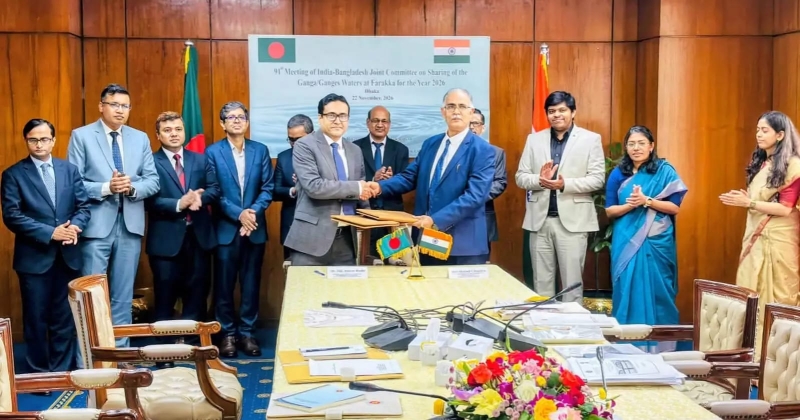
Meanwhile, the 91st meeting of the Bangladesh-India Joint Committee on the implementation of the Ganges Water Sharing Treaty was held in Dhaka on Sunday.
At the meeting, the two sides finalised the annual report on the implementation of the treaty for 2026, Titumir said.
Bangladesh and India signed the treaty on December 12, 1996, to share the waters of the Ganges River at Farakka.
Under Article IV of the treaty, a Joint Committee was formed under the leadership of the two countries' Joint Rivers Commissions to monitor its implementation.
Since 1997, the Joint Committee has overseen joint monitoring teams at Farakka and the Hardinge Bridge points, monitored their activities and prepared annual reports on the treaty's implementation.
The committee holds three meetings each year. One is held in Kolkata following a field visit to Farakka, while another takes place in Dhaka after a field visit to the Ganges-Padma River in the Hardinge Bridge area. The third meeting is devoted to preparing the annual report.
A total of 91 meetings of the Joint Committee have been held alternately in Bangladesh and India since 1997.
The committee's 89th meeting was held in Dhaka on April 8, 2026, while its 90th meeting took place in Kolkata on May 22.
Md Anwar Kadir, a member of the Bangladesh Joint Rivers Commission and chairman of the Joint Committee on the Bangladesh side, led the six-member Bangladeshi delegation at Sunday's meeting.
Sharad Chandra, Commissioner (FM) and member of India's Joint Rivers Commission, led the Indian delegation.
The Indian delegation also included Sanjay Kumar Gangwar, Chief Engineer of the Central Water Commission; Ramesh Raj Sambharia, Senior Joint Commissioner; Kanneluru Gautam, Under Secretary (IFD); Renjina Mary Varghese, Under Secretary (BM Division) at the Ministry of External Affairs; and Pooja Kumari Jha, Second Secretary (P&I) at the Indian High Commission.
The Bangladesh delegation included Dr Md Sazzad Hossain, Chief Engineer (Hydrology) of the Bangladesh Water Development Board; Mohammad Abu Sayed, Director of the Joint Rivers Commission; Mohammad Samsozzaman of the Ministry of Water Resources; Md Baky Billah, Director (South Asia-1) of the South Asia Wing at the Ministry of Foreign Affairs; and Kazi Shahidur Rahman, Executive Engineer of the Joint Rivers Commission.
Securing its fair share of water from transboundary rivers is expected to become a major issue for Bangladesh, making effective water diplomacy, international cooperation and constructive engagement with India increasingly important, officials and experts have said.
The government has recently become more vocal about seeking a new or revised agreement that safeguards Bangladesh's interests, particularly its share of dry-season flows, with a guarantee clause.
"Water could emerge as one of the major challenges for the entire world, including Bangladesh, in the future," Local Government, Rural Development and Co-operatives Minister Dr Abdul Moyeen Khan said recently, stressing the need to integrate proper water management into national development planning.
Bangladesh and India share 54 transboundary rivers, but the Ganges remains the only one covered by a bilateral water-sharing agreement between the two countries.
Water Resources Minister Shahiduddin Chowdhury Anee said Bangladesh wants a new or revised Ganges agreement rather than simply renewing the existing treaty, with provisions guaranteeing its required share of water during the dry season.
"Our main priority will be to bring back the guarantee clause that was included in the 1977 agreement," he said.
The 1977 agreement, negotiated during the tenure of BNP founder Ziaur Rahman, included a safeguard stipulating that if the Ganges flow at Farakka fell below the level projected to be available to Bangladesh during any 10-day period, the release to Bangladesh would not fall below 80 per cent of its scheduled share.
State Minister for Foreign Affairs Humaiun Kobir recently said Bangladesh would seek an outcome that safeguards its national interests and security, including through a possible guarantee clause.
Asked whether the existing treaty would be renewed or replaced with a new agreement, he said, "Whatever is best for Bangladesh's interest will be done."
Foreign Minister Dr Khalilur, speaking on the sidelines of the ninth Indian Ocean Conference in Mauritius, said Bangladesh wanted a new or revised treaty that would ensure the essential needs of its people.
"These are common rivers, and we have common legacies here, common interests, and, as I said, there's no other alternative but to seek a solution that is durable and will win public trust. And this will also be very important to lay the basis for the relationship over the next 25 to 50 years," he said.
The Foreign Minister said Bangladesh and India had already completed 55 years of bilateral relations and should look beyond the next five or 10 years.
"Mutual climate resilience as a priority in our foreign policies, our people policy, I should say, will actually be a key driver of the future," he added.