

Thursday, November 19, 2026
News update
- ICJ Says Myanmar Forces Killed About 10,000 Rohingya |
- UN top court convicts Myanmar of ‘genocidal intent’ against Rohingya |
- PM Urges People to Unite Against Alleged Arson, Violence |
- Unified ‘One Health’ Action Urged to Curb Superbug Crisis |
- UN Committee Adopts Rohingya Resolution With 128 Votes |
Weak Revenue, Not Debt, Bangladesh's Main Challenge: Minister
Staff Correspondent:
Economy
2026-11-15, 2:27pm
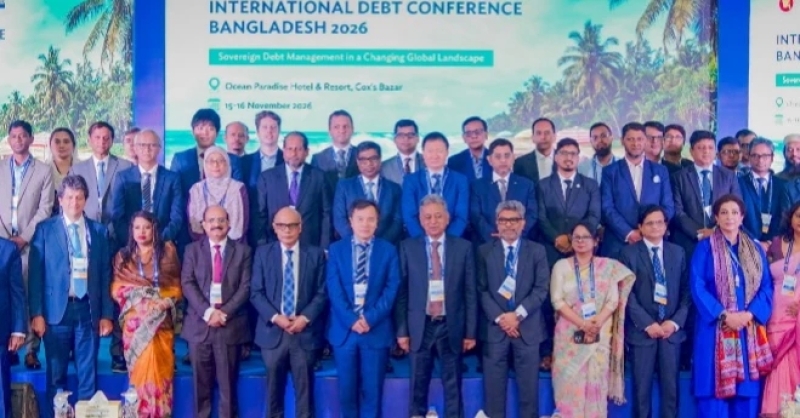
Finance and Planning Minister Amir Khosru Mahmud Chowdhury on Sunday said Bangladesh's main economic challenge was not the size of its debt but weak revenue mobilisation, stressing that debt sustainability depended on tax reforms and borrowing that generated sufficient returns.
"What matters is not how much was borrowed, but how well the borrowed money has been put to use," he said.
Speaking at the International Debt Conference Bangladesh 2026 in Cox's Bazar, the minister said macroeconomic stability had returned after the interim government's tenure, with budget financing from Bangladesh Bank halted, foreign exchange reserves recovering and borrowing costs declining.
Organised by the Finance Division and the Asian Development Bank (ADB), the two-day event is the country's first international conference on sovereign debt management.
Experts from the World Bank, the International Monetary Fund (IMF) and the ADB, along with specialists from the United States, the United Kingdom, Malaysia, Indonesia, Pakistan and Sri Lanka, are taking part.
Discussions are focusing on borrowing in a high-interest-rate environment, the domestic bond market, Sukuk, private investment, debt risk assessment, the proposed Debt Management Office (DMO), and financing instruments such as green bonds and Eurobonds.
The conference aims to produce practical recommendations to help Bangladesh achieve its ambition of becoming a trillion-dollar economy by 2034 and graduate smoothly from the least developed country (LDC) category in 2029.
Debt and economic conditions
Describing the economic situation in August 2024, the minister cited official figures as of June 30 that year, shortly before the change of government on August 5.
He said public debt stood at Tk 18.89 lakh crore, equivalent to around $163 billion or 36% of GDP.
"It had risen by Tk 5.4 lakh crore in two years from Tk 13.44 lakh crore on June 30, 2022. Total external debt, public and private combined, was about $104 billion, up from around $23.5 billion in 2009," he said.
Government borrowing from Bangladesh Bank had increased from Tk 730 crore on June 30, 2022, to Tk 56,750 crore on June 30, 2024, fuelling inflation of nearly 10%, he added.
Interest payments exceeded Tk 1 lakh crore in FY2023-24, while interest on external debt rose 3.5 times between FY2021-22 and FY2023-24.
External debt servicing, including principal and interest payments, reached $3.4 billion in FY2023-24, he said.
Reserves calculated under the IMF's BPM6 methodology fell from $48 billion in August 2021 to around $20.5 billion in July 2024.
The government also had unpaid power and fertiliser subsidy bills worth about Tk 40,000 crore, along with roughly $2.5 billion in outstanding fuel import payments. The banking sector was also fragile and burdened with high levels of non-performing loans, he said.
Recent improvements and future debt pressure
The minister said government borrowing from Bangladesh Bank had fallen to Tk 482 crore by June 30, 2026.
Foreign exchange reserves under the BPM6 methodology rose to more than $30 billion in June 2026.
The interest rate on 91-day Treasury bills declined from around 12% in June 2025 to below 10% in June 2026 and currently stands between 8% and 9%, he said.
The government is increasingly relying on long-term bonds and Sukuk to reduce repayment risks.
He also cited greater transparency in debt management through the publication of a Debt Report, modernisation of the Primary Dealer system and the inclusion of Bangladesh's local bonds in the J.P. Morgan GBI-EM index.
However, he cautioned that repayments on previous borrowing were beginning to put pressure on the economy.
External debt servicing is projected to reach $4.5 billion in FY2025-26 and peak at around $5.5 billion in FY2029-30, he added.
Revenue and debt management reforms
Describing revenue mobilisation as the most important debt reform, the minister said the government would expand the tax net, remove unjustified tax exemptions and digitalise VAT and income tax systems.
Other proposed measures include reforming the banking sector and financial markets, recapitalising state-owned banks, prioritising concessional loans and avoiding costly short-term borrowing. He said the government would not print money to finance the budget.
The government also plans to publish its first Annual Borrowing Plan and introduce a new Medium-Term Debt Strategy.
The minister said financing would be prioritised for well-appraised, high-return projects, while ongoing projects would be completed as a priority.
Other measures include deepening the domestic bond market by attracting pension funds, insurance companies and foreign investors; clearing subsidy arrears; imposing limits and fees on government guarantees; and publishing a list of guarantees alongside a Fiscal Risk Statement.
He also outlined plans to establish a unified Debt Management Office and enact a modern Public Debt Act.
The government aims to access global capital markets at an appropriate time through US dollar-denominated Eurobonds, Sukuk, Samurai bonds and Panda bonds.
It also plans to open the capital market further to foreign investors by leveraging Bangladesh's inclusion in the J.P. Morgan GBI-EM index and linking settlement systems with Euroclear and Clearstream.
"Large, long-term investment finance will have to come from the capital market, not from banks alone," he said.
He added that the government would expand the issuance of Sukuk and green and blue bonds, while entering international bond markets only when conditions were favourable.