

- India's record 720-9 has New Zealand on the ropes in 1st test |
- 95 platoons of BGB deployed in seven districts, including Gopalganj |
- Turkey's final draft at UN COP31 doesn't mention fossil fuels |
- Dhaka Ranks 14th Among World's Most Polluted Cities on Sunday |
- MoFA Says Indian Media Misreported PM's November 19 Speech |
PM targets 35% GDP share from SMEs by 2031, manufacturing hub oush
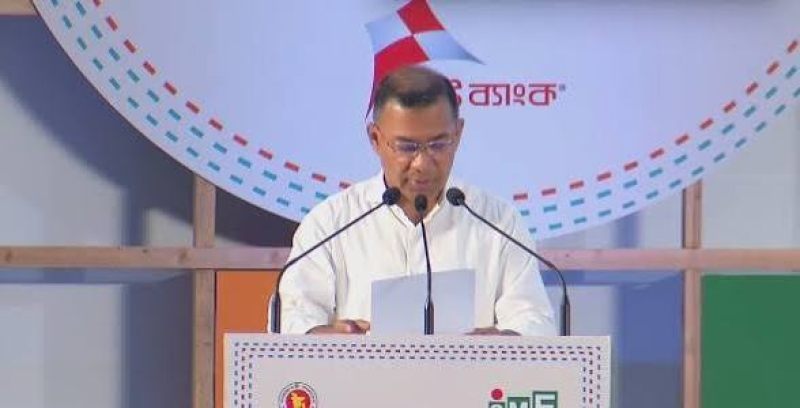
Prime Minister Tarique Rahman on Sunday said his government was working to establish Bangladesh as a manufacturing hub and an exporting gateway through a new SME policy, with a target of raising the sector's contribution to GDP to 35 percent by 2031.
“The draft National SME Policy 2026 has been prepared to turn this vision into reality, with a focus on making Bangladesh a manufacturing hub and an exporting gateway,” he said.
The Prime Minister made the remarks while speaking at the inaugural ceremony of the seven-day 13th National SME Product Fair 2026 at the Bangladesh-China Friendship Conference Centre in the capital.
He called upon local SME entrepreneurs to prepare for global markets with new products, saying Bangladesh should expand beyond the garment sector into leather goods, light engineering, agro-processing, plastics, handicrafts and information technology.
Tarique said the draft National SME Policy 2026 would be placed before the Cabinet soon for approval.
He said the policy aimed to create an environment where cottage, micro, small and medium enterprises (CMSMEs) can play a greater role in building a manufacturing-based economy and expanding the country's export market.
The Prime Minister said the government had also set a target of creating 25 lakh new jobs through the CMSME sector by 2031 as part of its broader goal of building a $1-trillion economy by 2034.
“Through the implementation of the SME policy, we aim to raise the contribution of the cottage, micro, small and medium industries sector to GDP to 35 percent by 2031 and create 25 lakh new jobs,” he said.
Tarique said the policy would take into account changing domestic and global economic realities, technological advances, the global trade situation and the challenges Bangladesh would face after graduating from the Least Developed Country (LDC) category.
He said the government planned to link small and medium enterprises with the country's broader production system, industrial supply chains and domestic and international value chains to support its target of building a $1-trillion economy by 2034.
The Prime Minister said SMEs should not remain confined to local markets but should also become suppliers of machinery, components and other inputs to larger industries and part of export-oriented production chains.
He said Bangladesh had already demonstrated its capabilities in the global market through the garment industry and should now prepare to enter international markets with a wider range of products.
Referring to Italy's specialised industrial clusters, Tarique said Bangladesh could promote area-based production of particular products to strengthen its SME sector.
He said SMEs were important for employment generation, poverty reduction, women's economic empowerment and the development of rural economies.
Many countries had advanced their economies by developing small and medium enterprises, the Prime Minister added.
However, he identified limited access to finance, lack of modern technology and skilled manpower, and difficulties in marketing products as major challenges facing local entrepreneurs.
Tarique said the government was working to make loans more accessible, provide modern training and offer necessary incentives to women and young entrepreneurs through coordinated efforts involving the public and private sectors.
He said the government planned to train at least 50,000 entrepreneurs over the next five years in branding, digital marketing and e-commerce to help them compete in domestic and international markets.
The Prime Minister also stressed the need to develop strong national brands like “Made in Bangladesh” and “Created in Bangladesh”, and provide entrepreneurs with support for geographical indication, trademark and design registration.
To expand the overseas market for local products, he said the government was considering arranging international trade fairs in major cities such as Singapore, London and Paris so that Bangladeshi entrepreneurs could showcase their products and secure foreign orders.
Tarique said Bangladesh had showcased jute-based products at a stall in the UN Climate Change Conference (COP31) in Türkiye, where foreign visitors showed interest and placed orders.
However, the entrepreneurs were not adequately prepared to receive and process those orders, he added.
The Prime Minister said the government would work to address such gaps by facilitating links between entrepreneurs, banks and international buyers.
He also called for reducing unnecessary administrative complexities, delays and costs that hamper business activities, while considering a preferential tax regime for the sector.
Tarique said the SME Foundation had identified 177 potential industrial clusters across the country. “The government plans to develop these clusters through initiatives such as ‘One Village, One Product’ and the creative economy programme.”
He said a National Creative and Design Centre would be established to help entrepreneurs improve product design, quality and packaging and make their goods more competitive in export markets.
The Prime Minister also spoke about the need to create more entrepreneurs, particularly among young people.
He urged young people to focus on becoming job creators through entrepreneurship rather than spending years only searching for jobs.
Under the SME Foundation's “SME Srishti” programme, Tarique said the government planned to create more than 25,000 new entrepreneurs in four years by supporting 100 entrepreneurs in each of the 64 districts every year.
He stressed the importance of increasing women's participation in business, saying they faced barriers in accessing finance, technology, training, business networks and distribution channels.
The Prime Minister said the government would take steps to connect small enterprises with large industries, supply chains and export-oriented production so that they could expand beyond the domestic market.
At the programme, Tarique also distributed the National SME Entrepreneur Awards 2026 among nine entrepreneurs in seven general categories and one special category.
The award recipients included the best medium, small and micro entrepreneurs of the year (male and female), the best startup, green SME business, technology-based creative entrepreneur and special entrepreneur.
The award recipients also took part in a group photo session with the Prime Minister.
On the occasion, the SME Foundation presented Tarique with a photo frame of Shaheed President Ziaur Rahman and former Prime Minister Begum Khaleda Zia.
Industries Minister Khandakar Abdul Muktadir chaired the function, while Finance Minister Amir Khosru Mahmud Chowdhury, FBCCI Administrator Md Fazlul Hoque, Industries Secretary and SME Foundation Chairperson Abdun Naser Khan, and City Bank PLC Managing Director and CEO Mashrur Arefin spoke.
A total of 380 enterprises from across the country are participating in the fair, around 60 percent of which are owned by women entrepreneurs.
The fair, organised by the SME Foundation under the Ministry of Industries, will continue until November 28, reports UNB.