

- Ensure no fascist force can ever use police against people: PM |
- 5 BNP, Jamaat men held in Kushtia for seeing drug dealer’s release |
- Japan views Bangladesh as key dev partner: Jamaat Ameer |
- Credit cards emerge as a financial lifeline for middle-class |
- Call for a radical shift to solar, LNG to overcome energy crisis |
Govt seeks UN delay of LDC graduation until 2029
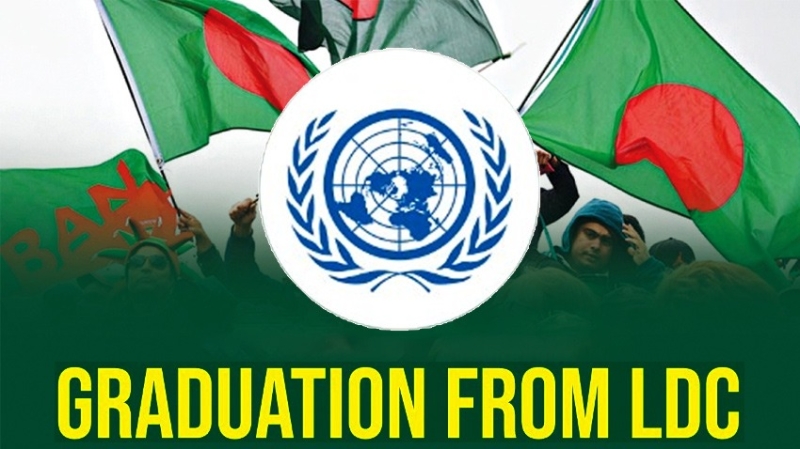
The government has formally requested the United Nations to postpone the country’s graduation from Least Developed Country (LDC) status by three years, citing a series of domestic and global economic shocks that have hampered preparations for transition.
The request was submitted on Wednesday by Economic Relations Division Secretary Shahriar Kader Siddiky in a letter to José Antonio Ocampo, chair of the UN Committee for Development Policy under the Economic and Social Council.
Dhaka has sought an extension of the transition period until November 24, 2029. Under the current timetable, the country is scheduled to graduate on November 24 this year, with the final review already in progress.
In the letter, the government said additional time is needed to stabilise the macroeconomy, consolidate reforms and complete priority measures outlined in its Smooth Transition Strategy. It argued that the five-year preparation period had been severely disrupted by successive crises.
Among the global challenges cited were the lingering effects of the Covid-19 pandemic, sluggish global recovery, the Russia–Ukraine war, volatility in energy and food markets, tighter international financial conditions, delays in trade recovery and instability in the Middle East.
Domestically, the government pointed to financial sector irregularities, political unrest following the 2024 mass uprising and the unresolved Rohingya repatriation issue as major obstacles.
According to the letter, these shocks contributed to slower economic growth, rising inflation, declining investment, a falling tax-to-GDP ratio, pressure on foreign exchange reserves and reduced imports of capital machinery and raw materials.
The government also highlighted fragility in the banking sector and capital market, warning that continued instability could undermine poverty reduction efforts.
Concerns were raised about uncertainty over post-graduation trade preferences. The ready-made garment sector may face difficulties in securing the European Union’s GSP+ facility, while possible counter-tariffs from the United States, changes in bilateral trade arrangements and new trade deals among competing countries could erode export competitiveness.
Recent export trends have already shown signs of weakening, the government noted, adding that heavy dependence on garments alongside energy and infrastructure constraints increases vulnerability.
Although progress has been made in tariff reforms, energy restructuring, export diversification and compliance improvements, repeated crises have delayed implementation, the letter said.
The government urged the committee to consider findings from an independent Graduation Readiness Assessment conducted by the UN Office of the High Representative for Least Developed Countries, Landlocked Developing Countries and Small Island Developing States. The assessment reportedly questioned whether graduating in November 2026 would align with the UN principle that transition should not disrupt development gains and suggested the country could seek relief under an enhanced monitoring framework.
First listed as an LDC in 1975, the country has benefited from duty-free market access and other preferential measures. The UN Committee for Development Policy recommends graduation based on triennial reviews assessing per capita gross national income, the Human Assets Index and the Economic Vulnerability Index.
The country met all three criteria in 2018 and 2021. Although graduation was initially recommended for 2024, it was deferred by two years due to the pandemic. By 2024, per capita GNI had risen to 2,820 dollars, well above the required threshold.
The previous interim administration had suggested coordinating with other LDCs such as Nepal and Laos to seek a further delay until 2030, leaving the final decision to the elected government. It also advised submitting the request ahead of the committee’s plenary session scheduled for February 24–27.
Any recommendation by the committee would require final approval from the UN General Assembly.
Experts say that although the country meets the formal graduation criteria, economic and political challenges could justify additional time to ensure a sustainable transition. They noted that recent political changes and elections have limited progress on the Smooth Transition Strategy.
They added that securing approval will depend not only on technical evaluation but also on diplomatic support from key partners, including India, China and the European Union.