

- Dhaka ranks 6th most polluted city |
- El Niño Could Threaten 347 Million Children Worldwide |
- PM Assures Support for Waste-to-Fuel Technology |
- CJP founder Abhijeet Dipke detained after flight lands in Delhi |
- India’s young return to streets as anger against EC and Modi grows |
Saki Calls for Cities Built Around Climate Risks
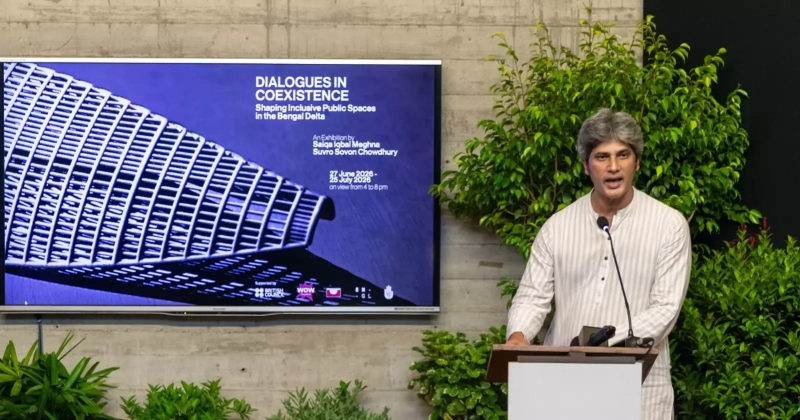
State Minister for Planning Zonayed Abdur Rahim Saki on Sunday said the government is moving towards a policy decision to make public space, urban planning and architecture suitable for Bangladesh’s own realities.
“Cities must be designed to coexist with rain, water and climate realities, instead of treating them as disruptions,” he said while inaugurating an exhibition titled “Dialogues in Coexistence: Shaping Inclusive Public Spaces in the Bengal Delta” at Bengal Shilpalay in Dhaka.
Speaking as the chief guest, Saki said master plans for Dhaka and divisional cities are being prioritised, with similar planning to gradually extend to district and upazila towns.
The State Minister said public projects must ensure accessibility, inclusivity and space for ordinary people, including persons with disabilities.
The exhibition will open to the public from 10am to 8pm daily until July 25.
The interdisciplinary art and architecture exhibition explores how feminist ethics, climate responsiveness, and public participation can inform the design of more inclusive civic spaces in the Bengal Delta.
Visitors are expected to encounter installations that foreground local materials, craft traditions, and environmental sensitivity while reimagining the relationship between people, place, and ecology.
Supported through the British Council's Women of the World (WOW) Bangladesh Grants Programme, the project is led by architects Saiqa Iqbal Meghna and Suvro Sovon Chowdhury.
The exhibition has been developed with curatorial guidance from Luva Nahid Choudhury, Director-General of Bengal Foundation, and Wakilur Rahman, acclaimed artist and Founder of Kala Kendra.
Cities must be designed to coexist with rain, water, climate realities: Zonayed Saki
Speaking at the programme, acting British High Commissioner and Development Director to Bangladesh James Goldman said, “I am delighted to be here at Dialogues in Coexistence, an inspiring exhibition that brings together art, architecture and innovation to explore more inclusive and resilient public spaces in the Bengal Delta.”
“The British Council’s Women of the World (WOW) programme supports this approach, aligning with the UK’s broader priorities and our ongoing endeavour to advance climate-responsive, inclusive and sustainable development in Bangladesh.”
Country Director Bangladesh, British Council Stephen Forbes said they are very happy to support this project, as its goal to connect the creative economy with inclusive communities, social justice, and youth agency closely aligns with the British Council’s overarching priorities in the arts sector.
Cities must be designed to coexist with rain, water, climate realities: Zonayed Saki
“We see enormous potential in Bangladesh’s creative economy, particularly in design, architecture, and culture. For peace and prosperity, communities must be inclusive and shaped by diverse perspectives,” Forbes said, noting that this exhibition shows how arts and architecture can help people think differently about shared public spaces.
The inauguration also featured a special address by Professor Kazi Khaleed Ashraf, architect, educator, and Director General of the Bengal Institute for Architecture, Landscapes and Settlements.
“The installation is a potential pavilion, a thing in flux, shaped through assembling, disassembling and collective making. It speaks of material exploration, craft and collaboration, from clay and tiles to the people who bring the structure together. It also opens a dialogue between the monsoon, the delta and public space, creating new relationships between the object, the landscape and the public,” he said.
This initiative reflects the British Council's ongoing commitment to advancing gender equality and addressing the climate emergency through arts and culture, while supporting women-led creative practice and interdisciplinary collaboration.
It forms part of a wider effort to strengthen the creative economy and support more inclusive and sustainable societies, reports UNB.