

- Rising Prices of Essentials Put Low, Middle-Income Families Under Strain |
- Mirza Fakhrul to Take Oath as Bangladesh President Today |
- Clean energy transition needs land; can it help restore it too? |
- Ruhul Kabir Rizvi Named BNP Acting Secretary General |
- Over 770 US Service Members Killed or Injured in Iran War |
Clean Energy Expansion Could Help Restore Degraded Land
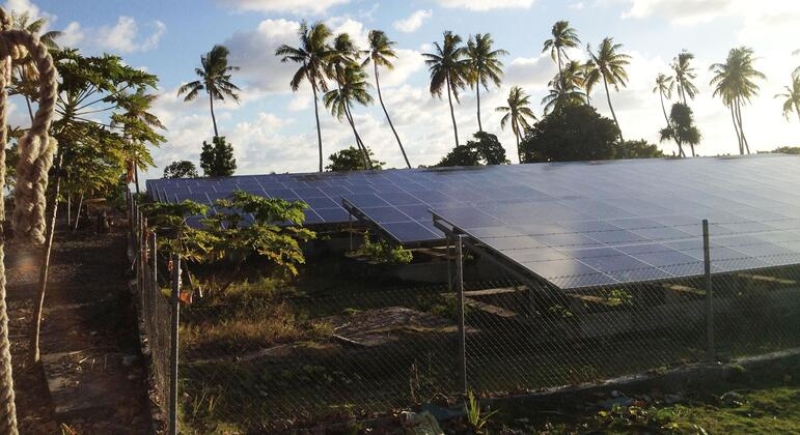
In Tokelau, a group of Pacific atolls, solar panels rise above crops, allowing the same land to support both food production and renewable energy.
The global shift toward clean energy will require vast amounts of land, but experts say renewable energy projects can also help restore degraded ecosystems when they are carefully planned.
At a UN desertification conference in Ulaanbaatar, Mongolia, experts discussed how renewable energy expansion can coexist with land protection and restoration, highlighting examples from South Africa, China and India.
Degraded mining areas in South Africa have been repurposed for renewable energy, while solar projects in China’s deserts are being combined with vegetation, water harvesting and sand-control measures. In India, solar-powered irrigation is allowing farmers to use the same land for both food production and clean energy.
The transition away from fossil fuels is expected to significantly expand the physical footprint of solar, wind and other renewable energy infrastructure. Land currently used for renewable energy projects could increase from about 500,000 hectares to three million hectares by 2032.
Julian Blanc, head of the Biodiversity and Land Branch at the UN Environment Programme (UNEP), described renewable energy expansion as potentially one of the largest land-use transformations in history.
He said the key question is whether renewable energy can be developed in ways that leave landscapes, ecosystems and communities better off.
Experts stressed that land-use planning should begin before renewable energy projects are developed. The location of solar panels, transmission lines and other infrastructure can determine whether projects support or damage ecosystems.
Muralee Thummarukudy, director of the UN Convention to Combat Desertification’s G20 Global Land Initiative, said solar energy can contribute to ecological restoration when projects are placed in appropriate locations, but the same approach may not work everywhere.
Solar projects can also have environmental costs, including vegetation loss, wildlife disruption and changes to water flows. Multiple projects within the same landscape can place additional pressure on biodiversity, fisheries and communities.
UNEP experts said planning should therefore consider entire landscapes, including biodiversity, water resources, communities, wildlife migration routes and exposure to floods and droughts, rather than assessing individual project sites in isolation.
Local communities should also have a role in planning because their knowledge of environmental risks can complement technical assessments.
In India, solar-powered irrigation demonstrates how renewable energy can complement agriculture rather than compete with it. Farmers can use solar electricity to operate irrigation pumps and sell surplus power, creating an additional source of income.
China is also using solar technology in desert areas to support ecological restoration. Solar-powered pumps help provide water for vegetation, while plants and shrubs can stabilise sand and reduce desertification. In some areas, water collected from solar panels is directed toward vegetation, while plants around installations can provide livestock feed or support other economic activities.
However, experts cautioned that these approaches cannot simply be replicated everywhere. Each renewable energy project must account for local environmental, social and economic conditions.
UNEP plans to collect examples of renewable energy projects that successfully integrate land, water, biodiversity and community interests, with the aim of providing countries with practical models as clean energy expands.
The challenge, therefore, is not simply to build more renewable energy infrastructure, but to ensure that the clean energy transition also contributes to protecting and restoring the land on which communities and ecosystems depend.