

- Around 7,500 Bangladeshis imprisoned in Saudi Arabia: Shama Obaed |
- Bangladesh Outperforms India in Global Hunger Index 2026 |
- Covered van hits Gazipur police patrol team, killing SI, BNP leader |
- Korean City scrambles to rescue dusky shark after it returns to canal |
- PM inspects Mongla Port, Sundarbans, proposed economic zone |
Govt Launches Major Plan to Combat Pollution in Dhaka Rivers
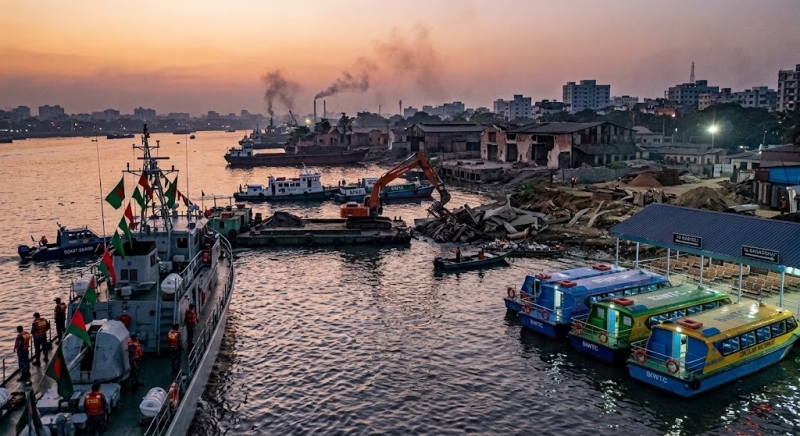
The government has launched a comprehensive plan to curb pollution, restore navigability and improve water flow in the five rivers surrounding Dhaka—Buriganga, Turag, Balu, Shitalakshya and Dhaleshwari.
The rivers are vital to the capital’s drainage, water transport, environment and biodiversity. However, they are in critical condition due to the unchecked discharge of industrial effluents and sewage, household waste and illegal structures along their banks.
To address the crisis, the government has adopted short-, medium- and long-term measures, initially focusing on preventing waste from entering the rivers and strengthening monitoring and enforcement.
Under the short-term plan, waste discharge points will be sealed. Joint operations will initially be conducted along the Turag, Buriganga and Dhaleshwari, followed by the Balu and Shitalakshya.
As part of the coordinated drives, authorities are updating lists of polluting factories, dockyards, institutions and other establishments. Regular enforcement operations will be conducted, with legal action against those responsible for polluting the waterways.
A vessel census has already begun to strengthen surveillance, while regular patrols will be conducted along the river routes.
The Prime Minister’s Office (PMO) will monitor the activities through a newly formed central cell, with the Bangladesh Navy acting as coordinator. The Navy will be deployed in the field under the “In Aid to Civil Power” arrangement.
Prime Minister Tarique Rahman has held several meetings with officials concerned about the rivers surrounding Dhaka and issued directives to restore their condition. He has also expressed interest in visiting the rivers personally to assess the situation.
The prime minister has additionally directed officials to expedite the Inner Circular Ring Road project to help ease Dhaka’s chronic traffic congestion.
Following his instructions, various ministries, departments and agencies have begun implementing field-level programmes. State Minister for Planning Md Jonaed Abdur Rahim Saki, Principal Secretary to the Prime Minister ABM Abdus Sattar and secretaries of several ministries have already inspected the condition of the rivers and ongoing project activities.
An additional secretary of the Ministry of Shipping said the prime minister had instructed all concerned to take immediate steps to stop river pollution, beginning with the Buriganga and Turag.
The government is also planning to introduce passenger and tourist vessel services on the rivers around Dhaka.
“We are encouraging private boat operators. If they do not agree, we will start passenger services using government vessels,” the additional secretary said, adding that services at intervals of about 20 minutes could help attract passengers.
Officials who attended PMO meetings said Dhaka has a 110-kilometre circular waterway linked by the five rivers, connecting Gazipur, Dhaka, Narayanganj and Munshiganj.
They said pollution or declining water flow in one river affects the water quality, navigability and ecological condition of the others.
Officials said enforcement operations would begin in the Turag and Buriganga and then move to the Dhaleshwari. The Turag has relatively lower levels of pollution and encroachment, and starting operations there could create positive momentum for similar efforts elsewhere, they said.
The Department of Environment (DoE) has meanwhile met leaders of industrial enterprises and business associations, instructing them to take measures to prevent pollution, including installing effluent treatment plants (ETPs).
According to Bangladesh Inland Water Transport Authority (BIWTA) data, government agencies themselves account for a significant number of waste discharge points.
Dhaka WASA has 66 waste outlets, Narayanganj City Corporation 37, Dhaka South City Corporation 21, Dhaka North City Corporation 16 and Gazipur City Corporation four.
A total of 631 pollution outlets have been identified along the Buriganga, Turag and Balu rivers—258 in the Buriganga, 269 in the Turag and 104 in the Balu. Another 62 waste discharge points have been identified along the Tongi Canal.
During an inspection in 2026, BIWTA identified 49 new waste outlets along the banks of the Buriganga alone, taking the total number of discharge points there to 307.
BIWTA Director (Port and Transport) Md Saiful Islam said steps were being taken to prevent waste from being discharged directly into the river through these outlets.
Notices have been served on owners of illegal structures, dockyards and other establishments along the riverbanks, ordering them to stop dumping waste into the waterways.
The Ministry of Shipping has decided to introduce passenger vessels on the circular waterway as part of the broader plan.
The Bangladesh Inland Water Transport Corporation (BIWTC) has been asked to build 12 small vessels, each capable of carrying 10–12 passengers, within six months.
The vessels will operate at intervals of 20–30 minutes on the Gabtoli–Postogola route via Sadarghat.
The government hopes the service will encourage greater use of waterways while reducing pressure on Dhaka’s road network.
To prevent illegal encroachment and pollution, restore natural navigability and reclaim occupied river areas around Dhaka, the government has formed a 37-member Central Cell at the PMO.
The Principal Secretary to the Prime Minister heads the cell, which will oversee three sub-committees. Ministers and state ministers from the Ministry of Environment, Forest and Climate Change; Ministry of Local Government, Rural Development and Co-operatives; Ministry of Shipping; and Ministry of Planning will serve as advisers.
The Bangladesh Navy will coordinate the cell’s activities.
The 37-member body includes secretaries from various ministries, a Bangladesh Navy representative of rear admiral rank, the Inspector General of Police, Director General of the Coast Guard, chairman of the National River Protection Commission, director general of the Water Development Board, director general of the DoE, chairman of RAJUK, chairman of BIWTA, the Dhaka divisional commissioner, an AIG of River Police and managing director of Dhaka WASA.
Chief executive officers of Dhaka North, Dhaka South, Narayanganj and Gazipur city corporations are also members.
Representatives of the Attorney General’s Office, deputy commissioners of Dhaka, Narayanganj and Gazipur, presidents of BGMEA, BKMEA, the Tannery Owners Association and Dockyard Association, as well as NGO representatives nominated by the DoE, are also included.
The three sub-committees have been assigned specific areas of responsibility.
Sub-Committee 1 will focus on controlling waste discharge sources, including industrial effluents; removing waste from canals and drains; reclaiming rivers and maintaining water flow; and preparing long-term plans, including the removal of solid waste accumulated on riverbeds.
The Central Cell will review progress every month and submit reports to the prime minister. It will also monitor and coordinate ongoing projects related to pollution control, river conservation and the management of waterways around Dhaka.
Available data show that about 60–61% of the liquid waste dumped into Dhaka’s rivers each day comes from industries, while the remaining 39–40% originates from households and other sources.
According to recent World Bank reports and environmental studies, more than 7,000 industrial units in greater Dhaka discharge around 2.4 billion litres of untreated toxic chemical and liquid waste into surrounding water bodies and rivers every day.
More than 10 million litres of untreated household wastewater and sewage also flow directly into the rivers daily.
Only about 2% of Dhaka is covered by a proper sewerage network, leaving the remaining 98% of household sewage to flow directly or through canals into the rivers.
The government’s latest initiative seeks to tackle the problem at multiple levels—from sealing pollution outlets and enforcing environmental laws to restoring water flow, removing encroachments, improving river surveillance and introducing waterway transport.
The success of the plan, however, will depend on sustained enforcement, coordination among agencies and effective action against both industrial and household sources of pollution.