

- Bangladesh to Introduce New Law to Curb Extortion, IGP Says |
- UN Marks 81 Years of Global Cooperation and Peace |
- Dhaka's air 5th worst in the world this morning |
- Around 7,500 Bangladeshis imprisoned in Saudi Arabia: Shama Obaed |
- Bangladesh Outperforms India in Global Hunger Index 2026 |
Bangladesh launches $112M project for climate-resilient rural livelihoods
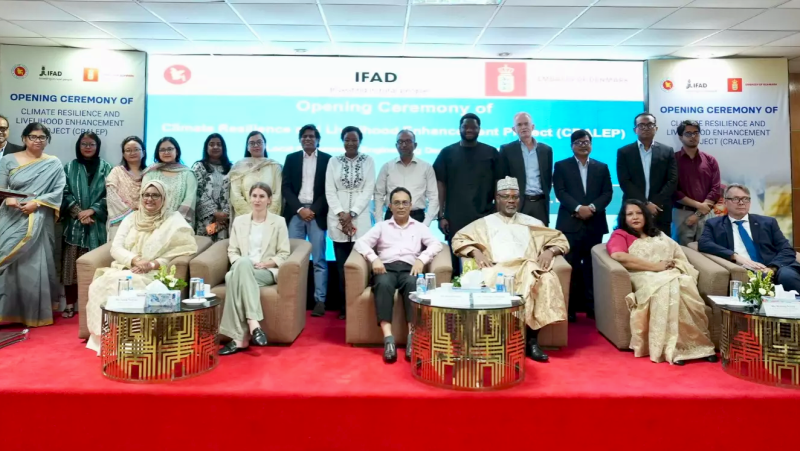
The government of Bangladesh, in partnership with the International Fund for Agricultural Development (IFAD) and the government of Denmark, has launched a US$112 million project to strengthen climate resilience and rural livelihoods.
The Climate Resilience and Livelihood Enhancement Project (CRALEP) will be implemented by the Local Government Engineering Department (LGED) in the flood-prone Haor and drought-prone High Barind regions, IFAD said on Monday.
Over six years, CRALEP aims to benefit approximately 1.5 million people across 33 upazilas. In the Haor, flash floods can destroy standing crops and isolate villages.
In the High Barind, drought and water scarcity put pressure on agriculture and rural incomes.
The project will address these risks through climate-resilient infrastructure, more diverse livelihoods and climate information services.
“The partnership between the Government of Bangladesh and IFAD is a long-standing development partnership since 1978, built on a shared commitment to reducing rural poverty, strengthening rural livelihoods and creating resilient and inclusive rural economies,” said Moslema Naznin, Wing Chief at the Economic Relations Division (ERD).
“The success of the project should therefore be measured not only by expenditure or physical outputs, but by whether communities become better connected, better protected, economically stronger and more resilient to climate shocks,” she said.
CRALEP will improve village roads, rural markets and boat landing facilities to support people reach services and sell their produce.
In the Haor, it will also support walkways, water and sanitation facilities, raised shelters for people and harvested crops, and nature-based measures to protect villages from erosion.
“We are not looking at infrastructure, agriculture, livelihoods and climate information as separate issues. They are interconnected. A resilient road improves access to markets. Better market access creates economic opportunities. Skills development increases employability. Climate information helps communities anticipate risks,” said Md Belal Hossain, the Chief Engineer of LGED.
The project will provide vocational and entrepreneurship training for young women and men and support employment for poor women through labour contracting societies.
Flash flood early warning in the Haor and drought forecasting in the High Barind will help communities prepare for climate risks. CRALEP will also strengthen the capacity of LGED to apply climate-resilient approaches and innovations in rural development.
“I think the intervention we’re looking at is very timely, and combining climate resilience with livelihood enhancement, which is what the project is all about, is very important. We hope this will reduce the negative impacts of climatic variability and increase community resilience,” said Anders B. Karlsen, Deputy Head of Mission, Embassy of Denmark in Bangladesh.
The project has an estimated cost of approximately US$112 million, comprising US$70 million in IFAD financing, approximately US$31.75 million from the government of Bangladesh and US$10 million in grant financing from the Government of Denmark.
“Climate resilience is about whether people can continue to earn a living and reach essential services when conditions become more difficult,” said Dr Valantine Achancho, IFAD Country Director and Representative in Bangladesh.
“CRALEP invests in the connections, information and skills that rural communities need to prepare for climate shocks and sustain their livelihoods. Working with LGED, we want the lessons from this investment to strengthen how rural infrastructure is planned and built in other vulnerable areas of Bangladesh.”
By improving roads, markets and village protection, CRALEP is expected to make access to services and economic opportunities more reliable, while reducing the damage and disruption caused by floods and erosion.
Earlier warnings of flash floods and droughts will help households make decisions to protect crops and other assets.
The project is also expected to create new employment and enterprise opportunities for young people and poor women, IFAD said.
Together, these investments aim to help rural families build more secure incomes, recover more quickly from climate shocks and sustain their livelihoods as climate risks grow, reports UNB.