

- COP31 to Focus on Implementing Climate Policies |
- 16 Killed, 46 Injured as 7.0-Magnitude Quake Hits China's Xizang |
- Dhaka Ranks 12th Among World's Most Polluted Cities on Friday |
- 10 universities in US and UK voted the best in the world |
- Speaker sees no possibility of Hasina's return even in 10-yrs |
Healthy Diet Becomes Costlier Although Hunger Eases
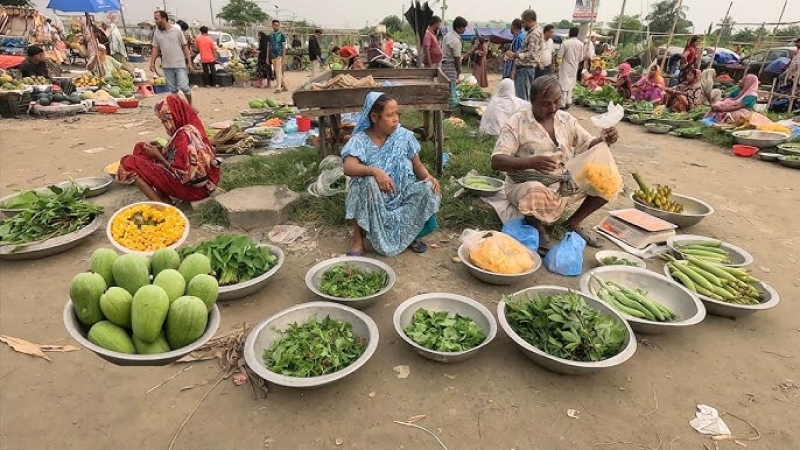
Female and male shopkeepers have displayed a wide variety of kitchen items at her shop at Uttara Bau Bazar, Dhaka. Photo collected
GreenWatch Desk
Prices of food items have increased in the last six months in Bangladesh putting low and middle income groups under pressure as their income has not increased to cope with this. It’s a difficult situation because the factors contributing to the food price inflation largely result from external shocks – high energy, fertilizer and transportation costs primarily caused by the war on Iran.
The latest State of Food Security and Nutrition in the World 2026 (SOFI) report launched on 21 July last says, globally the price of a healthy diet climbed by nearly a dollar to USD 4.28 per person per day. In Bangladesh the prices of most vegetable items have gone beyond Taka 100 a kg in retail markets. Eggs, meat and fishes have similarly become costlier.
Global hunger eased for the third consecutive year in 2025, offering a cautious sign that the world may finally be emerging from the prolonged food security crisis triggered by the pandemic, conflicts and climate shocks. Yet this improvement is overshadowed by a more troubling trend: the rising cost of a healthy diet. Produced jointly by five UN agencies, the report warns that while hunger is receding slowly, nutritious food is becoming increasingly unaffordable for billions, threatening to undermine global progress toward ending hunger and malnutrition by 2030.
The SOFI report confirms that 7.8 percent of the world’s population faced hunger in 2025, down from 8.1 percent in 2024 and 8.6 percent in 2022. As the document notes, “This means that around 645 million people were affected by hunger in 2025, representing a reduction of nearly 14 million compared to 2024 and 43 million compared to 2022.” Asia, Latin America and the Caribbean have recorded steady improvements, while Africa—despite early signs of stabilization—remains the epicentre of global hunger. Africa is now home to approximately 309 million hungry people, surpassing Asia in absolute numbers. Although the continent’s hunger rate fell slightly from 20.3 percent in 2024 to 20.0 percent in 2025, rapid population growth continues to outpace gains.
Broader measures of food access also show modest improvement. In 2025, an estimated 2.1 billion people experienced moderate or severe food insecurity, down from 2.97 billion in 2021. Yet disparities remain stark: more than half of Africa’s population—56.6 percent—faced moderate or severe food insecurity in 2025, compared with 20.3 percent in Asia and 8.7 percent in Northern America and Europe. Women continue to be disproportionately affected, though the gender gap narrowed slightly in 2025. Rural communities remain the most vulnerable, reflecting structural inequalities in access to markets, services and income opportunities.
The report warns that recent geopolitical and climatic shocks could reverse hard won progress. The conflict in the Middle East, which erupted in early 2026, has triggered global energy and fertilizer price spikes, raising food inflation worldwide. As the report states, “Depending on the length of the impact of the crisis on food inflation – which is driven by higher energy and fertilizer prices – approximately 510 to 520 million people may still be facing hunger in 2030.” These projections do not yet account for potential weather extremes, including El Niño events in 2026 and 2027, which could further disrupt food production and supply chains. Cuts in humanitarian funding and development assistance compound the risks, prompting the heads of the UN agencies to caution that without sustained investment, the world may fail to meet the 2030 nutrition targets.
While hunger has eased, global nutrition outcomes remain off track. Child stunting, wasting, overweight, low birthweight and exclusive breastfeeding show only marginal improvements. Alarmingly, anaemia among women aged 15–49 is worsening, and adult obesity continues to rise—from 12.1 percent in 2012 to 16.2 percent in 2024. Only 30.8 percent of children aged 6–23 months consume a minimally diverse diet, and 150 million children under five remain stunted. Regional trends diverge sharply. Asia is on track to meet the 2030 child stunting target, while Africa shows gradual improvement. Exclusive breastfeeding rates are rising across most regions, but child overweight is increasing rapidly in Oceania.
The SOFI 2026 report defines a healthy diet as one that is “adequate, balanced, diverse, and moderate.” In 2025, the global average cost a healthy diet rose to USD 4.28 PPP per person per day, up from USD 3.44 in 2021 and USD 2.94 in 2017. Latin America and the Caribbean recorded the highest costs at USD 4.91, while Africa saw the sharpest deterioration in affordability: 66.6 percent of Africans could not afford a healthy diet in 2025—more than double the share in Asia or Latin America. The report highlights structural drivers behind these rising costs. Animal source foods, fruits and vegetables account for the largest share of diet costs, while starchy staples contribute relatively little. Post farmgate activities—processing, logistics and wholesale—make up 70 to 75 percent of consumer food prices, with up to 40 percent of total costs arising in processing and logistics alone. Improving efficiency in these segments is critical, especially for perishable, nutrient rich foods.
Bangladesh’s experience in early 2026 mirrors the global trend but with sharper consequences for low income and middle income households. Food inflation climbed to 9.30% in February, surged further to a 16 month high of 9.42% overall general inflation by May 2026. Despite temporary import relaxations, inflation has continued to erode purchasing power. Food inflation briefly softened to 8.39 percent in April before rising again to 9.06 percent in May. The spike in general inflation—driven heavily by staple food items and rising non food costs—has squeezed household budgets across the country.
Underlying drivers of Bangladesh’s inflation shock include global energy and fertilizer constraints, disruptions affecting the Strait of Hormuz, and domestic fuel price adjustments that raised transport costs from farms to retail markets. Retail prices for daily essentials—including edible oils, lentils, onions, eggs and sugar—experienced renewed upward pressure.
The Bangladesh Bank temporarily removed letter of credit margins on essential food items like sugar, edible oil and chickpeas to encourage imports and cool domestic prices. For millions of households, the rising cost of a healthy diet means cutting back on protein, fruits and vegetables—precisely the foods needed for good nutrition. The SOFI report’s global warning resonates strongly in Bangladesh: affordability is deteriorating, and structural reforms are urgently needed.
The SOFI 2026 report outlines a clear set of policy levers to reduce the cost of healthy diets and strengthen food systems. These include investments in infrastructure such as roads, storage, cold chains and irrigation to reduce post harvest losses; boosting research and development for climate resilient crops and efficient value chains; reforming subsidies and trade policies to align incentives with nutrition and sustainability goals; improving regulatory frameworks to ensure food safety and reduce market distortions; and promoting sustainable practices that lower production costs while protecting ecosystems. Targeted interventions can simultaneously improve nutrition outcomes, strengthen resilience and support climate goals.
The SOFI report concludes with a powerful reminder that the work ahead is immense, but the goal—a world where a healthy diet is no longer out of reach for nearly one in three people—is worth striving for. Global hunger may be easing, but the rising cost of nutritious food threatens to undermine this progress. For Bangladesh, the inflation shock of 2026 underscores how quickly external crises can erode household welfare. Ensuring affordable, healthy diets will require bold reforms, resilient value chains and sustained investment—both globally and nationally. The world has shown that progress is possible. The challenge now is to accelerate it, protect it and ensure that no family is left behind.