

- US Suspends Visa Interviews Worldwide for Consular Training |
- Mecca Pact Puts Bangladesh’s Foreign Policy to New Test |
- Remittance reaches $2.34 billion in first 24 days of August |
- BSF men flee leaving behind 2 shotguns, walkie-talkie |
- Bhutan King makes brief stopover in Dhaka, meets President |
World Cup 2026 Ends with Records, Drama and Farewells
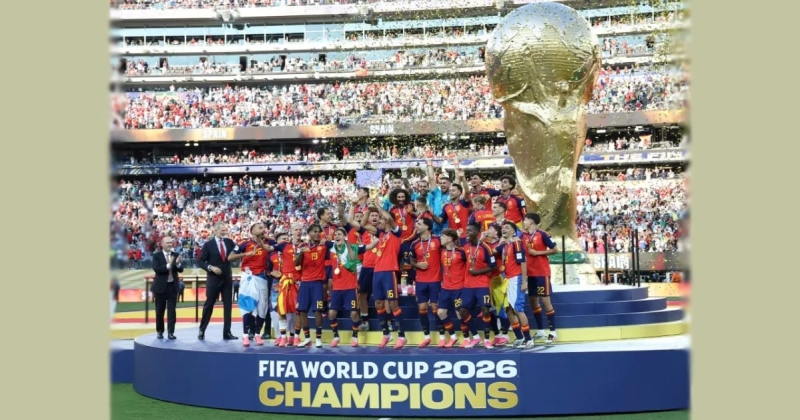
Team Spain celebrate during the awarding ceremony after the final match between Spain and Argentina at the 2026 FIFA World Cup at the New York New Jersey Stadium, the United States, July 19, 2026.
The 2026 FIFA World Cup rewrote history long before the first ball was kicked. Expanded to 48 teams for the first time and hosted jointly by Canada, Mexico and the United States, the tournament introduced a new era for international football with fresh rules, emerging stars, unforgettable drama and the end of several legendary careers.
New Format, New Rules
The tournament marked the first World Cup to feature 48 nations and the first to be staged across three host countries.
FIFA also introduced several new rules, including automatic red cards for players who deliberately covered their mouths during on-field confrontations, mandatory hydration breaks in every match, and corners awarded to attacking teams if goalkeepers held the ball for too long.
Contrasting Styles Define the Tournament
The expanded competition showcased a rich variety of tactical approaches.
France relied on the attacking brilliance of Kylian Mbappé, Ousmane Dembélé and Michael Olise, while eventual champions Spain built their success on patience, possession and defensive solidity.
Spain's defence made history by recording six consecutive World Cup clean sheets, a streak stretching back to the 2022 tournament, while goalkeeper Unai Simón went 609 minutes without conceding a goal before the run ended.
Morocco once again emerged as Africa's standard-bearer, combining disciplined defending with aggressive pressing and rapid counterattacks. South American teams produced flashes of brilliance, although traditional powers such as Brazil and Uruguay fell short of expectations.
New Stars Announce Their Arrival
The World Cup introduced several exciting young talents to the global stage.
Morocco's Ayyoub Bouaddi, 18, impressed after switching international allegiance from France and attracted interest from several leading European clubs.
Ivory Coast winger Yan Diomande, 19, justified the pre-tournament hype with a series of eye-catching performances, while Colombia midfielder Gustavo Puerta earned widespread praise for his creativity and composure.
End of an Era
The tournament also marked the final World Cup appearances for several football icons.
Cristiano Ronaldo, Luka Modrić and Neymar all bid farewell to the world's biggest football stage.
Argentina captain Lionel Messi, playing in his sixth and likely final World Cup, finished with eight goals, while France's Mbappé claimed the Golden Boot with 10 goals.
Controversies Grab Headlines
Several controversial incidents dominated discussion throughout the tournament.
Paraguay's Miguel Almirón became the first player sent off under FIFA's new rule prohibiting players from covering their mouths during confrontations with officials or opponents.
Another major controversy involved United States striker Folarin Balogun, who was initially suspended after receiving a red card against Bosnia and Herzegovina. FIFA later overturned the suspension, fined the striker $40,000, and allowed him to play in the next round.
The decision prompted protests from Belgium's football federation and criticism from UEFA, which described the ruling as "unprecedented" and "unjustifiable."
Chinese Companies Leave Their Mark
The tournament also highlighted China's growing commercial influence in global football.
Breakfast restaurants, cinemas and coffee shops across China adapted their business hours to accommodate early-morning kick-offs, while merchandise manufacturers in Yiwu reported strong demand for officially licensed World Cup products.
Chinese technology companies also played prominent roles. FIFA technology partner Lenovo supplied AI-powered infrastructure supporting tournament operations, while Hisense provided display technology used in broadcasting and officiating systems.
Spain Write the Final Chapter
The tournament concluded with Spain defeating Argentina 1-0 after extra time to lift their second World Cup title and end Argentina's reign as champions.
Ferran Torres' extra-time winner secured Spain's first World Cup triumph since 2010, denying Messi one final World Cup title and bringing the curtain down on one of the most memorable tournaments in football history.