

- Exports up over 6% to $13.1bn in Q1 of current fiscal |
- Declaration on Sea Level Rise Draws Mixed Global Response |
- PM inaugurates Tk 1,542 cr Muhuri-Kohua flood control project in Feni |
- Who gets to shape AI? UN debate centres on power, trust and inclusion |
- PM Tarique Rahman likely to visit Japan later this month |
Declaration on Sea Level Rise Draws Mixed Global Response
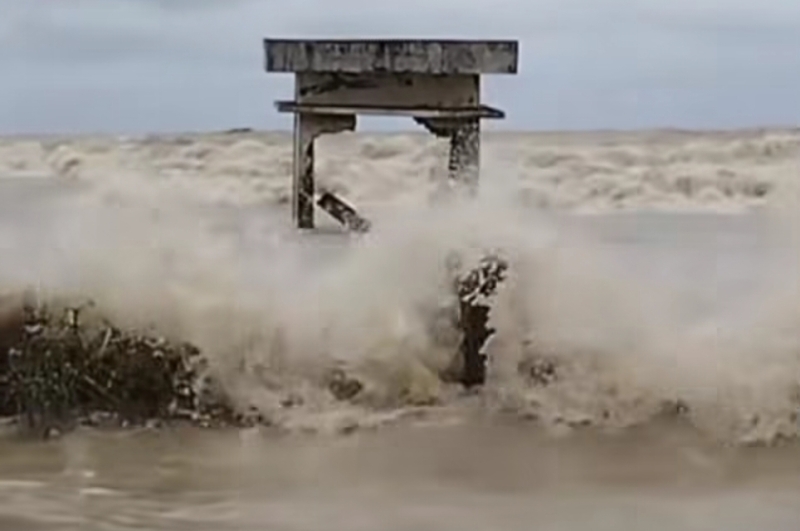
Sea waves hitting the Kuakata Beach in SouthWest Bangladesh.
GreenWatch Desk
At a special session of the UN General Assembly on 24 September last, a historic political declaration to combat one of the most alarming aspects of the climate crisis—sea level rise—was adopted unanimously. As millions of people worldwide face an existential threat due to climate change, this declaration is being hailed as a major milestone in global climate diplomacy. However, the declaration has drawn a mixed response from climate scientists, various UN agencies, and vulnerable island states.
The unanimously adopted declaration primarily focuses on three core pillars, which include assisting countries facing the immediate threats of rising sea levels through direct climate action, robust adaptation processes, early warning systems, and enhanced international cooperation. Furthermore, it aims at activating necessary financial resources and strengthening climate resilience in Small Island Developing States (SIDS) and other highly vulnerable coastal nations, while simultaneously accelerating global efforts under the Paris Agreement on climate change to limit future warming to 1.5°C, thereby curbing future sea level rise.
While UN policymakers and its various bodies welcomed the declaration, they heavily emphasized the need for a science-based implementation strategy. UN Secretary-General António Guterres issued a stark warning, calling for immediate action to protect the lives of coastal populations and stressing that sea level rise is not a remote threat, but a current reality rapidly endangering livelihoods. Meanwhile, the World Meteorological Organization (WMO) formally endorsed the declaration but highlighted a major gap, stating that accurately understanding and monitoring sea level changes requires a massive scale-up of satellite and advanced tide-gauge observations. The WMO warned that critical systemic gaps in science and collective risk assessment still remain in small island states and developing coastal regions.
For the Alliance of Small Island States (AOSIS)—those at the absolute forefront of this existential crisis—the declaration represents a "genuine victory" resulting from decades of intense diplomatic campaigning. Leaders from island nations like Tuvalu and Palau particularly welcomed the international commitment to safeguarding state sovereignty and maritime boundaries. This acknowledgment is crucial, as it hints at creating a legal framework to protect their statehood and rights under international law, even if their physical land is submerged. However, island leaders simultaneously expressed concern, noting that paper promises are only meaningful if developed nations fulfil their climate finance obligations.
Climate policy analysts and environmental scientists acknowledged the positive step but criticized several structural loopholes within the declaration, pointing out a distinct lack of legal enforcement. Because this is a political declaration, it is not legally binding under international law, meaning there is no enforcement mechanism if a nation fails to reduce its greenhouse gas emissions or provide financial aid.
Additionally, despite the text mentioning the mobilization of finance, it does not commit any new financial support or allocate specific funds for vulnerable countries, which experts argue makes building climate resilience nearly impossible. The overarching consensus among experts is that the true success of this declaration depends entirely on how quickly developed nations transition away from fossil fuels to curb global temperature rise and how sincerely they enforce the Paris Agreement.
The UN's unanimous declaration has undoubtedly pushed the crisis of sea level rise to the top of the global agenda, providing a solid legal and moral foundation for vulnerable nations to fight for their rights. However, the reactions from climate experts and affected states prove that signing a document is just the beginning. To save human civilization from the encroaching oceans, the world must now transition from rhetoric to rapid financial deployment and visible, decisive action.