

- PM Proposes Five Urgent Steps to Resolve Rohingya Crisis |
- Govt Appoints Indonesian Firm to Operate Cox’s Bazar SPM |
- ADB lowers Bangladesh’s growth forecast to 4 % in FY2027 |
- El Niño Tests Global Readiness for a Changing Climate |
- Dhaka's air quality recorded moderate on Wednesday morning |
Bangladesh Opens First Robotic Rehab Centre in Dhaka
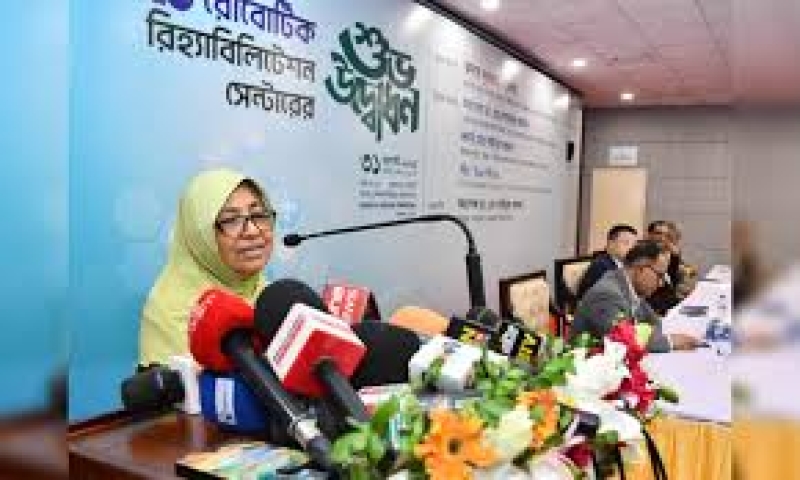
Bangladesh has launched its first-ever robotic rehabilitation centre at Bangladesh Medical University in Dhaka, introducing advanced treatment options for patients suffering from paralysis, neurological disorders, and complex physical impairments.
The centre, formally inaugurated on Sunday by Health and Family Welfare Adviser Nurjahan Begum, is expected to transform rehabilitation care in the country. For now, therapy is being provided to patients injured during the mass uprising in July, while broader public access will begin once the Directorate General of Drug Administration grants official approval.
Adviser Nurjahan, addressing the opening ceremony, said the centre is a milestone for Bangladesh’s healthcare sector. She noted that China had initially pledged 10–12 robots for rehabilitation but eventually donated 62, along with training for 27 doctors and physiotherapists. “This robotic centre will benefit patients across the nation,” she said, urging the establishment of similar facilities outside Dhaka.
She highlighted the urgent need for such treatment facilities, citing Bangladesh’s high rates of accidents that often leave young people with spinal cord injuries, brain damage, and other long-term disabilities. “Accidents happen almost daily. Many lose their lives, while others suffer irreversible injuries. This centre gives us an opportunity to help those who are fighting to recover,” she added.
The newly set up facility is equipped with Tk 200 million worth of robotic devices provided by the Chinese government, including 62 rehabilitation robots, 22 of which feature artificial intelligence technology. These machines are capable of delivering physiotherapy, neurological rehabilitation, and customised long-term care tailored to each patient’s needs.
Dr MA Shakur, professor of Physical Medicine at the university and focal person of the project, said the centre is ready to open to the public as soon as approval is granted. “We have already prepared a Standard Operating Procedure (SOP) to determine service costs and will ensure fees remain affordable for ordinary citizens,” he explained.
He also pointed out that the machines need to be kept operational to avoid damage from prolonged inactivity, which is why treatment has already begun for selected patients.
To prepare for the launch, a team of seven biomedical engineers from China trained Bangladeshi doctors and physiotherapists in operating the machines and providing advanced robotic therapy. Officials say this training will ensure that the technology is properly integrated into patient care.
The inauguration ceremony was also attended by Special Assistant to the Chief Adviser Dr Sayedur Rahman, Senior Secretary of the Health and Family Welfare Division Md Saidur Rahman, Vice Chancellor of Bangladesh Medical University Dr Shahinul Alam, and Chinese Ambassador to Bangladesh Yao Wen.
Health experts believe the centre marks a breakthrough in Bangladesh’s medical landscape, offering new hope to thousands of patients living with paralysis, nerve injuries, frozen shoulder, chronic pain, and other physical limitations.