

- BB launches Tk 1,000cr green fund for rural, local industries |
- Sirajganj farmers gear up for Eid with over 617,000 cattle |
- Trump rejects Iran proposal as fragile ceasefire faces uncertainty |
- BGB seizes smuggled Indian goods in Cumilla border raids |
- Central Bank to give targeted support to closed industries |
Dewan Bari Mosque: A Hidden Heritage in Dhaka’s Aminbazar
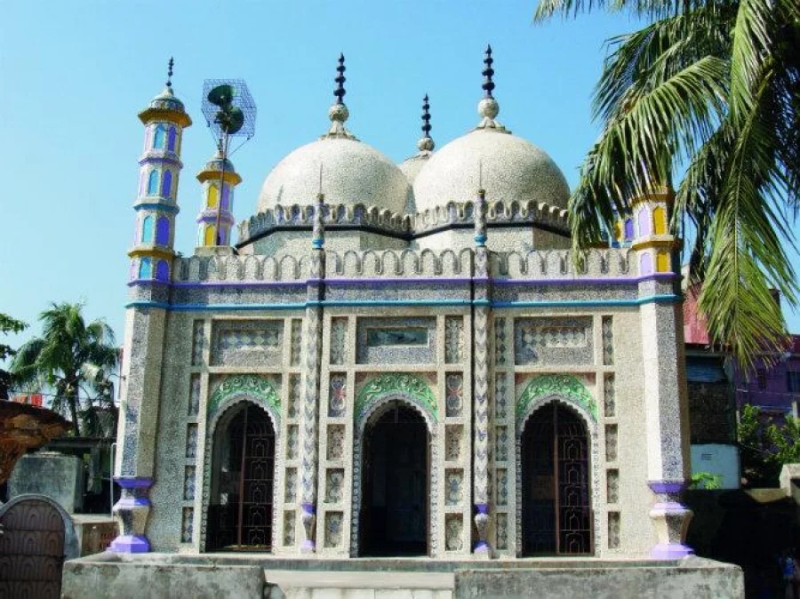
Dewan Bari Mosque: Photo Wikipedia
Tucked away in the bustling locality of Aminbazar, Dhaka the Dewan Bari Mosque stands as a silent witness to centuries of history.
With its traditional Mughal-inspired arches and unique use of materials, the mosque reflects both the spiritual and architectural heritage of the area. For generations, it has been more than just a place of prayer—it is a hub of community, culture, and living history for the people around it.
Located in Dewan Bari village near Aminbazar, just off the Dhaka-Aricha highway, the mosque is locally known as the Chini-Tikri Mosque for its decorative mosaic tiles.
According to the UNESCO-published volume "Mosque Architecture of Bangladesh", the mosque was originally constructed in 1880 by a wealthy leather trader named Alhaj Janab Ali.
Listed among the city’s heritage buildings by the Capital Development Authority (RAJUK), the site is officially recognized as the ‘Dewanbari Complex and Mosque'.
Declared a heritage site by gazette notification on February 2, 2009, Dewanbari complex features a palatial residence, a three-domed Dewanbari mosque and a graveyard.
Once there was a large pond next to the mosque, which had 4 ghats built on the banks. But the descendants of the family have filled the pond for their own needs.
It is a pity that this beautiful old landlord's house and the mosque decorated with white stone, have not been discussed much in our history pages.
During the British colonial era, Bengal witnessed the flourishing of a unique architectural trend known as the Chini-Tikri method—an intricate style of decoration using colourful ceramic shards, glass pieces, and porcelain tiles. This mosaic-like embellishment gave mosques and other religious structures a distinctive visual appeal, blending local artistry with Mughal and colonial influences.
In Dhaka, especially in Old Dhaka, several mosques were adorned in this fashion, their facades shimmering with delicate patterns that caught the sunlight. Beyond the capital, Saidpur became another hub of Chini-Tikri mosques, preserving this ornamental tradition in northern Bengal. Among the most notable examples stands the Dewan Bari Mosque in Aminbazar, whose walls and arches bear the same decorative legacy, making it not only a place of worship but also a living testimony to Bengal’s architectural craftsmanship under colonial rule.
According to Mosque Architecture in Bangladesh written by Dr Abu Sayed M Ahmed and published by the UNESCO in 2006, the mosque combines simple Mughal-inspired proportions with elaborate Chini-Tikri ornamentation. Its prayer hall, domes, and façades bear intricate mosaic patterns—
Japanese materials were used for the elaborate mosaics in these mosques. Although the style does not directly belong to the Mughal or Sultanate traditions, the structures clearly bear Mughal architectural influence. Interestingly, similar stylistic features can also be seen in several mosques built during the 17th century in Delhi, Agra, and Lahore.
According to Dhaka Kendra, while the Dewanbari mosque still retains much of its original shine, the two residential buildings now stand in a dilapidated state, serving as witnesses to the passing of time.
Over time, the name Dewanbari has extended beyond the residence itself, becoming the name of the entire area. The term “Dewan” historically referred to the chief revenue officer appointed by zamindars (landlords) during the Mughal and British periods. James Taylor’s book "Company Amoler Dhaka" (translated by Mohammad Asaduzzaman) notes that each major landlord employed a dewan, who often maintained a dawakhana or kacharighar (revenue office).
When the zamidari system was in operation, a person was appointed by the landlord to collect the rent. He was called a dewan. And the house built for the residence of the dewans was called a dewanbari. This is such a dewanbari. And the dewans had an office room called a dewakhana. In front of this dewanbari, there is also a room or house that the locals call a daptarkhana.
When the zamidari system was abolished, this dewanbari was purchased by a person named Alhaj Janab Ali who lived in Kolkata. He was a rawhide trader. He had about 40-42 warehouses in both Bengals, one of which was in this area. It is believed that he purchased this dewanbari at that time. Since he performed the first Hajj in this area at that time, the house was named Hajibari.
Currently, the descendants of that Ali Haji live in the house. Although the house has been renovated, the daptarkhana is quite abandoned. Janab Ali built a mosque next to the house around 1880, which is known as the Dewanbari Mosque.
Elderly residents like Abdul Hamid (71) recall that four generations before the present occupants, leather trader named Janab Ali settled here after migrating from India. His grandson, Quader Bepari, renovated the main south-facing building during the Pakistan period, expanding it from a single-storey to a two-storey structure.
The mosque has three domes. There is a veranda on the east side of the main prayer room. There are three doors on the east side to enter the mosque. There are one window each on the north and south sides.
The three-domed Dewan Bari Mosque, measuring 35 feet in length, 33 feet in width, and 40 feet in height, stands as a striking example of late 19th-century architecture. Its walls and arches are adorned with intricate sugarcane-inspired carvings, a decorative style that sets it apart from many other rural mosques of its time. The main prayer hall can accommodate 30 to 40 worshippers, while additional space in the extended courtyard serves overflow congregations during larger gatherings.
In more recent years, the mosque suffered theft of several historic items, including imported lamps, prompting caretakers to restrict access to only the main prayer area during prayer times.
While talking with this writer, Mahbubur Rahman Tipu, a descendant of the original builders, recalls the mosque’s golden days:
“Once upon a time there were four ghats on the banks of the pond. We have been here for four generations. There was a beautiful arrangement for sitting on the banks of the pond. The mosque was also beautiful. At one time, foreigners used to come here to see this mosque. I am one of the descendants of this mosque. My grandfather, the great-grandfather, actually built this mosque. We are the last descendants of this lineage.”
His grandfather, Rahman Haji, was among the earliest custodians of the mosque. Locals used to call him “Raje Dewan”, for he lived with the dignity and generosity of a zamindar, even though he never received formal landownership. From this heritage came the Mia lineage, which has continued to care for the mosque over the centuries.
Tipu adds: “The mosque was built about 200–250 years ago. A river used to flow past this mosque. There was a pond with four ghats here. People used to bathe here and then offer prayers. It was convenient for everyone. When travelers came, they would bathe here and then offer prayers.”
The craftsmanship of the mosque is striking. The Chinir-tikri decoration, a rare ornamental style often seen in colonial-era structures, still adorns its walls. According to oral memory, this design was inspired by patterns brought from Kolkata. The structure has survived largely unchanged, thanks to the continued efforts of the family and the local community.
“My grandfather and subsequent descendants have maintained this mosque. We are now five generations here. Currently, I, my cousin Bashir Ahmed, and the people of the village are taking care of it together."
There were no other buildings in this area during the British period. The mosque on the west side of the courtyard in front of the house was made for the public. Everyone in the village used to come to bathe in the pond on the south side. The small cemetery on the north side of the mosque is the family cemetery. Earlier, the office was used by the public. Now it is shared by Mr. Ali's descendants.
The defacing of the compound started when a major portion of the pond was filled up and a road was constructed from the central ghat of the pond, adjacent to the mosque. The ghat was used for the purpose of ablution. A new ablution place was later constructed.
The 18th-century i Mosque stands as more than just a house of prayer. It is a monument where history, heritage, and cinema intersect. From an archaeological standpoint, the mosque carries immense significance. Because of the exquisite beauty of the compound, it was once considered an attractive shooting location. Quite a few movies including Matir Moyna, Ei Desh Tomar Amar and Ke Tumi were shot in this beautiful complex.
Once a quiet local landmark, the mosque gained renewed prominence after being featured in the late filmmaker Tarek Masud's masterpiece film Matir Moyna (The Clay Bird), attracting widespread cultural attention."
The mosque gained global recognition when Tarek Masud chose it as one of the main shooting locations for Matir Moyna, the 2002 film that went on to win the International Critics’ Prize at Cannes. “The film gave this mosque a place in cinema history,” says local resident Mahbubur Rahman Tipu. “But the building today looks nothing like what you saw in the movie.”
(Adnan Hadi is a senior journalist mainly writing on archeological sites and sports. He could be reached at: adnangreenblack1987@gmail.com)