

- Five-Day Holiday Rush: Crowds Swamp Dhaka Bus Terminals |
- Dhaka Ranks Seventh Among 126 Cities on Tuesday |
- BD Consulate in Toronto tops global ranking for Diplomatic Service |
- Execution of 2 Bangladeshis in KSA “very disappointing”: State Minister Kobir |
- PM Urges Dhaka Officials to Keep City Clean for Children |
Hunger Remains an Avoidable Tragedy in a World of Plenty
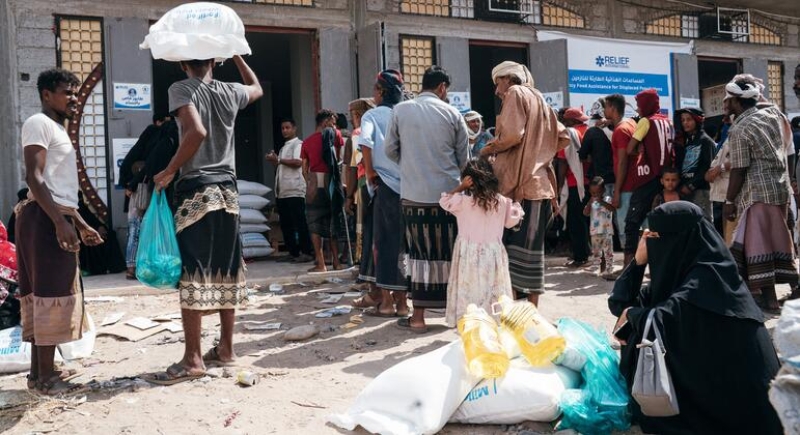
Emergency food supplies are distribution in Lahj, one of the biggest displacements hotspots due to the escalation of the conflict in Yemen.
More than a quarter of the world's population struggles to get enough food, despite global food production being sufficient to feed everyone, UN human rights chief Volker Türk said on Monday, describing hunger as an avoidable tragedy driven by injustice and the denial of human rights.
Addressing the UN-hosted Committee on World Food Security in Rome, the High Commissioner said the right to food was recognised in international treaties and national laws, but millions of people still struggled to access adequate meals.
“ For too many people, it has yet to find its way onto their dinner plates,” Türk said.
Global food supplies now exceed 3,000 calories per person per day, a historic high. However, progress in reducing hunger has failed to keep pace with the abundance of food.
“Too much of that abundance is swallowed up by injustice and the denial of human rights,” he said.
Waste, inequality and war
Households worldwide throw away more than one billion meals every day, Türk said.
At the same time, just one per cent of the world's farms operate more than 70 per cent of global farmland. Women farmers and Indigenous Peoples often lack adequate government support and access to land, further deepening inequalities in food production.
Conflict is another major driver of hunger, contributing to acute food insecurity in 12 of the 13 current hunger hotspots, according to Türk. Restrictions on humanitarian assistance and attacks on aid workers are cutting off vital lifelines for vulnerable communities.
He called for an economy grounded in human rights, with stronger social protection, fair taxation and agricultural policies aimed at reducing poverty. He also urged governments to ensure equitable access to land, water and seeds while taking meaningful action on climate change.
“We must do our utmost to ensure the rules of war are upheld and hunger is never used as a method of warfare,” he said.
Famine and starvation as weapons of war
UN Special Rapporteur on the right to food Sofía Monsalve Suárez, addressing the committee for the first time in her role, warned that the rapid rise in famine and the use of starvation as a weapon of war were among her greatest concerns.
Although chronic hunger declined in 2025, acute hunger has been rising steadily since 2016, she said.
Around 1.4 million people in six countries now face catastrophic levels of hunger, nine times the number recorded in 2016. Meanwhile, 266 million people face acute hunger, including populations in Sudan, South Sudan, the Democratic Republic of the Congo, Yemen and Gaza.
“The return of famine and the deliberate use of starvation as a weapon of war is an unprecedented moral challenge for our generation. These crimes continue with impunity,” Suárez said.
She called for stronger accountability and prevention mechanisms, alongside better coordination among the UN Security Council, the Committee on World Food Security, human rights bodies and food security monitoring systems.
Improved coordination and early-warning mechanisms, she said, are essential to identifying emerging crises and preventing further deterioration in food security.