

- Trump’s Economic Approval Hits New Low as Prices Stay High |
- Exports up over 6% to $13.1bn in Q1 of current fiscal |
- Declaration on Sea Level Rise Draws Mixed Global Response |
- PM inaugurates Tk 1,542 cr Muhuri-Kohua flood control project in Feni |
- Who gets to shape AI? UN debate centres on power, trust and inclusion |
Powerful Quake Hits Philippines on School Opening Day
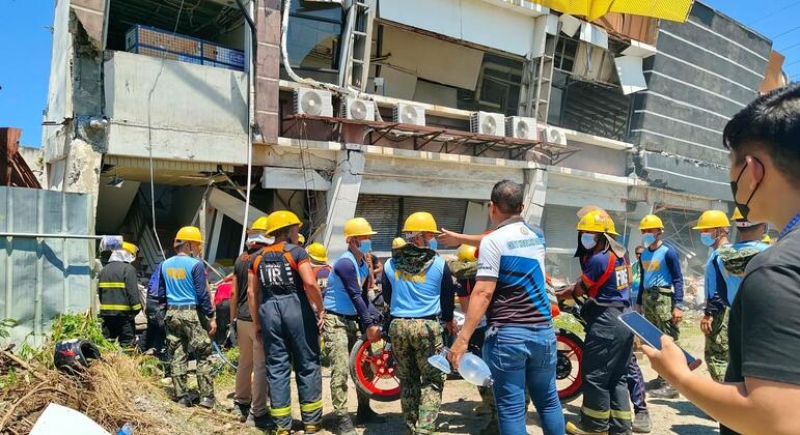
At least 19 people were killed after a 7.8 magnitude earthquake struck Sarangani province in the southern Philippines in the early hours of 8 June 2026.
A powerful earthquake struck the southern Philippine island of Mindanao on Monday morning, just as millions of children were returning to school after the summer break.
At least 19 people were killed, while hospitals, homes and classrooms sustained extensive damage.
The 7.8-magnitude quake struck at 7:37am local time (7:37pm Sunday in New York), about 32 kilometres (20 miles) offshore west of Maasim in Sarangani province, according to the UN Office for the Coordination of Humanitarian Affairs (OCHA).
Mindanao, the Philippines’ second-largest and second-most populous island, is home to roughly 26 million people. The quake triggered tsunami alerts across parts of the Philippines and neighbouring countries, prompting coastal evacuations before warnings were later lifted.
Initial government reports cited by OCHA indicate that 19 people were killed, 12 remain missing, and at least 134 were injured. Authorities cautioned that the figures remain provisional as assessments continue.
Over 100 Aftershocks
Many of the fatalities were reported in Sarangani province, including deaths caused by landslides, although figures have not yet been fully verified.
More than 138 aftershocks, ranging in magnitude from 1.3 to 6.7, were recorded following the quake. Operations at General Santos International Airport were temporarily suspended before later resuming on a limited basis.
Initial reports indicate widespread damage to schools, hospitals, government buildings and other structures. Power outages and telecommunications blackouts were reported in several affected areas, while damaged roads and bridges have hindered access to some communities.
Millions of Students Affected
The earthquake struck on the first day of the new school year for millions of students across Mindanao.
More than 3.2 million learners have been affected, with classes suspended in over 6,200 public and private schools pending safety inspections and structural assessments.
The UN Children’s Fund (UNICEF) expressed concern about the impact on children. Early reports indicate injuries among some students and damage to school buildings and public facilities.
“The safety of learners and teachers must remain the top priority,” UNICEF said, adding that emergency supplies and cash assistance are ready for rapid deployment.
Humanitarian partners warned that the psychological impact on children could be significant due to the main quake and ongoing aftershocks.
Emergency Response
The Philippine government placed national disaster management teams on “red alert” and activated inter-agency humanitarian coordination mechanisms.
President Ferdinand Marcos Jr. ordered government agencies to respond immediately, while search, rescue and retrieval operations continued throughout the day.
Disaster management, health, education and public works teams have been deployed to affected areas. Social workers, mobile command centres and field kitchens have also been mobilised to support displaced families.
UN and Partners Mobilise
The UN in the Philippines issued a statement of solidarity, commending the swift response of national and local authorities and reaffirming its readiness to support government-led relief efforts.
The UN World Food Programme (WFP) is deploying staff and emergency equipment to help establish temporary storage facilities for relief supplies. The Philippine Red Cross and other partners have also begun mobilising response teams.
Humanitarian organisations are conducting rapid assessments to identify urgent needs, while an ad hoc Humanitarian Country Team meeting is scheduled for Tuesday as authorities assess the full scale of one of the strongest earthquakes to hit Mindanao in recent years.