

- PM Proposes Five Urgent Steps to Resolve Rohingya Crisis |
- Govt Appoints Indonesian Firm to Operate Cox’s Bazar SPM |
- ADB lowers Bangladesh’s growth forecast to 4 % in FY2027 |
- El Niño Tests Global Readiness for a Changing Climate |
- Dhaka's air quality recorded moderate on Wednesday morning |
As rivers swallow villages, wooden house keeps hope alive
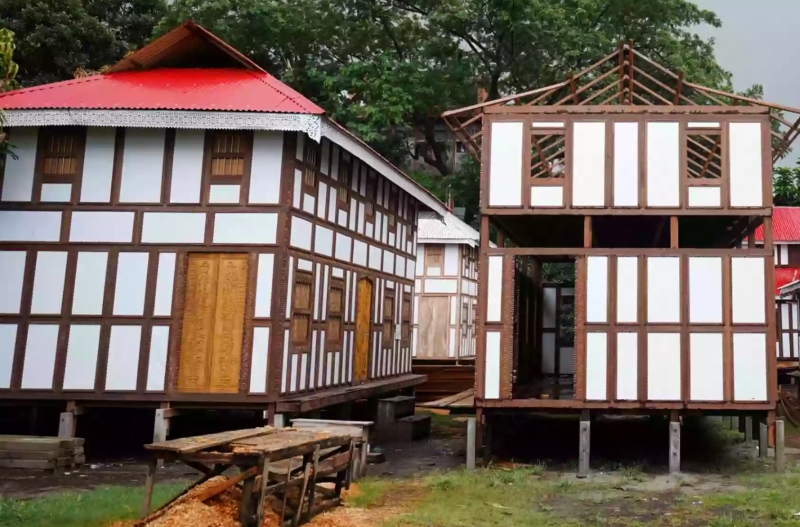
Wooden houses of Munshiganj can be dismantles, shifted and reassebbled to build home anew in the face of riberbank erosion. Photo- Samsul Hady-UNB
For 30-year-old fisherman Mohammad Sumon Midya, the hardest battle is not making a living from the river. It is holding on to a place to call home.
The river has already claimed two of the islands where he once lived.
It swallowed his childhood homestead, the trees that shaded it and the memories tied to the land.
Yet one thing has survived every collapse of the riverbank: a modest wooden house that has travelled with his family from one disappearing island to another.
Born on Jauttia Char in Munshiganj, Sumon spent the first 15 years of his life there before relentless erosion forced his family to leave.
Rather than abandoning their home, they dismantled the wooden structure, loaded it onto a boat and rebuilt it on nearby Majhirkanda Char, where they started over.
There, Sumon married, raised a family and lived alongside his parents, relatives and neighbours, who had also rebuilt their lives after displacement.
But the river returned.
As erosion reached Majhirkanda Char, the family once again took apart the same house before the land disappeared beneath the water.
About a year ago, they moved to Singarati in Lauhajang upazila, where three related families now live side by side on rented land.
One house shelters Sumon’s parents, another his aunt’s family, while Sumon lives in the third with his wife, Hena, and their child.
For families living along Bangladesh’s erosion-prone rivers, displacement is a recurring reality.
Every year, thousands lose homes, farmland and livelihoods as powerful rivers reshape the landscape.
Sumon earns around Tk 10,000 to Tk 12,000 a month from fishing — far from enough to buy land or build a permanent home.
The portable wooden house has therefore become more than shelter; it is the family’s most valuable possession and their only dependable form of security.
“When the river starts eating the land, there is no time to wait,” Sumon says. “We dismantle the house, take whatever we can and leave. The first few days in a new place are always difficult. Sometimes we stay under the open sky before rebuilding the house again.”
In and around Ghoradour Bazaar in Lauhajang upazila, craftsmen have spent decades building these transportable wooden houses.
A house can be completed within four or five days and, if necessary, dismantled, transported by boat and reassembled in a single day — making them a practical solution for communities that know another move may only be a matter of time.
For most people, a house represents permanence.
For families living with river erosion, it offers resilience.
Unable to stop the river, Sumon’s wooden home has instead learned to move with it — carrying a family’s sense of belonging from one address to the next, proving that even after the land is lost, home does not have to disappear. - UNB