

- Dhaka's air 5th worst in the world this morning |
- Around 7,500 Bangladeshis imprisoned in Saudi Arabia: Shama Obaed |
- Bangladesh Outperforms India in Global Hunger Index 2026 |
- Covered van hits Gazipur police patrol team, killing SI, BNP leader |
- Korean City scrambles to rescue dusky shark after it returns to canal |
WFP Urges Greater Investment as Melissa Recovery Lags
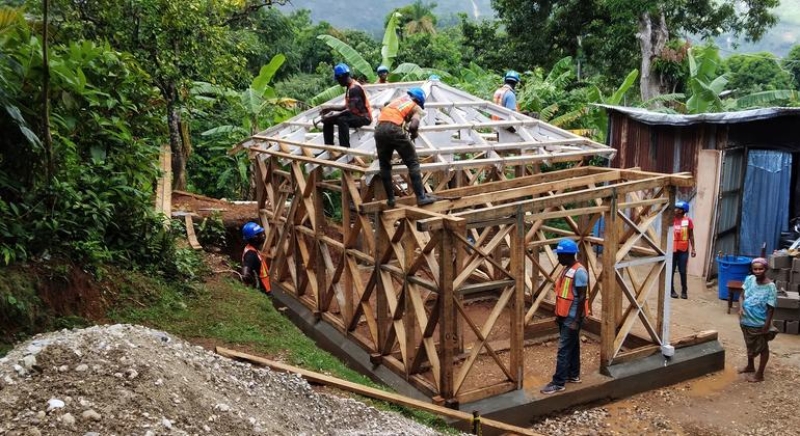
A house in southern Haiti is rebuilt to withstand strong winds and heavy rain.
More than a month after Hurricane Melissa slammed the Caribbean, devastated communities still urgently require assistance, the regional director for the World Food Programme (WFP) told journalists at UN Headquarters on Thursday.
“We cannot forget Haiti,” said Lola Castro, speaking from Port-au-Prince. She also appealed for support for Jamaica, Cuba and the Dominican Republic.
More than 80 people were killed and roughly six million were affected by the Category 5 hurricane — one of the most intense storms on record in the Atlantic.
Castro stressed that Haiti, already facing gang violence and severe food insecurity, remains in a particularly fragile state. Roughly 5.7 million people — more than half of the population — are going hungry, and 1.4 million are displaced nationwide.
Fleeing through rivers of mud
Hurricane Melissa dumped heavy rains on southern Haiti, impacting 1.2 million people.
Castro had just visited the town of Petit-Goâve, where a river burst its banks and “people had to escape from their houses in the middle of the night through rivers of mud.” Twenty-five residents died.
She described meeting “women and men in total distress” trying to rebuild their lives after losing loved ones, homes, livelihoods, crops and livestock.
WFP, alongside other UN agencies, NGOs and the government, has been on the ground “from day one,” first providing food and later cash transfers, allowing families to purchase what they need most. Women told her they planned to use the cash for food, soap and other essentials.
Local youth groups also appealed for continued support, saying, “Please don’t forget us… We need continued assistance.”
Recovery and rehabilitation
The hurricane caused catastrophic damage in western Jamaica and eastern Cuba, and WFP has reached more than 725,000 people across the four affected countries.
“We are now trying to work on recovery and rehabilitation,” Castro said, highlighting school feeding programmes and support for government efforts to expand social protection systems for affected families.
“But what is very clear in Haiti and in the whole region is that we need to invest much more in anticipatory action.”
Advance preparation critical
WFP took several preparedness measures before Melissa made landfall, including sending early warning messages to 3.5 million Haitians and distributing advance cash transfers to more than 50,000 people. In Cuba, teams pre-positioned food by moving supplies from the east to the west of the island.
“But we need to do much more of that,” Castro said. “We must ensure our simulations and preparedness mechanisms are ready.”
Building community resilience
She highlighted tools such as microinsurance payments, which help smallholder farmers — whose crops supply WFP’s homegrown school meals programme — continue producing after disasters.
“These new tools must be scaled up across the Caribbean,” she said. “Hurricanes and earthquakes hit every year. We must strengthen resilience so food insecurity does not become a permanent trend.”
WFP is seeking $83 million to reach 1.3 million people across the Caribbean affected by Hurricane Melissa, but only about half of the required funding has been secured.