

- Around 7,500 Bangladeshis imprisoned in Saudi Arabia: Shama Obaed |
- Bangladesh Outperforms India in Global Hunger Index 2026 |
- Covered van hits Gazipur police patrol team, killing SI, BNP leader |
- Korean City scrambles to rescue dusky shark after it returns to canal |
- PM inspects Mongla Port, Sundarbans, proposed economic zone |
Japan commits $3.2m for Rohingyas, host communities in Bangladesh
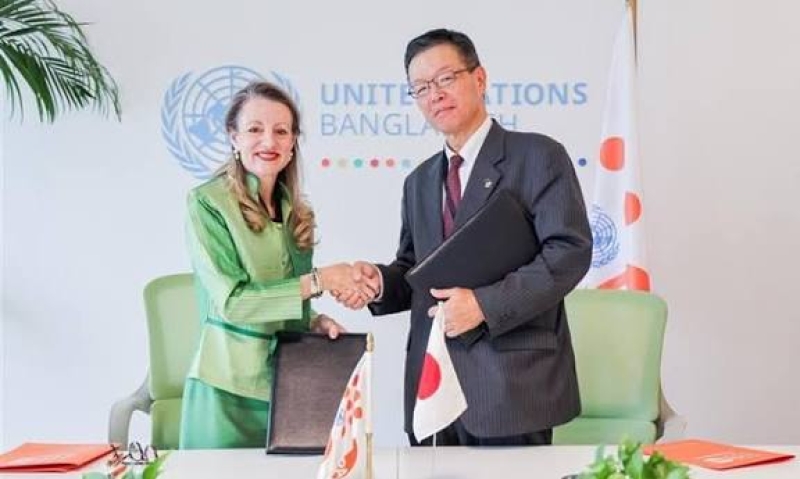
The Government of Japan has reaffirmed its strong commitment to the Rohingya humanitarian response by approving JPY 500 million (approximately $3.2 million) in funding to the United Nations Population Fund (UNFPA).
The new two-year project will aim at protecting the health and rights of women and adolescents affected by displacement in Cox’s Bazar and Bhasan Char. The funding will enable UNFPA to sustain essential life-saving sexual and reproductive health and rights and gender-based violence services for Rohingyas and surrounding host communities.
The Rohingya crisis remains one of the world’s protracted humanitarian crises, with Cox’s Bazar hosting over one million Rohingyas alongside vulnerable host communities.
Despite these growing needs, the funding environment became increasingly constrained, leaving the 2025-2026 Joint Response Plan for the Rohingya Humanitarian Crisis significantly underfunded, said a press release.
This shortfall has already forced the closure of six government-run health facilities that supported Rohingyas, a 16% reduction in the midwifery workforce and over 50% reduction in the number of GBV case managers. Japan’s timely contribution will provide a vital lifeline, allowing UNFPA to maintain around the clock emergency obstetric care, GBV case management, and mental health support for approximately 180,000 direct beneficiaries.
“The Government of Japan’s continued partnership comes at a critical moment for women and girls in the Rohingya response,” said Catherine Breen Kamkong, UNFPA Representative in Bangladesh. “This funding will allow UNFPA to sustain life-saving services that protect the health and dignity of women and adolescents who would otherwise face devastating gaps in care. We are deeply grateful for Japan’s principled and consistent support.”
The new phase builds on tangible results from previous Japan-funded initiatives. More than 38,000 women and girls have accessed essential services at UNFPA-supported facilities across Cox’s Bazar and Bhasan Char, helping to sustain critical care. The partnership also successfully expanded survivor-centred GBV services through Women Friendly Spaces and Women-Led Community Centres, reaching thousands of vulnerable women and girls.
In Bhasan Char, Japan’s support contributed to the operationalization of the 20-bed hospital, significantly reducing life-threatening referrals and helping maintain exceptionally low maternal mortality rates in the years following its operationalization.
Adolescent empowerment initiatives strengthened life skills and gender equality awareness among girls and boys, supporting longer-term prevention of gender-based violence.
Since 2017, the Government of Japan has contributed over $250 million to the Rohingya humanitarian response to UN agencies and NGOs in Bangladesh, including through UNFPA, making it one of the most consistent and reliable partners in addressing the needs of displaced populations and host communities in Bangladesh.
Saida Shinichi, Ambassador of Japan to Bangladesh expressed his hope that the support from the Government of Japan would improve the living conditions of both Rohingyas and host communities.
“Japan remains firmly committed to protecting the most vulnerable, particularly women and adolescents affected by displacement. Through our partnership with UNFPA, we aim to ensure continued access to essential health and protection services, even in the face of growing humanitarian and funding challenges,” said Ambassador Saida Shinichi.
UNFPA and the Government of Japan partnership will aim at continuing to inspire international solidarity and sustained investment in the protection, health, and dignity of women and girls affected by the Rohingya crisis, reports BSS.