

- Bangladesh to Introduce New Law to Curb Extortion, IGP Says |
- UN Marks 81 Years of Global Cooperation and Peace |
- Dhaka's air 5th worst in the world this morning |
- Around 7,500 Bangladeshis imprisoned in Saudi Arabia: Shama Obaed |
- Bangladesh Outperforms India in Global Hunger Index 2026 |
7.5 Million in Pakistan Face Acute Hunger Crisis: Report
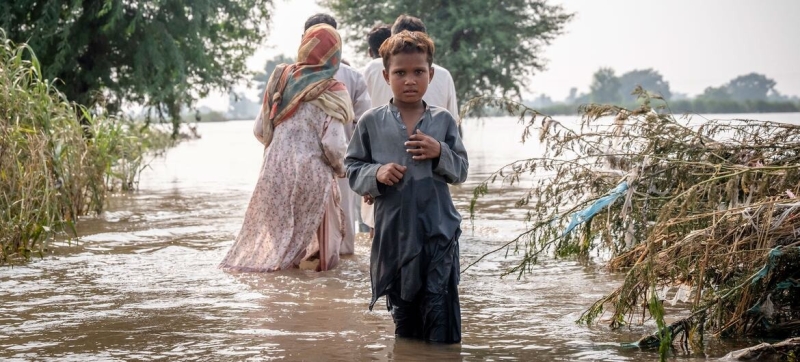
A young boy stands in floodwaters in Punjab, Pakistan. (file)
After a year marked by heavy monsoon floods, prolonged drought and dry spells, and a surge in violence, 7.5 million people in Pakistan face high levels of food insecurity and malnutrition, according to a report from the global hunger monitor.
At the most severe level, in the period from last December to March 2026, around 1.25 million people will be in “emergency” levels of acute food insecurity, characterised by large food gaps and high levels of acute malnutrition, the Integrated Food Security Phase Classification (IPC) report revealed.
Immediate lifesaving assistance is needed to prevent a “catastrophe” for more than one million people in emergency levels of food insecurity.
Drivers of the crisis
Residual impacts of the 2025 monsoon floods, drought, and localised insecurity have weakened agricultural and pastoral livelihoods, reduced production, disrupted markets, and strained coping capacity.
Seasonal factors have also worsened the crisis. The lean season (December to February) reduces farm labour and income opportunities, and in some areas harsh winter conditions have further constrained access and livelihoods.
Food access has been particularly limited in some areas by weak purchasing power, market dependence, price volatility, and indebtedness. Wheat flour has also been flagged as especially concerning during the lean season.
Regional differences
Variations in conditions have created larger concentrations of hunger in certain regions.
In the IPC analysis, which covers 45 vulnerable regions in Pakistan and about 15 per cent of the total population, the Balochistan province had the highest proportional burden, with 25 per cent of the analysed population experiencing at least high levels of food insecurity.
In the Sindh region, more than 3 million people are facing high levels of food insecurity. Meanwhile, in the Musakhel, Zhob, Kachi, Tank and Torghar districts, 30 per cent of people are experiencing at least high levels of food insecurity.
Potential for improvement
For the upcoming period from April to September, the report projects that 6.7 million people will face high levels of food insecurity or worse — a decrease of 855,000 from the current period.
Although some drivers are expected to persist — such as high staple prices, climatic risks, insecurity, and cross-border trade disruptions — seasonal factors like winter crop harvesting and Eid-related livestock sales may temporarily ease pressure.
While the number recorded has decreased from last year, the report warns that the comparison is misleading because geographic coverage has dropped from 68 districts to 45. It maintains that the prevalence of severe malnutrition remains similar.
Recommendations
To reduce food consumption gaps and protect lives, the report calls for scaling up access to sufficient and nutritious food through appropriate delivery methods, including cash and voucher assistance alongside targeted in-kind food distributions.