

- Saudi Remittance Rises 38% as UAE, Malaysia Inflows Fall |
- Dhaka Ranks World’s Most Polluted City Today |
- November 7 Declared a Public Holiday Every Year |
- LPG Shortage, Overcharging Hit Consumers Across Dhaka |
- Energy, investment, Rohingya issue to top Bangladesh-Indonesia talks |
Global demining efforts hit by war and falling aid
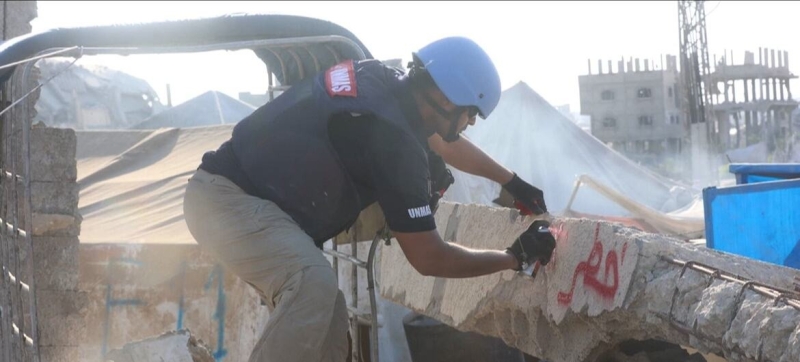
UNMAS team member is identifying explosive remnants of war located between destroyed buildings and near displaced persons’ tents in the Gaza Strip.
Demining experts from around the world have expressed growing concern over the widespread and increasing threat of unexploded ordnance, the new head of the UN Mine Action Service (UNMAS) said this week.
“They’re telling me, ‘Never in my career have I ever seen so many conflicts,’” said Kazumi Ogawa at the conclusion of a Mine Action National Directors and UN advisers meeting in Geneva.
Despite the clear need to continue demining work in both conflict zones and post-conflict regions, funding for humanitarian assistance has declined for various reasons, Ogawa noted.
Gaza “timebomb” situation
In Gaza, about 90 percent of people injured by explosive hazards from the Hamas-Israel conflict are civilians, and most of them are children, she said.
UNMAS has warned that between 5 and 10 percent of munitions fired in Gaza have failed to detonate, leaving dangerous unexploded ordnance scattered across the devastated territory.
“These hazards can be collected and cordoned off, but they cannot be destroyed immediately. So they remain in piles that children have to navigate,” Ogawa said.
She added that civilians, including children playing in the rubble or families returning to damaged homes, often come across these hidden dangers without knowing how to respond.
Funding shortages and rising casualties
Ogawa said demining and risk education are underfunded despite rising global conflicts. She linked the problem to shrinking humanitarian budgets as more national spending shifts toward defence.
“In Afghanistan, for example, one child is killed every day,” she said.
The situation in Syria is even more severe. “Where normally you might see around 300 deaths a year from explosive hazards, Syria sees about 200 deaths a week,” she said.
She warned that donor support is urgently needed for clearance operations, risk education, victim assistance, and broader humanitarian coordination.
Long-term impact and recovery
Beyond the immediate human toll, unexploded ordnance also slows economic recovery and creates long-term social burdens for families and communities.
“If a child is maimed, the family has to care for them into adulthood, and the community must adapt. It’s not just one life lost,” Ogawa said.
She also highlighted positive initiatives supported by the UN, including in Colombia, where former combatants are involved in demining and community recovery efforts under transitional justice programmes.
Treaty under pressure
The 1997 Anti-Personnel Landmines Convention has significantly reduced the use of landmines worldwide. However, several European countries have recently moved to withdraw from the treaty.
Ogawa stressed that the goal of such conventions is not only compliance but ensuring safety on the ground.
“These agreements exist so people can live in safety and security,” she said.