

- A New Arms Race is Threatening to Take-off—Now in Outer Space |
- Equality ‘ends at doors of Security Council’, Kenya’s Ruto at UNGA |
- কলাপাড়ায় প্রাথমিক শিক্ষায় হ-য-ব-র-ল |
- BDRCS and IFRC scale up dengue response to reach 300,000 people |
- World leaders approve new declaration to tackle rising sea levels |
Houthis Strike Saudi Airport After Sanaa Air Raid
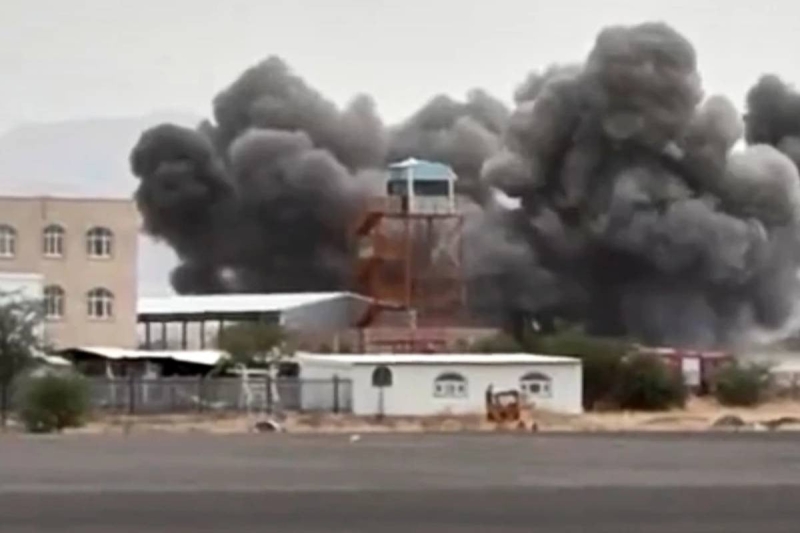
An explosion at the Sanaa International Airport broadcast on a Houthi news channel
Yemen's Iran-backed Houthi rebels said they launched missiles and drones at Saudi Arabia's Abha International Airport on Monday, hours after accusing Saudi-led forces of carrying out airstrikes on Sanaa International Airport, sharply escalating regional tensions.
No casualties were immediately reported from either incident.
Houthi military spokesperson Brig. Gen. Yahya Saree said the attack on Abha airport was carried out in retaliation for the reported Saudi strike on Sanaa airport. He also warned commercial airlines against using Saudi airspace until what he described as the blockade of Sanaa International Airport is lifted.
Saudi authorities did not immediately comment on the Houthi claim. Later, Saudi-led coalition spokesperson Maj. Gen. Turki al-Malki said the kingdom's air defence systems intercepted ballistic missiles launched toward the country's southern region but provided no further details.
Earlier, Yemen's internationally recognised government said the strike on Sanaa airport was intended to prevent an Iranian aircraft from landing.
Defence Minister Gen. Taher al-Aqili said the runway was targeted to stop an Iranian plane carrying a Houthi delegation returning from Tehran after attending the funeral of Iran's late Supreme Leader Ayatollah Ali Khamenei.
The Houthis said the aircraft was diverted to Hodeida Airport instead.
The Yemeni government also announced the closure of all airports until further notice and ordered the evacuation of Sanaa airport and nearby areas.
The Presidential Leadership Council said it had rejected Iran's request to allow a Mahan Air flight from Tehran to Sanaa, accusing the Houthis of attempting to receive the aircraft outside established civil aviation procedures.
The latest exchange marked the most serious confrontation between the Houthis and Saudi Arabia since a UN-brokered truce came into effect in 2022.
The developments prompted an emergency meeting of the UN Security Council, where UN Assistant Secretary-General for Political Affairs Khaled Khiari warned against renewed violence.
"Yemen and the wider region cannot afford another cycle of escalation," he said, urging all parties to return to UN-mediated negotiations.
UN Special Envoy for Yemen Hans Grundberg also expressed concern over the latest developments and called for dialogue to preserve the relative calm that has largely held since the 2022 truce.
Yemen's civil war began in 2014 when the Houthis seized the capital, Sanaa, prompting a Saudi-led military intervention the following year in support of the internationally recognised government.