

- Greenhouse Gas Levels Reach Record High in 2025: WMO |
- Dengue deaths hit 400 as 11 more die in 24 hours |
- Bangladesh’s Dengue Death Toll Hits 400 After 11 More Deaths |
- Support to coastal security, early completion of MRT lines, Airport Terminal III, business promotion assured |
- Tarique Seeks Japanese Support for Energy, Tech and Infrastructure |
Rising violence triggers UNSC emergency meeting on Yemen
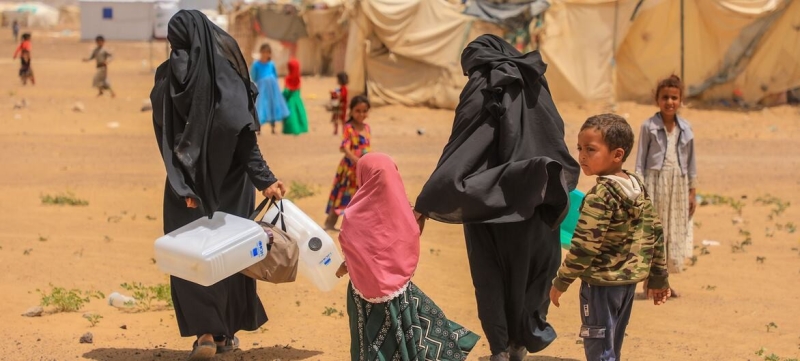
Women and children who have fled conflict in Yemen go in search of water in Taiz. © IOM
15 September 2026 - Amid rising violence in Yemen, the Security Council met in emergency session on Tuesday to discuss the situation surrounding the critical Bab el-Mandeb Strait shipping route as UN agencies warn of rising displacement, including thousands of Yemenis fleeing to Djibouti.
What you need to know:
• Ongoing recent clashes between Saudi-backed Yemeni Government forces and Iran-backed Houthi militia have triggered widespread displacement across Aden, Hudaydah, Abyan and Ta’iz, reflecting the widening crisis
• The Bab el-Mandeb Strait has seen a spike in military operations, with the Houthis seizing several islands last week
• 2,883 casualties since 6 August, the World Health Organization (WHO) reports
• 93,864 have been newly displaced, said the International Organization for Migration (IOM)
• Seven health facilities and assets damaged, out of service or directly hit in 10 days, according to WHO’s latest situation report
• Rapidly escalating hostilities along Yemen’s western coast have forced thousands more to seek safety across the Bab el-Mandeb Strait in Djibouti, said the UN refugee agency, UNHCR
• Continued insecurity could affect humanitarian and commercial shipping supplies
• Nearly half of Yemen’s 41 million people need aid as acute hunger continues to grow
• The facts: The Security Council met in its second emergency meeting on Yemen in less than a week, amid Houthi advances towards the Bab al-Mandab Strait and escalating fighting. Houthi forces reportedly captured several Red Sea islands, while Yemen’s Government launched a counteroffensive.
• The impact: At least 125,000 people have been displaced since the start of September. The escalation threatens a critical international maritime route and has spread beyond Yemen, with Houthi attacks reported in Saudi Arabia.
• The call to action: Council members called for de-escalation and renewed dialogue, while several urged enforcement of the arms embargo and an end to external support for the Houthis. Yemen called for implementation of relevant resolutions, while Saudi Arabia backed UN-led efforts towards a political settlement.
Houthi escalation threatens global trade, Red Sea security, KSA warns
Abdulaziz M. Alwasil (Saudi Arabia) warned that Houthi escalation threatens Yemen, regional security, international trade and global supply chains. He cited attacks on Abha, Khamis Mushait, Jazan and Najran that injured civilians, as well as renewed attacks on 14 September and continued targeting of commercial vessels in the Red Sea.
He said the Houthis and militias supporting them are pursuing a policy of “choking the straits”, holding the international community and global economy hostage. Protecting vital waterways is a collective responsibility requiring a firm Council response and implementation of resolutions 2216 (2015) and 2722 (2024).
Saudi Arabia remains committed to de-escalation and peace, he said, while reserving its right to defend its territory and citizens. He reaffirmed support for Yemen’s unity, sovereignty and a comprehensive political settlement.
China urges restraint, negotiations as Red Sea tensions escalate
Sun Lei (China), expressing concern over the rapid escalation, reaffirmed respect for the sovereignty and territorial integrity of Yemen and Saudi Arabia. Opposing attacks on energy and civilian infrastructure, he said protecting shipping in the Red Sea is a common international responsibility and the rights of merchant vessels must be respected.
Securing freedom of navigation requires ending armed conflict and achieving lasting peace, he said, urging all parties to exercise restraint and return to negotiations. Noting that Gulf countries are uniquely positioned to mediate, he called for a greater role for them and for a new security architecture for the Middle East.
United States urges Council to confront Iran’s support for Houthis
“Freedom of navigation underpins the global economy, and the United States is working with our partners to protect it,” said Jennifer Locetta (United States). She demanded that the Houthis halt their advances, withdraw from seized territory and cease their attacks. She also called on Iran to end its support for the group, urging the Council to remain “clear-eyed” about Tehran’s role in arming, funding and directing the Houthis.
Addressing such external support is essential to eliminating Houthi capabilities, she said, calling for effective implementation of resolutions 2140 (2014) and 2216 (2015). Describing Iran as the “principal violator” of both resolutions, she stressed that the Council “cannot look away from those facts”.
African members warn Red Sea disruption driving up costs across their continent
Lewis Garseedah Brown II (Liberia), speaking on behalf of the three African Security Council members — Democratic Republic of the Congo, Somalia and Liberia — voiced concern that further territorial changes along Yemen’s coast could increase tensions, threaten international navigation and undermine efforts towards a political settlement. He stressed there is no military solution and warned against Yemen becoming an arena for proxy warfare.
For Africa, Red Sea security is particularly important, he said, warning that disrupted shipping and rising freight and insurance costs translate into higher prices for imported grain, fuel and fertilizer across the continent. Merchant vessels and civilian seafarers must not be targeted.
He also called for the immediate release of detained UN and humanitarian personnel and urged confidence-building measures, including opening transit routes, paying public sector salaries and establishing a permanent nationwide ceasefire. – UN News