

- ADB Approves $100m Loan for Affordable Housing in Bangladesh |
- No Respite From Poisonous Air: Radical Cure Urgent |
- Minimising The Energy Shocks In Bangladesh |
- How Bad Loans, Capital Erosion Pressure Banks In BD |
Iran Turns North as Hormuz Disruption Hits Trade
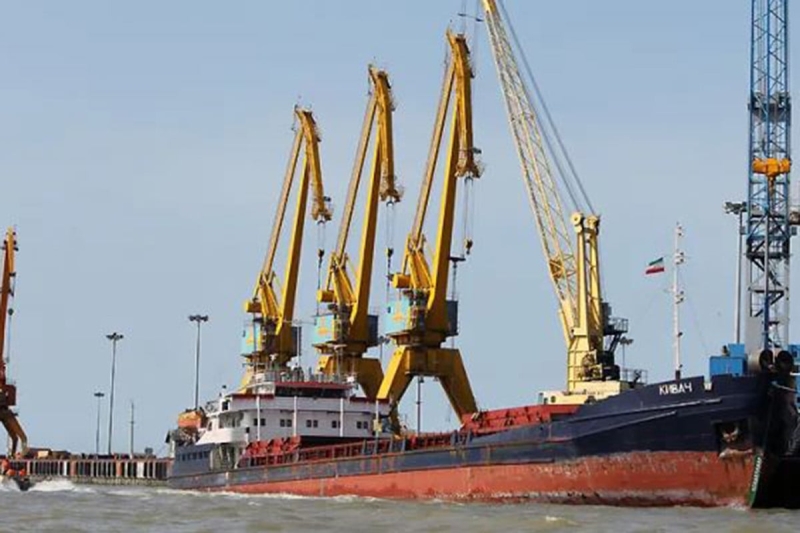
With Iran’s southern ports facing a US naval blockade and trade through the Strait of Hormuz severely disrupted, Tehran is turning to northern routes in an effort to keep essential imports moving and maintain access to foreign markets.
The Caspian Sea, along Iran’s northern coast, has emerged as an increasingly important alternative gateway. But while the route can help Iran move food and other essential goods, analysts say it cannot quickly replace the scale and capacity of the country’s southern maritime trade.
Recent diplomatic efforts to resolve the standoff between Tehran and Washington have also failed to produce a breakthrough. US President Donald Trump has rejected an Iranian proposal linked to reopening the Strait of Hormuz, adding to uncertainty over how long the disruption will continue.
Caspian Sea faces major challenges
The Caspian Sea is the world’s largest inland body of water and is bordered by Iran, Russia, Azerbaijan, Kazakhstan and Turkmenistan.
However, falling water levels are creating growing problems for maritime transport. The decline has reduced the size of vessels that can safely operate at some Iranian northern ports, limiting the amount of cargo that can be moved through the region.
Iranian shipping officials have warned that vessels operating in the Caspian and along the Volga route have faced difficulties because of reduced water depth. These constraints are particularly significant because northern ports generally handle much smaller vessels than Iran’s major southern ports.
The capacity gap is substantial. A large vessel operating through Iran’s southern ports can carry cargo equivalent to that of numerous smaller ships operating in the Caspian, making it difficult to replicate southern maritime trade volumes in the north.
Trade shifts from south to north
For decades, most of Iran’s maritime trade has passed through its southern ports on the Persian Gulf and Gulf of Oman. The disruption has forced Tehran to increase its reliance on the Caspian Sea, land borders and overland transport corridors.
Iranian officials and analysts say traffic through northern ports has increased, particularly for food and other essential goods. Recent reports indicate that more than 30 percent of Iran’s imports are now moving through northern ports, although the precise calculation behind the figure has not been publicly detailed.
Ports such as Anzali, Amirabad and Nowshahr have therefore gained greater importance.
Iran’s northern ports also have a geographic advantage for some domestic markets. They are closer to major population centres such as Tehran, Isfahan and Arak than the country’s main southern gateway, potentially reducing inland transportation costs for some imported goods.
Roads and borders under pressure
The shift is not limited to maritime trade. Iran is also relying more heavily on its land borders with Turkey, Armenia, Azerbaijan, Turkmenistan and other neighbouring countries.
But increased traffic has created congestion at border crossings. Trucks have faced long waiting times as customs facilities, road infrastructure and terminal capacity struggle to handle additional traffic.
Analysts say the bottlenecks are not simply the result of higher cargo volumes. Customs procedures, limited terminal capacity, road conditions and ongoing construction projects are also contributing to delays.
The disruption to air travel has added further pressure, with more passengers using land routes through neighbouring countries.
Rail network remains a weak link
Railways could provide a more efficient alternative to road transport, particularly for cargo moving between Iran, Central Asia, Russia and China.
Iran has rail connections toward Turkmenistan and Central Asia, but railway links with the South Caucasus remain incomplete or disconnected in important areas.
The revival of the Julfa-Nakhchivan railway connection, for example, depends partly on developments in the Armenia-Azerbaijan peace process and wider regional transport agreements.
Iran is also seeking to accelerate work on the incomplete sections of the Rasht-Astara railway. The project is strategically important because it would strengthen the western branch of the International North-South Transport Corridor linking Iran with Azerbaijan and Russia.
If completed, the railway could increase Iran’s ability to move cargo between the Persian Gulf region, the Caucasus and Russia without relying entirely on maritime routes through Hormuz.
China-Kazakhstan-Iran route gains attention
Another emerging option is a route connecting China, Kazakhstan and northern Iran.
Under this model, cargo can travel by rail from China to Kazakhstan’s Aktau port, cross the Caspian Sea by ship and then enter Iran through its northern ports before continuing by road or rail to inland destinations.
Iranian officials have reported a sharp increase in container traffic through Caspian ports in recent months, indicating growing interest in the route.
The corridor could become particularly useful for food, manufactured goods and other general cargo. But its ability to handle the volumes traditionally carried through Iran’s southern ports remains limited.
Energy exports are harder to reroute
The biggest challenge is oil.
Iran’s southern ports have traditionally been central to its energy exports, and crude oil is difficult to move in comparable volumes through northern land and maritime routes.
A large crude tanker can carry millions of barrels, while replacing that capacity with road or rail would require a very large number of individual shipments. Analysts therefore say northern corridors can help maintain essential goods and some non-oil trade, but they cannot serve as a full substitute for Iran’s traditional energy-export routes.
This distinction is important because Iran’s economic dependence on oil exports means that maintaining access to foreign buyers is considerably more difficult than simply keeping food and consumer goods flowing.
Dependence on Russia brings new risks
Greater use of the Caspian corridor would also deepen Iran’s dependence on Russia and other northern neighbours.
Both Iran and Russia face extensive international sanctions, while Russia remains involved in the war in Ukraine. Any disruption to Russian infrastructure, shipping or financial channels could therefore affect Iran’s northern trade.
At the same time, greater economic integration with Russia could create opportunities through the International North-South Transport Corridor and expanded Caspian shipping.
The route is therefore both an opportunity and a source of additional geopolitical and logistical risks.
An alternative, but not a full replacement
Iran’s move toward the Caspian Sea, northern ports and land corridors shows that Tehran has options beyond the Strait of Hormuz.
These routes could become increasingly important if the disruption in the Persian Gulf continues, particularly for food, agricultural products and other essential imports.
But falling Caspian water levels, smaller vessel capacity, limited port infrastructure, border congestion, incomplete rail links and dependence on neighbouring countries all constrain the scale at which the northern network can operate.
The southern ports have a vastly greater capacity for handling bulk cargo and energy shipments. As a result, Iran’s northern routes can provide a partial alternative to Hormuz, but not a full replacement in the short term.
The longer the disruption around the Strait of Hormuz continues, the greater the pressure on Iran to expand these alternative corridors—and the more visible their capacity limitations are likely to become.