

- Trump says top tech firms have signed accord to 'self-police' AI dev |
- France Student Protests Spread Nationwide, Over 400 Detained |
- State Minister Amit urges global firms to join BD offshore bidding |
- Heart Disease Linked to 777 Daily Deaths in Bangladesh |
Asian stocks mostly gain despite concerns over Iran war
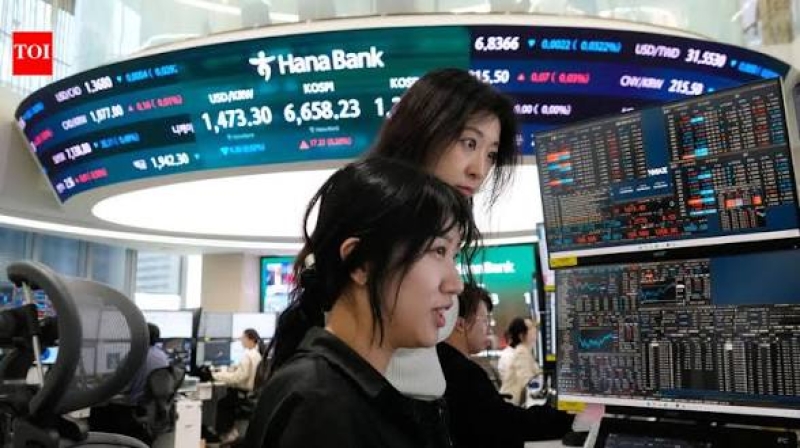
Asian stocks mostly rose Wednesday, supported by continued optimism over artificial intelligence and chip-related companies despite concerns about the ongoing war in Iran.
Japan’s benchmark Nikkei 225 jumped 2.1% in afternoon trading to 66,882.34. Australia’s S&P/ASX 200 gained 1.1% to 8,806.40, while South Korea’s Kospi slipped 0.1% to 6,861.30 after giving up earlier gains.
Hong Kong’s Hang Seng rose 0.3% to 24,585.63, and the Shanghai Composite added 0.5% to 3,847.55.
SoftBank Group Corp., which has invested in OpenAI, surged more than 6% in Tokyo. Japanese chip-related companies, including Renesas Electronics and Rohm Co., also gained.
On Wall Street, stocks ended slightly lower Tuesday as rising long-term Treasury yields put pressure on markets.
The S&P 500 fell 0.2% after moving between small gains and losses during the session. The Dow Jones Industrial Average declined 0.3%, while the Nasdaq composite dropped 0.1%.
Major indexes turned lower as higher bond yields offset gains by several major technology companies. Nvidia, the market’s most influential stock, fell 0.7% after an early rise, while Broadcom gained 1.6%.
Oil prices have fluctuated sharply as the U.S.-Iran war continues, contributing to a rise in Treasury yields to their highest level in 24 years.
U.S. benchmark crude rose 0.1% to $89.47 a barrel, while Brent crude, the international benchmark, gained 0.49% to $103.09. Brent remains well above the roughly $72 a barrel recorded before the U.S. and Israel attacked Iran in late February.
Mediators continued efforts to help the United States and Iran reach an agreement to end the fighting and reopen the Strait of Hormuz. President Donald Trump rejected a proposal from Tehran over the weekend to reopen the key waterway.
The yield on the 10-year Treasury rose to 5.25% from 5.24% late Monday. It had reached 5.28% earlier Tuesday, its highest level since 2002, according to Tradeweb.
The S&P 500 lost 12.85 points to close at 7,670.84. The Dow fell 131.59 points to 51,349.92, while the Nasdaq declined 22.84 points to 26,797.54.
Several major U.S. economic reports are due this week, which could give investors and the Federal Reserve a clearer picture of the inflation outlook.
U.S. inflation has remained above 3% for most of the year, well above the Fed’s 2% target. Wall Street expects the central bank to raise its benchmark interest rate again at its October meeting.
“While it is easy to focus on the macroeconomic headwinds of bond yields and oil, the underlying U.S. economy remains remarkably resilient,” said Tina Teng, a market analyst at MooMoo, a global financial technology and online brokerage company.
In currency trading, the U.S. dollar fell to 156.93 Japanese yen from 157.27 yen. The euro slipped to $1.1344 from $1.1347, reports UNB.