

- Korean City scrambles to rescue dusky shark after it returns to canal |
- PM inspects Mongla Port, Sundarbans, proposed economic zone |
- Early winter cucumber brings hope of bumper harvest in Sirajganj |
- Saudi coalition intercepts Houthi missile after blasts in Riyadh |
- COP31 to Focus on Implementing Climate Policies |
UN Warns Cash Crisis as Unpaid Dues Near $1.6 Billion
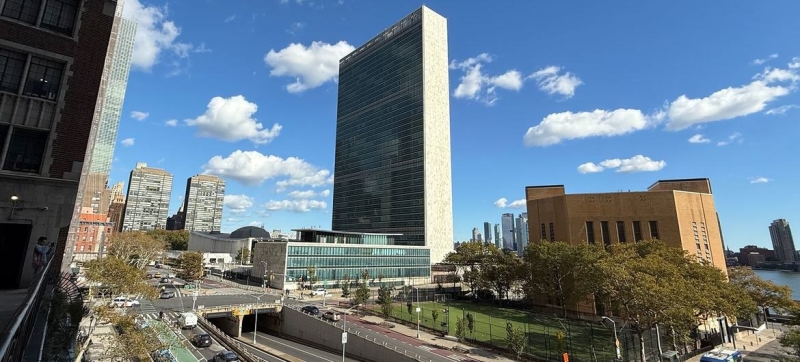
The United Nations Headquarters as seen from First Avenue in New York City.
With nearly $1.6 billion in unpaid dues, the UN Secretary-General warned on Monday that chronic late payments are undermining the Organisation’s ability to function, even as sweeping budget cuts advance through the General Assembly’s main budget committee.
António Guterres told the Fifth Committee that the UN is facing its most fragile cash position in years, despite sharp reductions already built into next year’s spending plans.
“Liquidity remains fragile, and this challenge will persist regardless of the final budget approved,” he said, pointing to the “unacceptable volume of arrears” owed by Member States.
The UN ended 2024 with $760 million in unpaid assessments, most of which remain outstanding, and has yet to receive $877 million in contributions due for 2025—bringing total arrears to roughly $1.586 billion.
With fewer than five weeks left in the year, only 145 of the UN’s 193 Member States have paid their 2025 dues in full.
Key contributors such as the United States and Russia have yet to meet their obligations, although China paid its full assessment on 29 October.
“I have repeatedly appealed to Member States to pay their assessed contributions in full and on time,” the Secretary-General said, warning that cash shortfalls are forcing the Organisation to operate well below approved budget levels.
Deep spending cuts already planned
The warning comes as delegations consider revised estimates for the UN’s 2026 regular budget, which already incorporate deep structural cuts under the UN80 reform initiative—a system-wide effort aimed at modernising operations and reducing costs.
Under the revised proposal, the regular budget for 2026 would stand at $3.238 billion, a reduction of $577 million—or 15.1 per cent—compared with 2025. A total of 2,681 posts would be cut, representing an 18.8 per cent reduction from current staffing levels.
Special political missions would also face cuts of more than 21 per cent compared with 2025, largely due to mission closures and streamlined staffing.
Functions consolidated, jobs relocated
To achieve further savings, the UN plans to consolidate payroll processing into a single global team across three duty stations and establish shared administrative hubs in New York and Bangkok.
The Secretariat is also reviewing functions that can be moved to lower-cost locations. Since 2017, lease terminations in New York have already saved $126 million, with an additional $24.5 million in yearly savings expected from further closures by 2028.
The plan includes one-time separation and relocation costs of $5.4 million, with voluntary exit programmes used to limit forced redundancies.
Delegations weigh in
The revised estimates have been reviewed by the Advisory Committee on Administrative and Budgetary Questions (ACABQ) and are now before the Fifth Committee for negotiations ahead of year-end approval.
ACABQ Chair Juliana Gaspar Ruas welcomed the reform drive but cautioned that the estimates were prepared under tight time constraints, limiting the Committee’s ability to fully assess the basis for some proposed cuts. While supporting consolidation and efficiency efforts, she noted uneven methodologies across departments and called for clearer criteria on staff relocations.
Member States commended the Secretary-General for presenting the revised estimates, acknowledged the UN’s ongoing liquidity challenges, and expressed support for a stronger and more agile Organisation.
Several delegations, however, echoed concerns about the compressed timeline, noting that the late arrival of key documents has constrained proper scrutiny. Some diplomats warned that the cuts disproportionately affect junior and general service staff rather than senior posts, threatening geographic balance and workforce rejuvenation.
Others pointed out that reductions appear uneven across the UN’s three pillars, with proportionally deeper cuts to development-related programmes.
The Secretary-General said he was “sincerely worried” by that concern. He stressed that, overall, the development pillar is facing the smallest proportional reduction, with Africa-related programmes largely protected. The largest cuts, he said, fall on support and back-office functions rather than frontline delivery.
“Our commitment to development is absolutely fundamental, and our commitment to the African continent is absolutely fundamental,” he said.
Final approval will require endorsement by the full General Assembly later this month.
Cash crisis already affecting operations
Despite the planned reductions, Mr. Guterres said the UN has already been forced to underspend in 2025 because the cash simply is not available.
“Vacancies do not correspond to a strategic priority,” he said, “but simply to the fact that people left and we do not have the money to pay for their replacement.”
To protect liquidity, the UN has proposed temporarily suspending the return of budget credits to Member States—essentially delaying reimbursements until cash levels stabilise.
“It is difficult to give back money because we didn’t receive it,” Mr. Guterres told the committee.
He warned that unless payments improve, financial strain will continue to undermine operations, regardless of how lean the approved budget becomes.