

- Dhaka's air 5th worst in the world this morning |
- Around 7,500 Bangladeshis imprisoned in Saudi Arabia: Shama Obaed |
- Bangladesh Outperforms India in Global Hunger Index 2026 |
- Covered van hits Gazipur police patrol team, killing SI, BNP leader |
- Korean City scrambles to rescue dusky shark after it returns to canal |
Guterres hails new chapter as UN Iraq mission ends
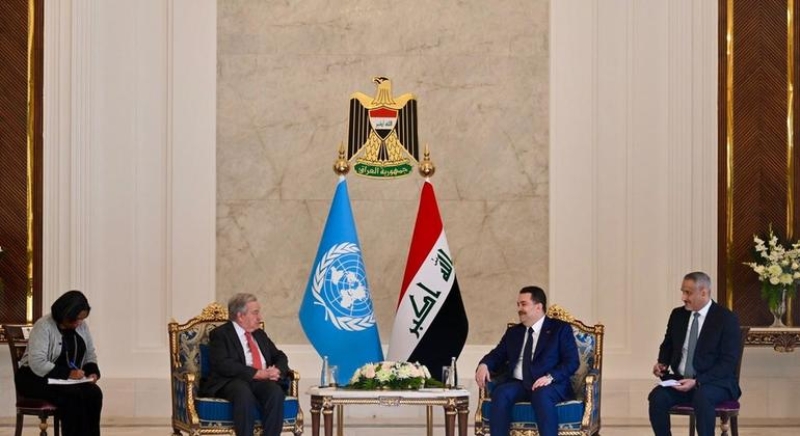
UN Secretary-General Antonio Guterres meets with Iraqi Prime Minister Mohammed Al-Sudani.
The United Nations Assistance Mission for Iraq (UNAMI) is ending operations this month, but support for the country will continue, Secretary-General António Guterres affirmed at the official closing ceremony in Baghdad on Saturday.
UNAMI was established in 2003 following the fall of Saddam Hussein and has supported Iraq through political transition, post-conflict recovery, and the fight against ISIL, also known as Da’esh. Its mandate concludes on December 31.
Mr. Guterres said the progress made by the Iraqi people in recent years is a source of inspiration.
“We recognize that today, as we close one chapter in the history of the United Nations and Iraq, we are opening another,” he said.
A country at peace
The Secretary-General hailed the courage, fortitude, and determination of the Iraqi people, who overcame decades of violence, oppression, war, terrorism, sectarianism, and foreign interference.
“Against all odds, the Iraqi people never wavered in their commitment to build a peaceful, inclusive society based on the rule of law and democratic institutions,” he said.
He pointed to milestones achieved over the past two decades, including the drafting of the 2005 Constitution, multiple national elections, and the territorial defeat of the terrorist group Da’esh.
Today, Iraq is “a country at peace, with increased security and a clear determination to win the battle of development,” he added.
UN mission’s role
“UNAMI was honoured and humbled to walk side by side with the Iraqi people,” Mr. Guterres said, noting that the mission advised successive governments and parliaments on judicial and legal reforms, promoted human rights, and supported civic space for women, youth, and minorities.
When Da’esh seized large parts of Iraqi territory, UNAMI helped mobilize and coordinate support to protect civilians and millions of displaced people.
The mission also promoted inclusive political dialogue and national reconciliation and helped ensure the safe return of millions of displaced people, including returnees from the al-Hol camp in northeastern Syria and members of the Yazidi community who suffered abuse and violence at the hands of Da’esh.
Tribute to staff
The Secretary-General saluted all UNAMI staff and paid tribute to the victims of the terrorist attack on the mission’s headquarters on August 19, 2003, which killed 22 personnel and injured more than 100.
“It is deeply moving for us to be joined by some of the survivors and victims’ families,” he said.
“We honour the memory and legacy of them all, including Sérgio Vieira de Mello, the first Special Representative to lead the mission.”
He also expressed gratitude to the mission’s national staff members “who worked year in and year out to rebuild and strengthen their country.”
An enduring partnership
Concluding his remarks, Mr. Guterres highlighted his meeting with Prime Minister Mohammed Shia’ al-Sudani, during which he reaffirmed the UN’s commitment to supporting Iraq as it strengthens institutions, governance, and accountability; improves public services; and diversifies the economy.
“I emphasized that while a mission may conclude, the United Nations will always walk alongside the people of Iraq on the path toward peace, sustainable development, and human rights,” he said.
Mr. Guterres said he was especially touched that the government has dedicated a street in Baghdad as “UN Street,” calling it “a powerful symbol of our enduring partnership — a reminder of the road we have travelled together and the road that still lies ahead.”
“It is important that the international community understands that today marks a new chapter. Relations between Iraq and the United Nations will be normal relations,” he added.
The Secretary-General assured Iraqis that “the United Nations will continue to be with you every step of the way.”